


The Scot Who Brought Bagpipes to Afrobeat: Norman Macleod’s Musical Odyssey

 Quick Read
The bagpipe skirls of Scotland intermingled with Afrobeat rhythm to create a captivating fusion, which captivated music lovers. At the genesis of this sound revolution was Scottish oil and gas specialist Norman Macleod.
By Adesope Kalejaiye
In the cosmopolitan city of Lagos, Nigeria, a new sound echoed on the streets late in the 1990s. The bagpipe skirls of Scotland intermingled with Afrobeat rhythm to create a captivating fusion, which captivated music lovers. At the genesis of this sound revolution was Scottish oil and gas specialist Norman Macleod. His passion for music transformed his life and altered the music horizon in Nigeria.
Norman developed his love for music from his childhood days in Scotland, where there was always the traditional Scottish music filling his house. He attended Milngavie Primary School and Glasgow Academy in Glasgow, Scotland. Norman then graduated in Engineering Science as a Bachelor degree holder from Oxford University, England, in 1975. Norman began his career life in Shell International in The Hague, Netherlands, as a graduate management trainee. Over the next 20 years, he was employed in several countries, including Brunei, the UK, the Netherlands, Norway, the Philippines, the Maldives, and Syria, in drilling engineering, petroleum operations engineering, and project management. He discovered his vocation during his time in Nigeria: fusing the rich tones of Scottish bagpipes and the vibrant energies of African indigenous music. This unlikely partnership was made possible through his collaboration with the legendary Nigerian artist, John Oboh, affectionately known as Mighty Mouse.
With Norman and John Oboh, they came up with a distinct sound that was retro yet avant-garde. Their work produced a musical terrain that was symbolic of cultural fusion and emphasized the limitless possibilities of fusion music.
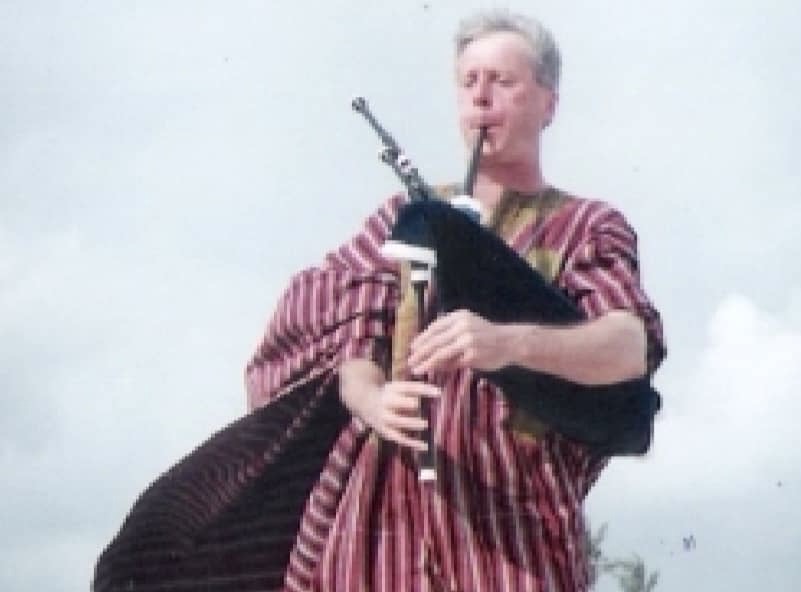
Norman was the first-ever European to use the bagpipes to play African music in Nigeria. He revolutionized traditional Nigerian music in the 1990s by masterfully blending classical Esan and Yoruba rhythms with the distinctive sound of Scottish bagpipes. Under the expert guidance of renowned producer John Oboh, Macleod’s innovative fusion of cultures and genres resulted in a unique and captivating musical style that continues to inspire and delight audiences to this day.
His record releases, including “Scottish Essence, African Mood” (1998), “Step Up Tempo” (1999), and “African Unity” (2005), presented his phenomenal ability to merge disparate musical cultures into a functional and fantastic experience.
Norman’s music endeavors extended beyond the recording studio; he took his unique sound to the stage, sharing the stage with Nigerian music legends, including Femi Kuti. His performances radiated infectious energy, bridging cultural divides effortlessly and uniting diverse crowds in celebration. Each concert was a celebration of the redemptive power of music, transcending language and cultural divides.
In a world in which musical divides are continually tumbling, Norman Macleod’s contribution to the genre of fusion music stands as a reminder to us all of the abiding strength of imagination and teamwork. His is a journey of affirmation of the fact that music has no geographical boundaries or parameters, speaking to our shared commonality in the same way nothing else can.
As we reflect on the life of Norman Macleod, the inspirational musician that he was at his picks, we are reminded once more that music’s greatest beauty is in the way it can unite us in our differences. In a world too often divided, his music is evidence of the boundless possibilities that are revealed when different cultures come together in harmony.
Norman’s legacy is not only that of musical innovation but of a powerful reminder of the bridges we can construct through the language of music that is universal.
Comments