


Britain, US Mull Military Action Against Gaddafi

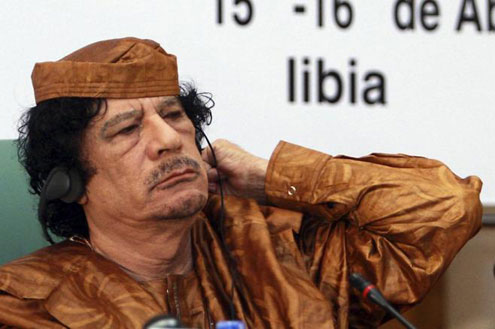
Western leaders including Britain and the United States have announced plans to remove defiant Libyan leader, Colonel Moammar Gaddafi.
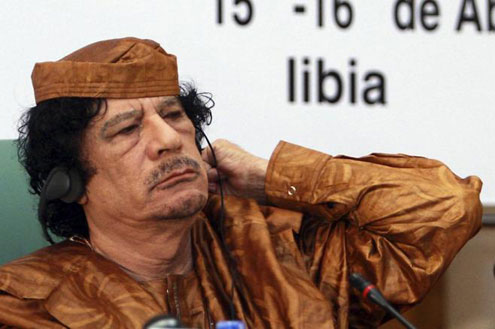
Libyans, for weeks, have trooped to the streets of Tripoli, Libya capital city, Benghazi and others protesting the tyrannical rule of Gaddafi.
The demonstrators also demanded for the entrenchment of democracy, saying they wanted to have a say in how they are governed.
However, Gaddafi who has been in power for 42 years, ordered military action against the protesters leading to the death of hundreds of Libyans.
David Cameron threatened Colonel Gaddafi with military action last night, promising a no-fly zone and arms shipments to his enemies. The Prime Minister even suggested he could send British troops into Libya as a peacekeeping force to stop Gaddafi’s henchmen killing democracy campaigners.
At a National Security Council meeting yesterday morning, he ordered military chiefs to draw up plans for the no-fly zone. If Gaddafi turned his air force on the rebels, RAF warplanes would be able to intervene.
Mr Cameron’s dramatic move, which may come to define his premiership, came on the day that papers revealed UK forces have trained Libyan troops in Britain and Gaddafi’s son Saif repeated his pledge that the regime would ‘fight to the last bullet’.
In another hard-hitting move intended to force Gaddafi to step down, the Pentagon started moving warships in preparation to police a no-fly zone and world leaders imposed a raft of diplomatic and financial sanctions.
Meanwhile, former Prime Minister Tony Blair was condemned for ‘dodgy dealing’ that led to the now infamous ‘deal in the desert’ with Gaddafi in 2004.
A chip off the old block: Gaddafi’s son ‘caught on video urging loyalists to sacrifice themselves until the last bullet’
A previously unpublished document shows that Mr Blair’s Government agreed to supply military hardware and expertise to the despotic regime.
And it proves that there were plans for Britain to train Libyan military officers at ‘its prestigious military colleges and institutions’ such as the Royal Military Academy at Sandhurst.
The revelation came as Mr Cameron vowed that world leaders need to look again at their relationship with Arab dictators and trade agreements with them.
The New Libyan Army showed off a frightening array of weapons yesterday, including anti-aircraft guns
Libyan militia members who are fighting against Gaddafi organised ammunition at a military base in Benghazi, in eastern Libya yesterday
Mr Cameron’s intervention was designed to pile the pressure on Gaddafi to quit – an outcome many had expected already.
But, while the dictator has lost control of much of his country, he still remains in charge of Tripoli, the capital and home to a third of Libya’s people.
Yesterday Gaddafi showed no sign of wanting to quit, giving a deranged interview to world’s media. ‘They love me, all my people love me,’ he told the BBC. ‘They would die to protect me.’ Asked why so many appeared to be rebelling, he blamed Osama Bin Laden: ‘This is Al Qaeda, not my people. They come from outside.’
Gaddafi’s remarks were met with derision in Washington. “It sounds, just frankly, delusional,” said US ambassador to the UN Susan Rice.
She said Gaddafi’s behaviour, including laughing on camera in TV interviews amid the chaos, ‘underscores how unfit he is to lead and how disconnected he is from reality’.
Despite having criticised Mr Blair’s speed at going to war, Mr Cameron said he wanted Britain to be ‘on the front foot’ over the North African crisis.
‘We must not tolerate this regime using military force against its own people,’ he told MPs. ‘In that context I have asked the Ministry of Defence and the Chief of the Defence Staff to work with our allies on plans for a military no-fly zone. My message to Colonel Gaddafi is simple: go now. We do not in any way rule out the use of military assets.’
Asked whether Britain could supply arms to the Libyan opposition, Mr Cameron told MPs: ‘It is certainly something we should be considering.
Gaddafi told the world’s media that his people would die to protect him.
France said it would fly aid to the opposition-controlled eastern half of the country following the lead of the US and the United Nations.
The EU was also considering the creation of a no-fly zone over Libya and the US and Europe were freezing billions in Libya’s foreign assets.
The war clouds darkened when the Pentagon announced it has begun to ‘reposition’ warships including an aircraft carrier with 90 fighter aircraft to join a no-fly zone. U.S. Secretary of State Hillary Clinton said: ‘The no-fly zone is an option we are actively considering. All options are on the table.’
Under the plans, Britain, the U.S. and other Nato allies would police a no-fly zone with different air forces providing cover at different times. The flight ban may cover the whole of Libya, or areas under rebel control.
Britain could deploy up to 59 Eurofighter Typhoons from RAF Coningsby and RAF Leuchars in Scotland – leaving 12 for home air defence. They are expected to fly from RAF Akrotiri in Cyprus, where British ‘eye in the sky’ AWACS aircraft are already stationed.
If troops are needed, a detachment of the Mercian regiment, earmarked for Afghanistan, is available in Cyprus. The Parachute regiment or the Royal Marines are the more likely options.
Last night Mr Cameron spoke to French President Nicolas Sarkozy, who has also backed a no-fly zone. They agreed the French and British military should work together.
Downing Street officials said they feared Gaddafi could use his stockpile of mustard gas.
Britain yesterday joined the European Union in agreeing to freeze the assets of another 12 senior members of the regime after a similar ban was placed on Gaddafi and his children.
A senior Foreign Office official said key figures would be warned they face prosecution for war crimes.
A growing force dubbed the ‘New Libyan Army’ is hoping to play a major part in bringing down Colonel Gaddafi.
Bolstered by tens of thousands of defectors from the armed forces and police, the rebel movement is now in charge of formidable firepower.
In Zawiyah, the rebel-held city just 30 miles from the capital Tripoli, opponents yesterday showed off a frightening array of tanks, machineguns and anti-aircraft guns.
Libyan soldiers from forces that defected against Gaddafi sit on an anti-aircraft battery outside a military base in Benghazi, eastern Libya, yesterday
It is a far cry from the peaceful demonstrations staged in cities across the country two weeks ago that prompted Gaddafi to slaughter his own people.
Gaddafi’s lethal response saw army general Abdel Fattah Younes Al Abidi – a former close ally of the tyrant – switch sides. His defection encouraged other disaffected police, military and state security personnel to follow suit.
It is impossible to say how many of Libya’s 76,000 troops have defected. But it is clear that the pro-democracy ranks have access to large stores of weapons from looted military stockpiles or smuggled across the border. Citizen groups say they will use them to stop Gaddafi’s forces retaking rebel territory. The ‘New Libyan Army’ is becoming more organised and steps have been taken to establish a unified military council in the east.
Small groups of rebel soldiers have been dispatched to infiltrate the capital, according to commanders.
They said hundreds of young men are volunteering to go there to bolster the pro-democracy groups. Judging by the show of strength in Zawiyah, they are a force to be reckoned with.
Comments