


Beggars And The Homeless

Of all the states in Nigeria, Lagos State, our very own Centre of Excellence, boasts the greatest number of the homeless, helpless and many times hopeless. In open places, hidden places, right in the middle of the city and on the fringes of the metropolis, the homeless abound.
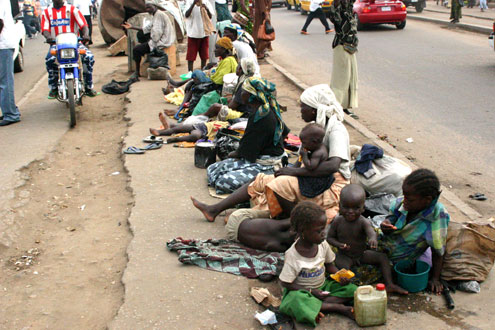
There are different categories of homeless people in the city. One category of homeless people include beggars, most of them from northern Nigeria, who roam the streets during the day and hang around motor parks and other public places at night. Another group are social miscreants and street urchins who do menial jobs or constitute a nuisance on the streets during the day, and sometimes at night.
But not all beggars are homeless, and not all homeless people are beggars. Many commuter bus (danfo) drivers spend most nights in their buses, otherwise they sleep in cheap hotels with their customers, the ever-ready call girls; they really have no place they can call home.
The bus conductors are no different as most of them are runaways who sleep under the bridge or in any nook or cranny where they can avoid the elements. Most of them are homeless, some though by choice, but they are not beggars.
Many ‘homeless’ people have jobs and squat with friends and family, often for several years. These are not beggars but responsible people, though they earn so little that, except for a miracle, they will never be able to afford the cost of a room, even on the fringes of the ever-growing city, and how else do we describe them if not homeless?.
The number of people seeking accommodation is so large that an army of desperadoes has emerged to exploit the situation. They call themselves estate agents and swindle prospective tenants of hard-earned millions of naira.
There have been cases where a single room was let out to as many as a dozen prospective tenants.
In one instance, 24 prospective tenants had paid various sums of money to an estate agent to secure a room around Ilupeju area of Lagos. After waiting for over three months, one of the desperate prospective tenants moved into the uncompleted building, hoping to fix the windows and doors and collect a refund from the estate agent later.
He got the shock of his life when the real owner of the building chased him out with thugs, claiming that he does not even know the estate agent. None of those who paid eventually got the room and majority did not get a refund as the fake estate agent had fled.
Some of these men without a home but who have jobs may have to wait several years to secure accommodation before getting married, if they ever get married; after all, how many women would marry a man without a home. Many squat with friends for several years before they are able to scrape everything together, if they are not duped, and rent a room or two before thinking of raising a family.
For the women, the story is not better. For want of a roof over their heads, many unfortunate young women have jumped into relationships they have lived to regret.
Having to live with a sister and her husband has spurned so many bad tales, the least of which is sexual molestation by the sister’s husband. Allegations of witchcraft have been levelled against such squatters while others have been accused of stealing. It is that bad.
And meanwhile all over the state, especially in highbrow areas, several buildings remain empty except for the Hausa or the Nigerien watchmen that guard the gates. In most rich neighbourhoods, families of two or five stay in 6-14 bedroom mansions with no thought for the poor; of course it’s not their faults.
Except perhaps for Abuja where the accommodation problem is also serious, Lagos State has the worst accommodation problem in the entire country. And in spite of this, people still flock to the city to seek greener pastures.
The opportunities that abound in the state are usually the bait that lures the unwary; and before one realises, one is trapped.
Most of the time, going back home is an unattractive alternative, so one stays in Lagos, without a home but full of hope that one day, things will get better.
It does get better for some but the majority will hope till kingdom come, because the reality of the situation is that while their income is not rising, the cost of securing accommodation keeps rising, and so goes the vicious cycle.
One class of homeless people have become a greater menace to residents of the city; these are beggars of all classes. Disabled and able-bodied beggars daily accost Lagosians in all parts of the city, harassing and getting in the faces of hapless motorists in traffic jams and pedestrians on the way.
One would have assumed that beggars are homeless people but some of these beggars have homes. And the surprise? They are professional beggars. They dress up in the morning and head for bus stops and other public places to solicit for alms. They don’t just stand and beg passers-by; they actually approach well-dressed pedestrians and tell some cock and bull story.
Two times out of ten, they are lucky and some unsuspecting Lagosian parts with some money. This cheerful giver would not get wiser until he is approached by the same couple some other time in some other place. Then he’s on to the trick, and becomes a wary resident who views anybody that approaches him on the street with some suspicion. Can you blame him?
Another set of beggars, majority of who are not homeless, claim to be suffering from one disease or another, real or imagined.
“Good afternoon sir, brother, please help me; I’m suffering from epilepsy.†That is one beggar’s opening line. Most of those who hear him for the first either scamper for safety or quickly part with some cash, just to avoid being so close to an epileptic; as if one could contact epilepsy. One wonders if an epileptic cannot be a useful member of the society.
The lazy disabled is one set of beggars that have perfected their act. Some of them proudly display their disability, begging in the name of God. Most of them are from northern Nigeria, though others from other parts of the country have joined the fray when they realised how profitable begging could be in Lagos.
Non-government organisations, orphanages and others have helped to provide homes for the homeless and most of the time prevented them from becoming beggars, but some people just can’t leave the streets.
The lure of easy money is too enticing, and Nigerians are generous people; who would refuse to be generous when he sees people he’s better than. What other way to thank God than give generously to those you think you’re superior to.
Successive administrations have battled to stem homelessness as much as they can but their number keeps growing. Everyday, more people flock into the city, seeking the golden fleece like the mythical Jason. But do they ever find it? Maybe, maybe not.
Some get lucky and within a short while can afford to get decent accommodation. Those not so lucky remain squatters with friends and family, or are forced to live in the several slums on the fringes, or even in the heart, of the city.
Everyday the churches are filled with people praying for a miracle. Sometimes the miracle they pray for would surprise you: all they want is a decent place to live. Is this asking too much of God and society?
—Tunde Adekeye
Comments