


Lagos: The Beautiful And The Ugly

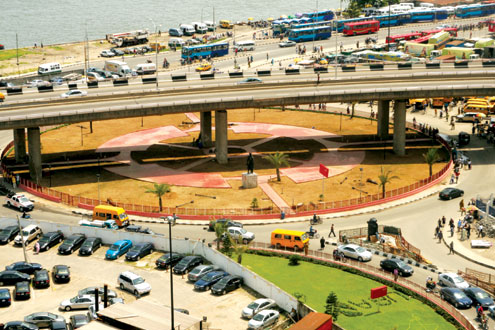
The marked difference in infrastructural development in various Lagos communities paints a grim picture of a tale of two worlds – the beautiful and ugly
A tale of two worlds exists within the cosmopolitan state of Lagos. The first supports claims by government for massive urban face-lifts and regeneration of various parts of the state. The second is an evident negation of these touted developments. The result, however, is the existence of two worlds of a beautiful Lagos, with good roads, well-lit, functional drainages and communities of happy people, while the other exposes the hardships in many areas where these goodies are negligently absent.
During his campaign in April 2011 for a second term of office, one of Governor Babatunde Fashola’s campaign signposts depicted portraits of smiling faces, including that of himself. The signposts, mounted at strategic places across the metropolis, illustrated the projects embarked upon by the governor and were titled in a three-word phrase: “I Can See.â€
But the case of many areas in the state begging for government attention seemingly contradict the campaign slogan. Plainly, people dwelling in the affected communities are not smiling, like the governor. In many parts of Lagos State, where good road networks are lacking, human existence has been reduced to anguish, pains and frustration. Hence, the governor’s claim of superlative performance in the provision of infrastructure, like roads, functional drainage and pedestrian bridges is widely disputed. The reason is not hard to decipher. Many Lagos dwellers feel alienated from governance due to uneven spread of development across the state. The over-concentration of development projects in a few areas apparently prioritised over others is at the root of the growing disenchantment in the state. The marked differences between seemingly favoured areas like Victoria Island, Ikoyi and Ikeja and its grotesquely-looking opposites, for instance, Ajegunle, Iju, Ipaja and Mushin, paint a grim picture of two worlds pitched together.
“All we hear around is ‘new Lagos’, ‘Lagos is working’, ‘Eko o ni baje’, but nothing can be farther from the truth. Living in Ikotun is like living in hell because many of the roads are bad, especially the inner roads,†said Barrister Chidi Okpara, a resident of Alhaja Olojo Street in Ikotun-Egbe.
Okpara is not alone in his despair over the state of roads in Lagos. Musibau Olanrewaju, a commercial bus operator at Okota told TheNEWS at a motor park in the area that “there is hardly any week that I don’t effect repairs on this bus. The traffic I encounter on this road has reduced the number of trips I make, making it difficult to meet my delivery target and reducing my daily income.â€
Residents of densely populated areas complain that developmental projects, mostly road construction, have been concentrated in elitist areas at the expense of areas like Okokomaiko, Mushin, Agboju, Orile, Ikorodu, Agbado-Ijaye, Ikotun, Agege and Iju. Even inhabitants of less populated areas in the state’s suburbs like Epe and Ikorodu are also grumbling.
During the 2010 budget presentation in the Lagos State House of Assembly, re-elected Speaker of the Assembly, Hon. Adeyemi Ikuforiji advised Fashola to be wary of the praises showered on him for extraordinary performance in infrastructural development in Lagos State. He reminded the governor of many undeveloped areas. Ikuforiji, also an ACN member, said: “While Lagosians in several constituencies commended the efforts of our government so far, visits (to undeveloped areas) also revealed some shortcomings and uneven spread in our developmental efforts. Over-concentration of efforts at the centre at the expense of the upcountry tends to isolate a big percentage of our constituents to the extent that a simple mind will simply not agree that users of Aboru Road, Ire-Akari/Ilasamaja Road, Lagos-Ikorodu Road, Itoikin/Epe Road and Pen Cinema-Ishaga Road are bonafide residents of our great state.â€
Some citizens of the state have also thumbed down local government chairmen in their localities for non-performance on road rehabilitation. They accused the chairmen of not justifying the mandate given to them at the polls. Many of the local government chairmen were alleged to have done shoddy, quick-fix rehabilitation works that cannot stand the test of time on roads. Lagos monarch, Oba Rilwan Akiolu blurted: “Some of the chairmen are bad. Everybody must play his own part to ensure that the council chairmen are made to do the right thing. I am calling on all the obas in the state to monitor how council funds are spent,†he declared at a ministerial briefing organised by the Ministry for Local Government Affairs recently.
On 24 July, Deputy Governor, Adejoke Adefulire-Orelope, on an inspection tour of flood-ravaged areas, confirmed the dilemma the government faces on the construction and rehabilitation of roads. She said: “If we want to embark on the rehabilitation of roads in Alimosho, we can not finish them in 10 years, even if they are the only roads we will rehabilitate. A 10-year budget can not complete the rehabilitation of Alimosho roads in Ikotun-Egbe and Egbeda/Idimu LCDA.â€
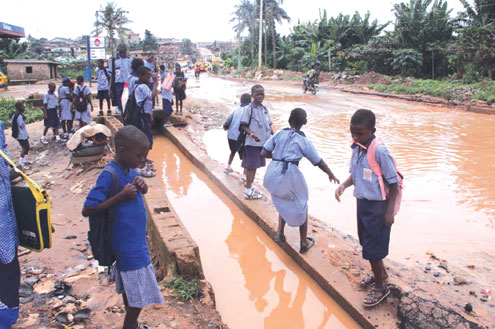
Residents of Ikorodu in Ikorodu Local Government have also been complaining of government’s neglect in the repair and construction of passable roads. The situation, they lamented, gets worse during the rainy season. Roads in Majidun, Agric, Agbede, Ishawo, Eyita Estate, Imota, Eru Elepe, Igbogbo, among others, are in a state of disrepair.
The anguished residents of the ancient town, reputed to be the fastest growing town in the state, groan under untold hardship occasioned by the dilapidated roads. Aside the regular harrowing encounters on the roads, huge manpower lost in attendant traffic gridlock, many vehicle owners in Ikorodu lament damage to their automobiles and cost of fixing them. “Despite assurance from Governor Fashola during his campaign that our roads would be fixed, things have continued to go from bad to worse,†Bimbo Gbamgbala, a resident of Lagos Road, Ikorodu fumed.
With new structures sprouting in Ikotun Egbe in Egbe/Idimu LCDA, road networks around the area have virtually collapsed. Both the inner and outer roads within the LCDA have become constant nightmares for the teeming residents. The Ikotun-Ijegun road, which is the major link road to the area, is filled with gaping potholes that cause traffic snarls. Residents lament the effect on smale-scale businesses in the area, while commuters groan under regular hike in transport fare by commercial bus drivers.
Folajuwon Ademola, a student of Lagos State Polytechnic, Isolo, also recounted his ordeal: “Despite the fact that I leave home early for lectures, I still spend hours commuting on a stretch of road that should not take more than 15 minutes,†he lamented.
The Ipaja/Ayobo roads in Ipaja/Ayobo LCDA are not an exception to the problem of bad roads. A visit by this magazine showed that roads like Baruwa, Boystown, Akinyele, Church, Oja, NEPA and Atan-Kekere are urgently begging for government attention. Amukoko in Ajeromi Ifelodun Local Government Area is another densely-populated suburb in the state. Compared to some developed areas, Amukoko and its environs cut a pitiable picture of a ravaged community.
In many cases, the road problem is simply of a job badly done. One instance is contract for rehabilitation of Ajuwon road in Isale-Iju community which the Fashola administration awarded in 2008 to Baschul Construction Company Limited. The project, which was completed in 2009, went bad a few months after, leaving huge craters for residents and motorists plying the road to contend with. In the same year, the Lagos State government mobilised its Public Works Bureau to embark on a rehabilitation of the road, but today the road project is a failure and has gone worse than the agency met it.
Fashola, leaders of thoughts, traditional rulers and concerned citizens have clamoured that the federal government confer a special developmental status on the state by complementing the efforts of the state government on road construction and rehabilitation. Some opponents of the Lagos State administration, however, argue that development of the state has been made easier as a former federal capital territory, FCT, unlike other states which were developed from next to nothing. The antagonists maintain that the claim by the Lagos State government that the parlous state of infrastructure is due to its cosmopolitan status is merely passing the buck.
A former Federal Commissioner and indigene of the state, who spoke with TheNEWS anonymously disagreed with that position. “That is not correct and is unfair to some former administrators and governors of the state. Can someone say that Alhaji Lateef Jakande did not perform, even with meagre resources? The same question goes for Mobolaji Johnson,†he said.
However, a sharp difference is noticed in upscale neighbourhoods of Victoria Island, Ikoyi and its environs. In those places, not only are the roads well constructed and lit, the Lagos State government is also expending huge resources to give them the aesthetic appeal of a modern city-state.
Even in Surulere, new roads, fitted with drainages and street lights are constructed in areas that are just few metres away from one another. From Adeniran Ogunsanya, Ogunlana Drive and Adelabu to Ishaga, among the other areas in Surulere, the metropolis wears a new look. Critics of the government believe that the projects going on in Surulere simultaneously should be duplicated in other areas that have become hell holes in the state.
During the campaigns for the April elections, Fashola claimed to have constructed and repaired 147 roads spread across the state. Many more roads, observers pointed out, remain in utter dilapidation and disrepair. Given the economic and other potentials of Lagos State, the deplorable state of its roads, economists opined, is a great disincentive to investment and makes nonsense of its emerging mega-city status. The problem requires urgent attention by all tiers of government, they urged.
—Fola Ademosu
Visit www.thenewsafrica.com for more newsÂ
Comments