



Lagos Moves To Stem Collapse Of Buildings

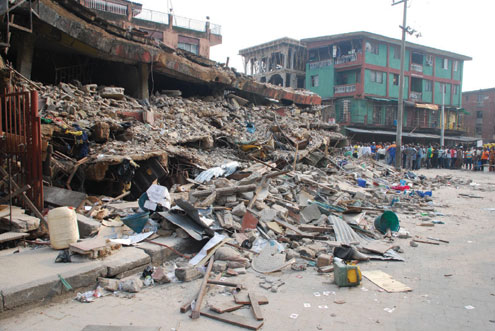
In recent times, buildings have been collapsing at an alarming rate in Lagos State, southwest Nigeria. The quest of Lagos to attain a megacity status is being threatened by this ugly trend, while several lives and properties have been lost. To stem this shameful reccuring decimal, stakeholders in the built industry met last week for a three-day retreat to proffer solutions to the frequent collapse of buildings in the metropolis. Kazeem Ugbodaga was at the retreat.
Lagos State, with a current population of over 20 million is facing the challenge of urban management which include rapid urbanization, insecurity, poverty, environmental degradation, infrastructure decay, housing shortage and unemployment and building collapse among others.
Addressing these challenges requires proper urban planning and management, both essential to making the city environmentally friendly, economically vibrant, culturally meaningful and safe for all.
Experts are of the view that physical planning translates political visions and values into physical realities represented by ordered cities and urban and rural areas. There, in order to effectively perform its function of guiding development across the geographic space, physical planning must be responsive and proactive to developmental challenges, particularly of cities and urban areas, without abandoning the city development.
In the last four years, the Lagos State government has invested considerable resources on mapping and preparation of a number of physical development plans.
To achieve the visions and objectives of these initiatives, experts believe that there is need for an effective development and building control systems through an institutionalized credible and transparent implementation of the new physical planning law.
It was as a result of this that the Lagos State Ministry of Physical Planning and Urban Development brought together stakeholders in the built industry for a retreat on the Implementation of Policy Reforms on Physical Planning and Building Control at the Golden Tulip Hotel, FESTAC, Lagos, southwest Nigeria, recently.
“Our task at the retreat is to examine the law and the respective regulations with a view to making workable recommendations for implementation. The recommendations should address the multi-tasking challenges of delay in granting planning permits, menace of building collapse, planning for the vulnerable in the society, adoption of sustainable physical planning to address climate change and making Lagos Africa’s model mega city,†says Commissioner for Physical Planning and Urban Development, Mr. Olutoyin Ayinde.
“The state government expects the participants at this retreat to be proactive and patriotic in their approaches and contributions. The interest of the good citizens of Lagos should be paramount in our minds as we brainstorm to make Lagos a truly excellent state,†he stated.
Lagos State Governor, Mr Babatunde Raji Fashola, who declared the retreat open, charged stakeholders in the built industry to generate workable administrative provisions that would aid the implementation of the 2010 law on physical planning, development and building control.
Fashola, who was represented by the Commissioner for Works and Infrastructure, Dr. Obafemi Hamzat, noted that the implementation of the law would foreclose the menace of building collapse. He called on different stakeholders to evolve appropriate regulations, codes and guidelines to drive the law.
He pointed out that the implementation would positively impact on the living conditions of the people, create a safe environment and, provide good platform for investments and tourism in the megacity. He urged stakeholders to collaborate and contribute ideas as well as lend support to the implementation of the law in order to ensure its success, adding that the state government was committed to doing the needful to implement their recommendations.
Fashola emphasised that the task of transforming Lagos into Africa’s Model Mega City is a very challenging task and that Lagosians must see the three-day retreat as an avenue to contribute meaningfully to policies and programmes designed to benefit them.
At the retreat, six papers bothering on the structure, objectives and scope of the new planning law, including best practices from other jurisdictions, were delivered by resource persons.
The retreat delved into cases of frequent building collapse in Lagos State; the changes in the physical environment, the economy, rapid urbanisation and behavioural aspects of Lagos State citizens to issues pertaining to Planning and Building Control Law; the status of Lagos as a Mega City; the need for Strategic Development Plans, Master Plans and lower level development plans as physical bases on which economic and social development of Lagos State should anchor upon, and the need for sustainable planning and building control regime that will address the problem of climate change, flooding, collapsed building syndrome and sustainable development;
Others are the need for efficient, simple, and user-friendly Physical Planning and Building Control Law; the gaps in the existing Urban and Regional Planning and Development Law that may hamper effective implementation of the law and the role of professionals, stakeholders and citizens in the effective implementation of the law.
The stakeholders resolved that as matter of priority, the administrative structures of the Lagos State Planning Permits Authority, LSPPA; Lagos State Building Control Authority, LASBCA and Lagos State Urban Renewal Agency, LASURA should be put in place for effective take-off and that the Lagos State government should as a matter of urgency constitute and inaugurate the Physical Planning and Building Control Appeals Committee in line with section 79 of the Law.
They also resolved that the Ministry, in collaboration with the agencies should urgently develop and regularly update regulations, such as Physical Planning Regulation, Building Control Regulations and Urban Renewal Regulations among others that would facilitate the effective performance of their functions under the law.
They opined that harmonious relationship should be promoted among the agencies through regular interactions, seminars and collaboration for effective synergy among the agencies to reduce the incidence of intra- and inter-agency conflict and competition, and that government should provide adequate funding to improve facilities, space accommodation and the capacity of the personnel of the agencies in the performance of their functions.
The participants recommended that the agencies should embrace ICT in their operations, particularly e-submission and e-processing as well as the introduction of pre-screening/pre-submission of development plans by the Lagos State Planning Permit Authority, LSPPA, in its operations.
The resolution reached at the retreat was that applications submitted for planning permit on existing structures shall be processed by LSPPA, while the structural stability/integrity test must be carried out by an accredited laboratory outfit and submitted along with the application for permit.
It is also expected that the administration of the planning and building control laws, regulations and policies must be transparent and user-friendly through proper dissemination of information and positive attitude by the agencies officials while there is an urgent need for a meeting between the Ministry of Physical Planning and all insurance companies for the establishment of a template for the processes that would be involved in the insurance policy on building control.
The retreat advised government agencies to collaborate, cooperate and partner with professional bodies in the built environment. In addition, the professionals in the built environment should uphold professional ethics, codes of conduct and integrity in order to assist the government in effective implementation of the law.
Other resolutions reached at the event were that for better performance, the new Lagos State Urban and Regional Planning and Development Law 2010, and the regulation made thereafter should be vigorously enforced; that LASURA should be commercialised, restructured and appropriately staffed to attract funding; that all practicing professionals, consultants and other stakeholders in the state should avail themselves of the opportunity of understanding all the relevant laws/regulations on physical planning and other connected matters and that each agency should urgently come up with core competency requirement of personnel, accommodation and equipment.
It was resolved that the government should without delay put the necessary machinery in motion to implement all the above resolutions. It is believed that the implementation of the resolutions would go a long way to facilitate the implementation of the new law.
Comments