


I’ve Had A Fulfilled Sports Journalism

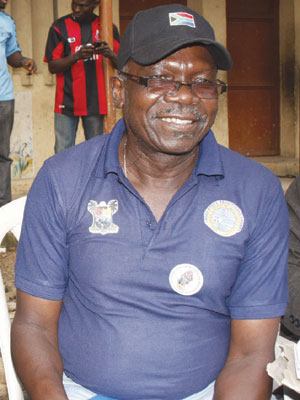
The name Segun Adenuga may not ring a bell to many young sports fans of this age, but not to sports pundits who have been following sports, be it boxing, football, cricket, golf, from the 60s’ till date. Adenuga is a seasoned sports journalist who has been in the business of sports reporting in and outside Nigeria for almost five decades now. Adenuga, who sees himself as a Lagosian, owing to the fact that he has been residing in Lagos for most part of his life, hails from Ijebu-Omu in Ogun State, Southwest Nigeria. Co-incidentally, he clocked 70 years on 17 January, 2012, same day the Great Muhammed Ali celebrated the same age. In this interview with Bamidele Olowsagba and Sunday Akintoye, Adenuga talks about how he got into sports journalism, the challenges of the profession then and now, and how Nigeria got it wrong in sports.
Congratulations on your 70th birthday celebrated recently.
Thank you. It’s a delight to me and my family. We give all praises and glory to the Almighty God.
After over 40 years in sports journalism, how would you describe your early days in the profession?
Well, I started sports journalism as a freelancer with a local newspaper in 1962/63 before joining a regional-based newspaper in the Northern part of the country, called the Herald. From there, I joined the Democrat, also in the North. But in 1973/74, I moved over to Jos, where I joined the Standard of Jos, also as a freelancer. I had a short spell with them before I moved to The Punch, as one of the founding members in 1976.
I actually wrote the first sports story published in the Punch Newspaper, when I was working with Owolabi Ilori as the Sports Editor then. The present Publisher of Vanguard, Sam Amuka, was the man in charge of Punch then.
I must say that it was tough and challenging when I started. In fact, My first salary at the Punch was N120. I wouldn’t know its equivalent now but it was a big money then. Back in our days, being a journalist is a thing of joy and of high prestige among our peers in other industries in the society. Perhaps it was because we kept to the ethics of the profession. I mean we were honest in reporting our stories and disciplined in writing, we didn’t allow money, personal influence or other things to influence what we wrote and above all, we saw ourselves as the eyes of the society.
What were the challenges that you faced those days?
There were so many on-the-job challenges back then. For instance, to gather sports stories for the Newspaper then, I would have to moved around from Onikan to Onipetesi and many other places that events were taking place. There were no computers, no internet or phones for us to work with. So, it was a big challenge for us (journalists) to send our reports to the office for publishing unlike what obtains nowadays that journalists can easily gather stories from any part of the world and send it back to their offices via their phones, E-mail and other communication facilities.
There was also the challenge of having to cover virtually all the sports you can talk about. In those days, I would cover table tennis in the morning, then go to Onikan to cover league matches in the evening and later go to cover boxing, all in a day. It was a bit challenging but it was all fun for us.
Another serious challenge was when friends and family members decided to distant themselves from us because of our profession. They tend to see us as ‘Amebo’ (whistle blowers) and some even said it to our face that we didn’t worth being friends with. It was a big challenge in those days.
Now that you’ve become a veteran in sports journalism, would you see yourself as an achiever?
I see myself as an achiever because I have had a fulfilled sports journalism. Even if I find myself in another world I would still love to be a sports journalist.
You mean no regrets so far?
No, I don’t have any regret! I may not be a millionaire like some of my friends but I derive a great pleasure from the fact that I have been able to gain so much knowledge from sports journalism. Let me tell you, I do not have to look at the African map before I know that countries like Niger Republic, DR Congo and Libya are bigger than Nigeria in terms of land mass. I know this because when I went to these countries to cover sporting events it was obvious for one to see.
I have been to over 36 countries on the continent of Africa to report sports related championships. That’s a big honour and pride for me. Also, when I see sports reporters, whom I have worked with at one time or the other in the past becoming multi-millionaires, people like Larry Izamoje, owner of Brilafm, who was once a junior sports reporter under me, and Sunny Obazu-Ojeagbase, owner of Complete Sports Communications, who also once worked under me, I feel it is a bigger achievement than being a millionaire, who has not contributed anything to his profession.
What is your take on the current state of sports in Nigeria?
Our sports started to decline when we stopped the school sports championships several years ago. School sports have been an avenue where we used to discover raw talents and nurture them to stardom, be it in football, boxing, athletics and other sports.
In my days, I reported Nigerian sports in the grassroots and know that many sports legends were first spotted while playing in grassroots competitions, especially in school sports competitions.
Great footballers like Haruna Ilerika, Tunde Disu, Amusa Shittu and many boxers were products of school sports competitions. Take a look at the Principal’s Cup that used to produce so many football talents for the country. It has now turned to mediocrity championship, where adults would parade themselves as secondary school students.
For us to bring back the old glory, we must go back to the basics and revive school sports across the nation. Through that process, Nigeria will be become a force to reckon with once again, not only in football but in Boxing, Athletics and other sports.
Also, the old Challenge Cup, later Football Association Cup, FA Cup and now the Federation Cup, no longer attracts huge crowd that it used to. For clear reasons, football fans in the country don’t have favourite players in the domestic league, whom they would want to go to the stadium to watch. Unlike in our days when we had national team players playing for clubs in the national league.
Fans were ready to pay any amount to watch them play in the local league. It was with huge passion that we would go to Onikan stadium in Lagos or Adamasigba stadium in Ibadan to watch Stationary Stores or Shooting Stars play matches then.
Comments