


Seriake Dickson’s Bayelsa state clocks 16

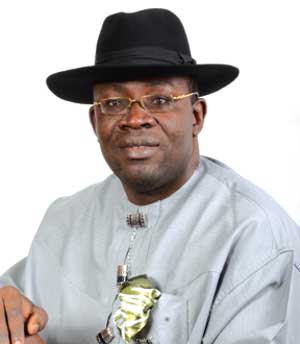
—OKAFOR OFIEBOR/Port Harcourt
Bayelsa State which shares the same date of birth with Nigeria, clocks 16
The Ijaw of the Niger Delta occupy the littoral region of the country up to Ondo State. Although they are the fourth largest ethnic group in Nigeria, they had no state they could call their own. That was why they started agitating for the creation of Bayelsa State, a wish that was granted by the late head of state, General Sani Abacha, on 1 October 1996.
For this reason, one of the most popular roads in Yenagoa, the state capital, is called Sani Abacha Expressway.
Bayelsa is an acronym for three former local government areas – Brass, Yenagoa and Sagbama – in the then Rivers State from which it was carved. It has an area of about 21,110 square kilometres. The then Brass LGA was split into the present Nembe, Brass and Ogbia LGAs. The then Yenagoa LGA now consists of Yenagoa, Kolokuma/Opokuma and Southern Ijaw LGAs and what was Sagbama LGA is made up the present Sagbama and Ekeremor LGAs.
Today, Bayelsa is made up of only eight local government areas. But Governor Diepreye Alamieyeseigha created 24 local government development areas, making the local administration units 32 in all. The state has an estimated population of two million people. Within the brief period that Dr. Goodluck Jonathan was the governor, his administration created an additional eight development centres. The councils are Ogbia, Yenagoa, Nembe, Brass, Sagbama, Ekeremor, Kolokuma/Opokuma and Southern Ijaw, making a total of 40 councils. However, the federal government refused to recognise the additional councils apart from the original eight recognised at the time the state was created.
Between 1999 and 2007, Bayelsa was a hotbed of legitimate and illegitimate agitations that almost crippled the economy of the country. But the late President Umaru Yar’Ardua granted amnesty to all the youths bearing arms and this brought relative peace to the state and the entire Niger Delta.
At the dawn of democracy, Alamieyeseigha was sworn in as the first executive governor of the state. But he was impeached because of his corruption trial. President Goodluck Jonathan, who was his deputy, was sworn in as acting governor and later governor. He was to later become vice-president to the late Yar’Ardua, ultimately succeeding him as president. Chief Timipre Sylva, who succeeded Jonathan as governor, also ran into troubled waters as he was arrested and charged to court by the Economic and Financial Crimes Commission, EFCC, over an alleged misappropriation of N2bn funds belonging to the state. Now, the state has a new helmsman: Governor Henry Seriake-Dickson.
Bayelsa’s contribution to the economic development of Nigeria is great. Rich in hydro-carbon resources and with a thriving petroleum sector in the heart of the Niger Delta, Bayelsa is the source of 30 to 40 per cent of Nigeria’s oil and gas production. In fact, the first oil struck in quantities sufficient for commercial production in Nigeria, in 1956, was in Oloibiri, Ogbia Local Government Area of the state.
Today, gas production activities in the state are being intensified. The LNG Gas Supply Plant that generates 53 per cent of the gas feedstock to the LNG plant in Bonny is located in Oluasiri, in Nembe LGA. There is a proposed network of associated gas gathering pipelines from the Nembe Creek oilfields to the LNG plant. The major oil exploration and production companies operating in the state are Shell, Agip and ChevronTexaco.
In addition to oil and gas, the state has large reserves of clay, sand and gravel needed by the industrial sector.
Governor Henry Seriake-Dickson, a lawyer, former attorney general of the state and immediate past member of the House of Representatives, seems to have learnt from the mistakes of past governors. He has set up a Restoration Team, started compulsory monthly savings and initiated transparency in governance. In fact, under Seriake-Dickson, a new Bayelsa is emerging.
Commercial motorbikes were recently banned in Yenagoa and replaced with brand new taxi cabs, given out under public private partnership. Some abandoned projects like the five-star hotel in Yenagoa and roads have been kick-started. His government has an ambitious infrastructure development policy and is building three ring roads in Yenagoa, an airport, deep sea port, as well as dualising Isaac Boro road and others. Apart from declaring free and compulsory primary and secondary education, the new government is embarking on massive investment in critical infrastructure in the sector.
In the area of agriculture, apart from the special purpose vehicles for commercial agriculture development, government plans to partner with multilateral agencies to boost food production. The government is also undertaking entrepreneurial skills training programmes for the people.
As the state celebrates its 16th anniversary, its citizens and leaders will take stock of the pitfalls of the past and forge a more prosperous future.
Comments