


Jeers For President Jonathan’s Budget

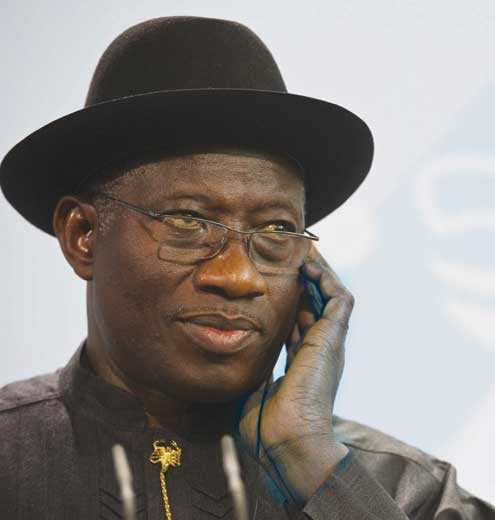
President Goodluck Jonathan’s 2013 budget proposal attracts knocks and commendations
Wrangling between the executive and the legislature over the appropriate price per barrel of oil benchmark aside, other issues that will continue to be objects of discussion in the N4.92 trillion 2013 budget presented to the National Assembly by President Goodluck Jonathan on Thursday 11 October are allocations to the various subheads.
And given the controversy it generated last year, it is not a surprise that one of the sub-heads the media and the public will be interested in is the amount allocated for feeding in Aso Rock presidential villa. The near-N1 billion allocated for the same purpose in the 2012 budget generated a swirl of controversy big enough to force the Presidency to order a reduction. Well, in the 2013 budget, the President tried to come down a bit with allocation, particularly in the area of expenses on food, refreshment and welfare for the state house, the Vice-President and other ministries. Nigerians have complained that the millions of naira allocated to welfare is simply outrageous.
The total allocation to the Presidency in the 2013 budget proposal is N35,545,673,132, with total personnel cost put at N11,476,593,929. Total overhead is N11,569,079,204, with total recurrent put at N23,045,673,132 while total capital stands at N12,500,000,000. Out of this, the Presidency budgeted N327,154,931 for refreshment and meals and another N406,738,969 to purchase foodstuff, just as Vice-President Namadi Sambo would spend N112, 500,000 to purchase food for the 2013 fiscal year, another N123,405,499 on refreshment and N7,020,750 to purchase cooking gas. When added, the total for the Presidency meals is not too far from the N1 billion budget of 2012.
The Presidency has however always argued that the allocation include budget for meals and drinks served during the different ceremonies and events at the State House and feeding of cabinet ministers during the weekly cabinet meetings. Even in spite of the boast about improved electricity supply across the country, the Presidency, it appears, is not ready to take chances on the possibility of outage. Hence in 2013, it proposed to spend N72, 510,832 to fuel its generators while it will also spend N553, 056,411 for honorarium and sitting allowance. Also up for scrutiny is the allocation to the Federal Ministry of Finance in the proposed budget.
The Ministry of Finance has a total allocation of N14,759,952, 110 in the 2013 budget proposal. Out of it, the ministry will spend N6,056,366,976 on personnel, N5,429,969,154 as overhead cost, N11,486,336,130 as total recurrent and N3,273,615,980 for capital. However, an aspect of the budget of the Ministry that has come up for scrutiny is the planned spending of N1,098,296,979 on sitting allowances and honorarium and another N43,515,655 on refreshment and meals in 2013. Also, the Ministry said it plans to expend N43,381,673 on cleaning and fumigation while security would gulp a total of N36,829,446 for the same year.
The Ministry of Finance also plans to spend N153,922, 307 on local travels, N170,922,307 on international travels while N68,613,133 will be for local training and N68,883,133 for international training. It also plans to spend N64,768,973 on the fuelling of its generators and N38,205,019 for the payment of electricity bills. The finance ministry also got allocated the sum of N400 million for the procurement of security equipment, repairs and rehabilitation of office buildings; N462 million for research and development and another N111 million on the acquisition of computer software within the financial year.
“The budget for the ministry together with its agencies is N14,759,952,111. This comes to 0.30% of the total National Budget. The agencies are Debt Management Office, Budget Office of the Federation, Office of the Accountant-General of the Federation, Investment and Securities Tribunal and the National Insurance Commission,” Paul Nwabuiku, media aide to Dr. Ngozi Okonjo-Iweala, Minister of Finance, said in reaction to criticisms on some of the specific allocations in the budget and insinuations that her boss may not be practising the modesty in government spending she has been mouthing. Nwabuiku described the allocations as “prudent and reasonable,” while affirming that the criticisms from some quarters are misguided. “The ministry under the leadership of Dr. Ngozi Okonjo-Iweala, is very conscious of its key role and will continue to lead by example in areas under its mandate. The focus, as always, is on managing the finances of the country in a manner that protects and enhances the interests of the country,” he said in a statement.
Even though the Petroleum Industry Bill is still pending at the National Assembly and there are even doubts if it will be passed given the opposition it has generated from lawmakers from a section of the country, the government has gone ahead to allocate the sum of N520,540,876 for its implementation. Also in 2013, as indicated in the budget, the Ministry of Petroleum Resources said it plans to hire a seven-seater helicopter for the sum of N200 million to inspect and monitor offshore terminals in the country and another N200 million to acquire gas flare monitoring and pipeline surveillance facilities to be used in the Niger Delta.
The Ministry will also from its total N60,834,291,536 allocation in the proposed budget, spend N1,200,731,099 for water pollution prevention and control, while it will use N22,525,507 for the fuelling of generators and N25,036,076 for maintenance of the same generators. Just like in the Presidency, staff in the office of the Secretary to the Federal Government will have more than enough to munch even as they go about their work next year with an allocation of N17,256,704 for refreshments and meals in the 2013 budget. The office has a total allocation of N7,713,308,382, with N2,509,000,000 voted for capital expenditure, N5,204,308,603 for recurrent, and total overhead, N1,529,324,603.
Though it does not have its own fire service, the SGF office will out of its total allocation spend N30,000,000 to purchase firefighting equipment, but teaching and learning equipment will gulp N13,000,000. Of the N9,328,155,023 the Economic and Financial Crimes Commission, EFCC, is allocated in the proposed budget, it plans to spend or N2,000,000,000 for the purchase of land, while its uniforms and other clothing will gulp N24,160,048; maintenance of generators will cost N8,629,595, clearing and fumigation will cost N5,370,011; honorarium and sitting allowance will take N17,087,106 and to fuel vehicles, the Commission plans to spend N31,976,146 while fuelling generators will cost N74,341,739. With the Ministry of Niger Delta regularly playing hosts to militants – retired, reformed or still active – from the creeks, it is understandable that the Ministry’s budget has generous provision for entertainment.
Thus, in 2013, Elder Godsday Orubebe, the minister plans to spend N26,226,833 on refreshment and meals while security will gulp a princely N305,000,889 out of the total allocation of N63,392,377,074 in the proposed budget. He will also spend N24,955,661 to fuel vehicles, N21,015,293 to fuel generators, and honorarium and sitting allowance will be N44, 363,766. In spite of the eyebrow-raising allocations and subheads, different stakeholders have been appraising the entire budget, especially with regard to their areas of interests. With N426.5 billion, education has the highest allocation in the proposed N4.9 trillion budget, defence came second with N348.9 billion and the Police have the third highest share of N319 billion.
But stakeholders said that even as big as it may seem, the allocation to education, which is just about 9 per cent of the budget proposal, failed to meet international standard of 26 per cent. Coming at a time of the virtual collapse of every segment of the education sector, it needs to be upwardly reviewed. Also, at 6 per cent at 1.65 per cent respectively, allocations to the health and agriculture sectors, analysts have expressed, are too little to make an appreciable turnaround in both sectors. “The 6.04 per cent sectoral allocation to health flies in the face of the Abuja 2001 declaration of African Heads of State to devote a minimum of 15 per cent of their national budget to health. Certainly, the allocation of N279.23 billion to health, which is about 41.9 per cent of the annual estimate needed to finance Nigeria’s National Strategic Health Development Plan, NSHDP, cannot achieve the desired health dividends of democracy,” Dr. Osahon Enabulele, National President, Nigerian Medical Association, NMA, said last week in a statement decrying the recurrent poor allocation to the health sector by the Federal Government.
In their own reaction, members of the Organised Private Sector, through the Lagos Chamber of Commerce and Industry, LCCI, said they are worried over the growing level of domestic debt and the high cost of debt in the proposed 2013 budget. In a statement by its President, Goodie Ibru, LCC said the country’s debt profile remains a major source of concern. The Chamber commended the provision of N100 billion sinking fund for the repayment of maturing debt obligations, but it also said it is concerned about the growing level of domestic debt and the high cost of debt servicing. Domestic borrowing is proposed to reduce from N747 billion in 2012 to N727 billion in 2013, a 2.3 per cent reduction while N591.76 billion is earmarked for debt servicing. LCCI said it is curious that while the government gives considerable attention to securitised debts, government did not indicate how it will pay debts owed to contractors.
LCC also commended fiscal policy measures in the budget, such as the 10 per cent import duty and 100 per cent levy planned to be applied to both brown and polished rice. “We commend these measures as they could boost domestic production, conserve foreign exchange and create jobs. However, the imposition of 100 per cent levy on rice which is a staple food may have some unintended consequences if there is no adequate supply side response on the domestic front,” it said.
The Chamber however predicted that if the domestic capacity to grow and process rice is not first put in place, there is the possibility of drastic increase in the price of rice which would result in escalation of poverty; escalation of smuggling and corruption at the ports and consequently, pressure on government for waivers of duty and the diversion of cargoes to neighbouring countries. This, LCCI said may lead to drastic loss of jobs and revenue in the maritime sector.
The 2013 budget is anchored on assumption of 2.53 million barrels of oil production per day; a benchmark oil price of $75 per barrel and exchange rate of N160/US$; and projected growth rate of 6.5 per cent, down from the 6.85 per cent proposed in the Fiscal Strategy Paper. The aggregate expenditure of N4.92tn is a 5 per cent increase over the N4.7tn appropriated in 2012. The capital component is 31.3 per cent of the budget as against the 28.5 per cent for the year 2012 while the recurrent also came down from 71.47 per cent of last year to 68.7 per cent of the overall proposal.
The fiscal deficit in the budget presented to the National Assembly is projected at -2.17 per cent of the Gross Domestic Product as against 2.85 per cent in 2012 budget. The National Assembly is asking the Presidency to increase the benchmark price of crude oil to reduce the deficit level in the budget. As at the time of writing this story last week, the Senate is insisting that the benchmark should be increased to $78 per barrel, while the House of Representatives is insisting on $80 benchmark. With the reduction of deficits, the lawmakers argued, government will do less borrowing from the capital market and ultimately enhance acess to loanable funds by the private sector.
Even though she has also expressed concern on the need to reduce government borrowing, the Minister of Finance has stuck to her guns, insisting that the $75 benchmark is a safe option for the economy with present global economic realities. She has support in Rezia Khan, Regional Head of Research, Africa, for Standard Chartered Bank, who commended the $75 per barrel oil price benchmark and warned against any attempt to increase it. “Of greater concern is the suggestion that there might be an attempt by the House to raise this to US$ 80/bbl. In our view, given global risks, and Nigeria’s ongoing fiscal and export dependency on a single commodity, the priority for Nigeria has got to be increasing its rate of savings. Were oil prices to fall, Nigeria would currently be left very vulnerable, with no sound mechanism for being able to achieve smooth spending, let alone provide a counter-cyclical boost to the economy,” Khan said.
Okonjo-Iweala is also concerned about the assumption of output of 2.53 million barrel per day: “Yes, some official data appear to indicate that Nigeria is currently producing near an all-time high. But there are such vast disparities in different estimates, and so many gaping holes in measures of Nigeria’s oil output, that the continued rise in Nigeria’s budgeted output assumptions, at a time when investment in the sector has been dwindling, does not inspire great confidence.”
Apart from its early presentation, other aspects of the budget that have received commendation include the focus on power supply, roads, rail and aviation safety, the gender-friendly nature of the budget and the provisions made to boost maternal and child welfare. Lawmakers in the both chambers of the National Assembly said last week they will not begin discussion on details of the budget until they finished their oversight functions to determine how well the 2012 budget has been implemented. Indeed, the bigger problem of lack of implementation, especially of the capital component of the budget, has over the years turned the yearly presentation of the budget into no more than a ritual.
—OLUOKUN AYORINDE/Abuja. Published on TheNEWS magazine.
Comments