


Fleecing Customers

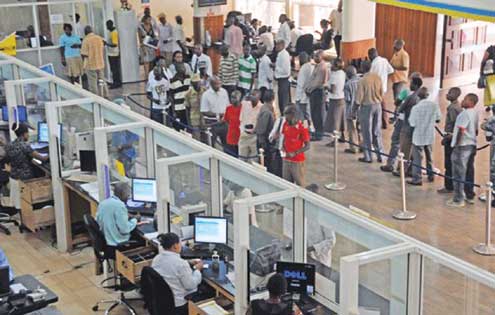
The Central Bank of Nigeria moves to rein in banks which have been fleecing their customers through spurious charges
The jumbo profits which Nigerian deposit money banks, DMBs, have been churning out over the years may largely have been dirty money creamed off depositors through all sorts of spurious charges. Attesting to this possibility last month was a top management official of the Central Bank of Nigeria, CBN, Dr. Kingsley Moghalu, Deputy Governor, Financial System Stability. As Moghalu disclosed, the CBN, between last year and now, had actually recovered about N5 billion in illegal fees charged customers by the DMBs.
Rights activists and bank customers have for many years been inundating the CBN with complaints of questionable charges the DMBs impose on customers. The banks have been accused of defaulting in applying the requisite statutory controls to effect internal cleansing on illegitimate charges. Section 3, sub-section 2 and 4 of the CBN Monetary, Foreign Trade and Exchange Policy Circular No 37 of 2 January 2004 mandates the Inspectorate Division of each bank to cross-check excess bank charges within 14 days. Any bank admitting excess charge must refund, within that period, the excess at the prevailing CBN minimum rediscount rate, along with a letter of apology to the customer. The bank must also refund some percentage to the CBN, while admitting it has been dispensing false information concerning the particular customer and that it had now investigated the account and discovered the true position so that whatever misgiving the CBN may have had about that account will be removed. It is widely agreed the DMBs have not be complying with the provision.
The N5bn the CBN recovered in wrong charges have since been returned to the affected customers. Moghalu did not disclose the banks involved in the illegal deductions, as he was silent on whether they returned it at the prevailing CBN minimum rediscount rate, as provided in the circular. He only posited the regulator is focusing on data integrity, financial stability, disclosure, transparency, corporate governance and risk management in the financial industry, with a view to ensuring that the gains of the reforms in the banking sector are not reversed.
Mr. Oriade Adeyemo, a forensic accountant and Chief Executive Officer, Forensic Consulting, who has been championing the need to fight illegal bank charges in Nigeria, told this magazine that banks defraud their customers by cashing in on their (customers’) ignorance of the financial system. This ignorance, Adeyemo argued, blinds the customers to the fact they are being fleeced.
One area of fraudulent transaction is the commission on turnover, COT. Adeyemo explained that COT should be chargeable only on valid withdrawals. In other words, returned cheques, on which some banks place charges, should not attract COT. Loans liquidation and any other transaction that has to do with liquidation should also not attract COT. Customers seeking loan facilities from banks are advised to watch out for the COT clause in the agreement they append their signatures to. Banks, Adeyemo revealed, insert a clause called the COT shortfall in the agreement signed by their customers. For instance, when a customer is projected to make a N100 million monthly turnover and doesn’t, the shortfall on the COT will be charged to his/her account. But the forensic accountant maintained the charge is illegal because the COT is chargeable on valid withdrawals only. Moreover, the COT shortfall does not exist on the Guidelines on Bank charges.
Some Nigerian banks are also alleged to be exerting charges on deposits paid into customers’ accounts, and punishing customers through fraudulent charges while reversing transactional mistakes made by their own staff. Almost all the banks charge their customers for making over-the-counter transactions on the excuse of encouraging customers to embrace the Automated Teller Machine, ATM.
Customers are advised to question charges/fees on processing, returned cheque, facility approval, renegotiation, management, above-the-limit and maintenance. Others are earned fee, COT shortfall fee, transfer fee and commission on cheques. Some banks have even been accused of compelling their customers to subscribe to short message service notifications which may attract as much as N10 per alert. In other climes, SMS notifications are free. Barclays Bank of England, as an example, informs its customers on its website to keep track of their cash flow with free text alerts to their mobile phones. “We will notify you by text when you get close to your limit or when a large amount comes in or out of your account. All text alerts are free and fully secure,” it writes.
Mr. Lucky Iluobe, a lawyer and financial advisory consultant, argued that customers too should share the blame for their nonchalance. “Customers have never protested against them,” he remarked. As he noted, fees wrongly charged are retrievable if customers would challenge them. Adeyemo corroborated that charges wrongly done can, indeed, be retrieved. The accountant recalled that while he was working with the Premier Specialist Medical Centre on Victoria Island, Lagos, he once examined its bank statement and discovered lots of spurious charges. He wrote to the bank and the charges were reversed. Later, when Adeyemo left the hospital for Cashlink, a financial house with close relationship with the banks, he investigated the company’s bank accounts in 2001 and discovered a lot of illegal charges. He enabled the finance house to recover over N1mn from the defunct Magnum Trust Bank which has now fused with Sterling Bank and another N5mn from Pacific Bank, which has now merged with Unity Bank.
Adeyemo fingered the CBN as the architect of the banking fraud in Nigeria. “The apex bank is encouraging banks to steal from customers while looking the other way. The CBN is aiding and abetting these banks. Why did it take the CBN this long before recovering illegal charges from the banks?” he queried. To the public, he advised that complaints about illegal bank charges be lodged with the Secretary, sub-committee on Ethics and Professionalism, Bankers Committee, Bankers House, Chartered Institute of Bankers of Nigeria, CIBN, PC 19, Adeola Hopewell Street, Victoria Island, Lagos.
Will the banks stop the practice? The CBN, as industry regulator, has the answer.
By Clement Oriloye/TheNEWS magazine
Comments