


Sierra Leone decides between Bio and Koroma

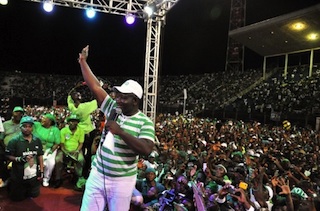
FREETOWN (AFP) – Sierra Leone readied Friday for a high-stakes election in which incumbent Ernest Koroma is seeking a second term in what is billed as a tight race with his main rival Julius Maada Bio.
Saturday’s election is the third since the end of a brutal 11-year civil war that ended in 2002. It will provide a crucial yardstick of the west African nation’s recovery and put the victors in charge of a lucrative mining boom.
In the capital Freetown, a hodge-podge of new construction, newly paved roads and slums recently ravaged by a cholera outbreak, the stakes are equally high for citizens for whom life is still a daily struggle.
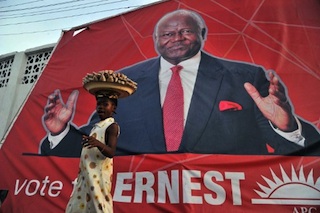
President Ernest Koroma of the All People’s Congress (APC) has been praised for the infrastructure boom, although his detractors say it has been marred by rampant corruption. He hopes to use the impending windfall from mineral resources to finish his governments projects. The country is rich in diamonds, iron ore, gold and the mineral rutile.
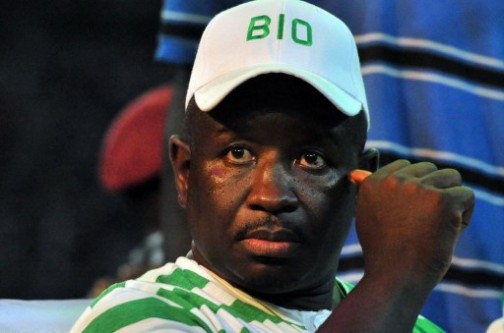
But supporters of the former military leader Julius Maada Bio argue that they cannot eat roads, electricity and fancy new buildings.
Ibrahima Ba, 28, said the improvements under Koroma were “just cosmetic things … to get food for a day is a burden for us.”
While Koroma is seen as the favourite, Bio has garnered significant support and the vote is expected to go to a run-off.
Koroma, 59, came into power in 2007. While that election was marked by several incidents of violence, they were followed by a peaceful transfer of power between the ousted Sierra Leone People’s Party (SLPP) and the APC.
While eight parties are contesting the presidential vote, these two parties have led the political scene since independence.
The election marks the first time the heavily donor-funded Sierra Leone government is bearing most of the poll costs, as well as the first time presidential, parliamentary and local elections are being held simultaneously.
According to the electoral body, only authorised vehicles will be allowed to move around on election day, and thousands of moto-taxis are banned from circulating in main cities, being allowed only in rural areas.
Police Inspector-General Francis Munu told AFP that 3,000 officers had been despatched to the provinces, and police had rolled out new uniforms after rumours that “some people had plans to wear police uniform and cause havoc.”
“This is why we kept the supply of uniform until this time when we are certain that nobody will be able to import any uniform resembling this one,” he told AFP.
An initiative called National Election Watch has set up a network of more than 9,000 observers around the country. From a “Situation Room” in Freetown, an 18-strong team will monitor screens containing live data from polling stations.
Coded SMS reports will flag up fraud incidents, voter demographics and turnout, and send out unofficial results from individual polling stations as they are counted.
Similar initiatives were used in recent elections in Senegal and Liberia.
“This process will give legitimacy and integrity to the elections, to the entire elections process, because … it’s real-time analysis,” said Ngolo Katta, spokesman for National Election Watch.
“As far as humanly possible, everything is ready for the elections,” Christiana Thorpe, chair of the electoral body, said in a radio interview.
To win in the first round, a presidential candidate needs at least 55 percent of votes. Some 2.6 million voters have registered and final results are expected by November 26.
Comments