


Egypt: Morsi’s aides resign, protests mount

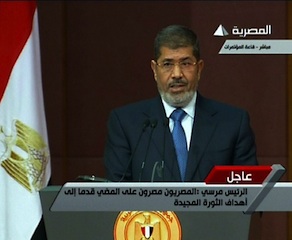
Supporters and opponents of Egyptian President Mohamed Morsi lobbed Molotov cocktails and rocks at each other on Wednesday as their standoff turned violent near the presidential palace in Cairo.
Bloodied protesters were seen being carried away as gunshots could be heard and the fierce political rivals torched cars and set off fireworks, AFP reporters said.
The protests continued as three of Morsi’s advisers resigned, state media said
Amr al-Laythi, Seif Abdel Fattah and Ayman al-Sayyad, all advisers to the Islamist president, had handed in their resignation, Egypt’s official MENA news agency reported.
At the heart of the protest
The November 22 constitutional declaration has sparked deadly protests and strikes, but Vice President Mahmud Mekki said a December 15 referendum on the charter would go ahead as planned.
Around the presidential palace in the upscale neighbourhood of Heliopolis, protesters from both camps fled into side streets.
Skirmishes broke out after thousands of Islamists rallying to the call of the Muslim Brotherhood bore down on the presidential palace, tearing down opposition tents and chanting that they would “cleanse” the area.
The two sides threw stones at each other before the secular-leaning opposition protesters, who had besieged the palace in their tens of thousands on Tuesday, escaped into side streets before regrouping.
But even as the clashes took place outside, Vice President Mekki told reporters at the Itihadiya palace that the vote “will go ahead on time”.
The opposition, he said, would be allowed to put any objections they have to articles of the constitution in writing, to be discussed by a parliament yet to be elected.
“There is a real political will to respond to the demands of the opposition,” he told journalists.
Prominent opposition leader and former UN nuclear watchdog chief Mohamed ElBaradei said Morsi bore “full responsibility” for the violence and that his regime was losing more legitimacy every day.
Tens of thousands of opposition protesters had encircled the palace on Tuesday demanding that Morsi go, opposing the charter and with some calling for a boycott of the referendum.
Islamist rallies converged outside the palace, where hundreds of anti-Morsi protesters had spent the night, forcing the opposition to leave the area.
“They (Islamists) attacked us, broke up our tents, and I was beaten up,” said Eman Ahmed, 47. “They accused us of being traitors.”
Protesters from the male-dominated Islamist marches harassed television news crews, trying to prevent them from working.
“I’m here to defend democracy. The president was elected by the ballot box. The opposition protesters ran away as they can’t face our strength,” said Wael Ali, a 40-year-old Morsi supporter with a long beard.
As the country faces its most divisive crisis since Morsi took power in June, the United States called for an open and “democratic dialogue”.
“The upheaval we are seeing… indicates that dialogue is urgently needed. It needs to be two-way,” US Secretary of State Hillary Clinton told journalists in the Belgian capital.
“Not one side talking at another side, but actual respectful exchanges of views and concerns among Egyptians themselves about the constitutional process and the substance of the constitution,” she added.
On Tuesday, the protesters demanded Morsi’s ouster in scenes not witnessed even during demonstrations that toppled Hosni Mubarak.
Morsi left the palace “on schedule” and went back to his house, before returning to work on Wednesday morning, officials said.
Comments