


Jonathan in talks with Cameron over ‘blood oil’ and Mali

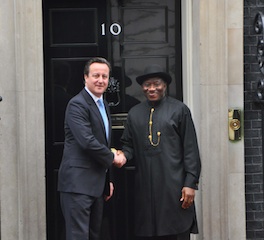
Nigeria’s President Goodluck Jonathan visited 10 Downing Street in London today to hold talks with British Prime Minister, David Cameron and pleaded for assistance to stem the big oil theft in Nigeria’s Niger Delta.
Oil theft, known in Nigeria as illegal bunkering accounts for more than 10 per cent of Nigeria’s daily oil production of 2.2 million barrels.
Jonathan told Cameron, who now chairs G8 While congratulating Cameron that stolen oil from the Nigeria is shipped abroad where it is refined and sold in the international market.
He described the crime as “blood oil”.
The president who called for sanctions for all those involved in the illegal trade, said that the G8 has a role to play in putting an end to the crime, challenging the group of industrialised nations to take a stand similar to the one taken on money laundering by public office holders
Jonathan also called on the G-8 to look into the issue of proliferarion of small arms and light weapons in Africa, and long term peace keeping support for Mali, a theme that he took across the Channels to Paris, where he later held talks with President Francois Hollande.
According to him, there is need to sustain stability in Mali after the military intervention, otherwise, the rebels may adopt a guerrillas approach of killings and suicide bombings, thus continuing their terrorist activities by other means.
While noting the cordial relations between Nigeria and the UK, the President expressed commitment to promoting trade and investment between both countries.
“We have a robust relationship in terms of trade, because trade between African nations are more difficult than trade with other countries. Without robust trading the economy cannot develop because whatever you
do either primary production or industrial, you need trade facilitation,” Jonathan said.
Responding, Cameron, said both nations had a close relationship based on successful trade and investment which would double in the coming years. Cameron also said that the two countries would continue to build on their strong diplomatic and political relations as well as aid and development partnership.
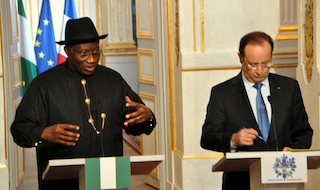
In France, President Francois Hollande told Jonathan that France was in the phase of securing areas from where Islamists had been routed in Mali as Jonathan warned this could not occur overnight.
Speaking exactly a month after France launched a military offensive in its former west African colony to flush out extremists holding the vast arid north, Hollande said the drive had been a huge success.
“The greater part of Malian territory has been freed, no town is occupied by a terrorist group and no networks or groups who had up til now threatened the lives of Malians are capable of launching a real offensive,” Hollande said.
“We are therefore no longer pursuing the liberation of territory but securing it,” he said, adding that an African force called AFISMA should now pick up the baton from the French troops.
France launched its operation on January 11, responding to a cry for help from Mali’s interim government by sending fighter jets, attack helicopters and ground troops to battle Islamists who had seized control of the north for 10 months and were advancing into southern territory.
The campaign racked up a string of early successes as French and African troops drove the extremists from Gao, Timbuktu and the rest of the towns under their control.
But the turn to suicide attacks, landmine explosions and guerrilla fighting show the deep security problems still facing Mali — and by extension France, which is eager to wind down the operation.
Nigerian President Goodluck Jonathan said the problem was just not “how to weed out the rebels but beyond” that, stressing that Mail’s “government is weak and is not elected.”
He underscored the need to “make sure that the elections are quickly done in Mali and to build up security.”
“AFISMA will continue to be there for some time because the rebels will come back as terrorists using guerrilla tactics,” he said.
“Terror groups are not groups you can overrun immediately,” he said. “It’s not going to be an overnight operation, it will take some time.”
The Nigerian leader had visited Egypt to attend the OIC summit in Cairo, after which he attended the launch of Obasanjo Foundation in London Friday night.
His visit to Cameron and Hollande today completed his five day tour.
Comments