


Combating Rooftop Riders


Train terminals at peak periods are like apparitions or paintings realised on canvas. In Lagos, the faces are usually of traders, civil servants, pensioners, young business executives and the hustlers who virtually crawl, walk and toil to make ends meet melt like a pout-pourri of images. Some of the passengers, especially the simpletons shun the cabins, opting instead for the roof of the locomotives. Some say they do this to escape the burning heat inside the cabins. For others, traveling on train-tops is just a normal way to jaunt from one part of the city to the other. While some actually hold legitimate tickets purchased from officials of the Nigerian Railway Corporation, NRC, others are mere opportunists benefiting from the sluggish movement of the trains without paying a dime.
Sitting on train top or hanging on doorways, windows or other spaces constitutes a dent on efforts by the corporation to make train journeys appeal to Lagosians. Some potential travelers by train who spoke to P.M.NEWS described the trains as decrepit, which is why many passengers choose to stand or hang on the train. Indeed, activities of these outlaws have raised safety concerns that the NRC is battling to fix. Odebunmi Dominga, Head, Lagos State Safety Commission, is peeved that the NRC’s lukewarm attitude to tackling its safety challenges. The safety expert was quoted recently as saying: “The practice of passengers hanging on coaches of trains is totally unacceptable. Residents should not collude with station managers on this act, considering the huge impact of a train accident. We will continue to mount pressure on the management until they can demonstrate that they are on top of the situation, but right now we are not pleased with what we have seen on ground,” she said regretfully.
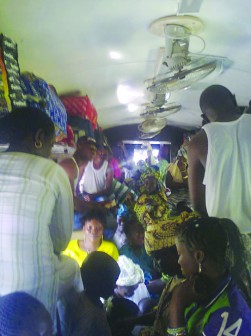
Train compartments are supposed to be salubrious areas. Comfort and ease are key considerations by manufacturers. In every cabin, it is clearly stated that each should sit 90 people. But at rush hours, the number of people occupying those cabins could double. When this reporter made took a ride on the morning of a workday last week, every available space was taken on the popular stand section was fully taken up, including the long-abandoned lavatories.
The cost of the ticket has also been blamed for the risk being taken by some travelers. The journey from Iddo, its terminal to Ijoko in Ogun State, cost N150 for ‘second class’ chambers. And for N500, a passenger can make the journey of same distance in a VIP cabin. A trip in this section of the train is not always as rosy as the name implies. Chika Odiachi, a young business executive who commutes regularly on the train said tickets are usually sold-out, pushing commuters to stand even on the so-called VIP compartments. “There is no VIP treatment anywhere in these cabins. Sometimes you get worse treatment during rush hours. People just stand or lean anywhere, just to get to their destinations,” he said.
The activities of ‘miscreants’ who ride on top of trains without paying for the ride is injurious to the operator. Although he will not confirm how much is lost to such people, Ademuyiwa Adekanmbi, District Public Relations Officer in charge of Lagos told this magazine that train hangers indirectly sabotage government effort at restructuring the rail transport system. “It is not possible to have statistics of those who hang on the trains. It is illegal to do so, we don’t recognize them,” he told P.M.NEWS. He explained that the corporation conducts raids “once or twice every week, arrests the culprits until other measures that management is putting in place to curtail this menace come to force.” Although he did not reveal the measures being put in place to combat the dangerous trend, he explained that some of those raids could yield as many as 40 criminals per operation and it is usually led by the railway Police which provides security services for the NRC. The lucky ones according to him scamper into residential areas or bushes when the police come after them. Those caught in the police net are slammed with 25,000 naira fines or judicial prosecution. This however, has not deterred offenders, some of whom this medium learnt have committed the crime several times.
Adekanmbi declined knowledge of any pressure on the railway service provider, resulting from the ban on commercial motor cycles, popularly called okada in Lagos. “We used to carry 13,000 to 14,000 daily and we are still doing so. Definitely, the number of people who come to board the train is the same, I don’t know of any pressure on us. Maybe it is the people who used to ply motorcycles that have joined the others in climbing on the trains,” he explained. The DPRO admitted that the train coaches current in use are inadequate, thus encouraging overcrowding. He noted however that government is refurbishing more coaches and complementing them with new ones to ease movement of goods and passengers.
Efforts made to reach the police for comments did not yield result. At the Area Command in Ebute Meta, this reporter was referred to the Railway Police Command at the corporation’s main terminal at Iddo. At the command, the officer designated to handle such issues was said to be away. A source who craved anonymity, however, described violators of railway rules as “Rooftop riders, who are damaging our economy. The police are going after them, based on orders that the NRC gives the officers. We will pursue them until the practice is stopped and traveling on trains becomes enjoyable,” the officer said.
Perhaps when the NRC accomplishes its much-talked-about ambition of providing many train coaches and varying travel times to cater for different category of people, this practice will stop. But for now, people who avoid the cabins will continue to hang precarious on any part of the train, making mockery of the law.
—Nkrumah Bankong-Obi
Comments