


Nigeria’s 2012 flood worst in 40 years

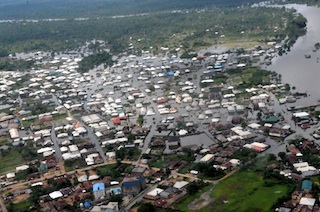
The heavy flood that hit 33 Nigerian states and affected more than seven million people is the country’s worst flood disaster in 40 years, the Nigeria Red Cross Society has said.
Mr Umar Mairiga, the society’s Disaster Management Coordinator, urged government and all stakeholders to put in everything to avoid a recurrence.
“The Nigerian Government must seriously entrench urban planning from the villages to the urban centres. It must also enforce building codes to reduce the rate of building collapse in the country.
“Government must also ban the building of houses in high risk areas such as stream beds, steep slopes and flood-prone areas to reduce the rate of casualties when flood occurs,’’ he said.
Mairiga spoke in an interview with The News Agency of Nigeria in Jos, capital of Plateau State.
The coordinator lauded NEMA’s aggressive awareness campaign on early warning signals, and commended its usually quick response to disasters.
He said that the disasters were particularly hard on societal growth because it mostly affected the poor either killing them or leaving them even poorer.
According to him, more than 547 million people are affected by disasters globally every year, and that, the poor have a much weaker capacity to recover.
“The fragile poor live in marginal areas exposed to disasters and they incidentally are the largest segment of the society,’’ he said.
Giving a breakdown of the disasters, he said that, an average of 296 million people are affected by “strange’’ disasters like Tsunami, each year.
According to him, another 145 million by drought, while 106 million are affected by flood each year across the globe.
He also disclosed that poor people were six times more prone to disasters than conflict, with them accounting for the greater proportion of casualty that rose in frequency and impact after every incident.
The official decried the lack of good drainage system, poor sanitation and the building of houses on natural water ways.
He also noted that, out of the 547 million people affected by disaster, 80 to 90 per cent of the death occurred in underdeveloped and developing countries with high consequence on Growth Domestic Products(GDPs).
“Whenever disaster strikes, with the consequent loss of productive and social infrastructure, people are forced out of their homes in search of food and safety.
“They lose their means of livelihood, normal sources of food and water, and are prone to communicable diseases resulting from poor sanitation and overcrowding in camps,’’ he added. (NAN)
F
Comments