


Confab will not break up Nigeria, says Jonathan

Ayorinde Oluokun/Abuja
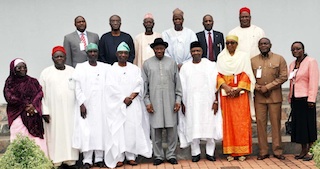
President Goodluck Jonathan gave an assurance on Monday that the proposed national dialogue will strengthen rather than lead to the break up of the country. The President said this while inaugurating the Advisory Committee on National Dialogue led by Dr. Femi Okunrounmu, a former Senator.
The President who described the Committee as “a child of necessity “ said the inauguration is a “historic and concrete steps that will further strengthen our understanding, expand the frontiers of our inclusiveness and deepen our bond as one people under God.”
“I will therefore like to allay the fears of those who think the Conference will call the integrity of Nigeria into question. This National Discourse will strengthen our union and address issues that are often on the front burner, and are too frequently ignored,” said the President.
He added that the proposed national dialogue “is a National Project, a sincere and fundamental undertaking, aimed at realistically examining and genuinely resolving, longstanding impediments to our cohesion and harmonious development as a truly united Nation.”.
The President acknowledged that like some Nigerians, he had previously held on to the view that there is no need for a national conference or dialogue because the country had organized similar forums in the past and out of the fear of the nomenclature of such a Conference, taking into cognizance existing democratic structures that were products of the will of the people.
He however said he has had to change his opinion because many Nigerians are demanding for national conference and the need to be dynamic in responding to contemporary problems facing the nation.
The President also disagreed with those who said similar conferences held in the past had not yielded any result.
He listed some of the gains and results of the past conferences.
The President noted for instance that the Conferences that were held before 1960 were designed to produce a political system and a roadmap to Nigeria’s independence.
“ The Constitutional Conference of 1957 in London, for example, effectively prepared Nigeria for Independence. The Eastern and Western regions were granted self-government in 1957, while the Northern region got its own in 1959. The Office of the Prime Minister was created and it was also decided that the Federal Legislature would be Bi-cameral.
“ Furthermore, the Constituent Assembly of 1978 gave us the 1979 Constitution and also created the current Presidential System with its attendant checks and balances and Fundamental Human Rights provisions.
“The 1999 Constitution we operate today, is a successor to the 1979 Constitution and records show that the 1999 Constitution also benefited from reports and recommendations arising from the 1994/1995 Constitutional Conference.
“ Although not enshrined in the 1999 Constitution, the idea of the current Six Geo-Political Zones that have become one of the avenues for equitable distribution of projects and public offices in Nigeria was also a product of Dialogue that emerged from the 1994/1995 Constitutional Conference.
“ The 2005 National Political Reform Conference produced a number of key recommendations that were sent to the 5th Assembly, which were however not perfected. In 2010, I reasoned that the outstanding recommendations from the 2005 Conference be revisited,” said the President.
He added that he also to set up the Justice Alpha Belgore Committee with a mandate to review the report of 2005 National Political Reform Conference for possible implementation of areas where there was a common agreement. The report of the Committee, he said has been included in a number of Bills that have been forwarded to the National Assembly where they are now key components of the on-going Constitutional Review .
The President said in the midst of agitations and tensions in the country, the proposed national conference is a platform for “calming down tensions and channeling our grievances, misgivings and suggestions into more positive use for the good of our Country.”
The President also noted that the concept of participatory democracy is such that even after the people have given their representatives the mandate to make laws and act on their behalf, there is also a space for the governed to make further input into the political processes, without undermining the authority of the statutory bodies.
“Sovereignty continues to be with the people even as the people evolve strategies and tactics to strengthen its foundation for the benefit of successor generations.
“ It is this sort of collaboration between the people and established institutions of government, that will allow for a robust outcome that leads to greater understanding and a more cohesive and inclusive Union. For me, there is no alternative to inclusivity, equity and justice in a modern democratic state. The President charged the committee to ensure that it consult widely before sitting down to develop the framework that will guide and guard the proceedings of the discussions. 
He also urged the Committee to to bear in mind, that what the country desire is what can work for the good of the people and nation with the ultimate goal of bequeathing a better and a greater Nigeria to the present and the generation that is to come.
The President however said the Committee now has six weeks to complete its assignment, contrary to one month which was announced before. He said the extension was made to give those who are presently on pilgrimage opportunity to contribute to the work of the committee when they returned to the country.
In the same vein, the President also said the Committee will determine the nomenclature of the kind of discussion Nigerians will engage in. In his reponse, Dr Okunrounmu, the Chairman of the Committee noted that while there have been vociferous demand for convocation of national conference in any form, there were also equally strong opposition to it by those who may not be loud as the advocates, but are politically powerful.
He said by agreeing to convene the conference, President Jonathan has not only showed courage, but has also demonstrated that he is a listening President. He therefore promised that his committee will not let the President and the nation down.
The Advisory Committee on National Dialogue will establish modalities for a national conference aimed at resolving issues that currently cause friction in the polity as announced by President Goodluck Jonathan in his Independence Day broadcast last Tuesday.
Other members of the committee are Prof George Obiozor; Prof. Ben Nwabueze; Sen. Khairat Gwadabe; Sen. Timothy Adudu; Col. Tony Nyiam (Rtd); Prof. Funke Adebayo; Dr. (Mrs) Mairo Ahmed Amshi; Dr. Abubakar Sadiq; Alh. Dauda Birma; Mallam Buhari Bello; and Mr. Tony Uranta; while Dr. Akilu Indabawa is the secretary.
Nwabueze was not present at the swearing in ceremony witnessed by Vice President Namadi Sambo, Governors of Kogi and Katsina States, Ministers and top echelon of Peoples Democratic Party.
The Constitutional lawyer is said to be undergoing medical treatment outside the country.
Terms of Reference of the committee are:
*To consult expeditiously with all relevant stakeholders with a view to drawing up a feasible agenda for the proposed national dialogue/conference
*To make recommendations to government on structure and modalities for the proposed national dialogue/conference
*To make recommendations to government on how representation of various interest groups at the national dialogue/conference will be determined.
*To advise on a timeframe for the national dialogue/conference.
Comments