


China underscores superpower status by rover’s landing on moon

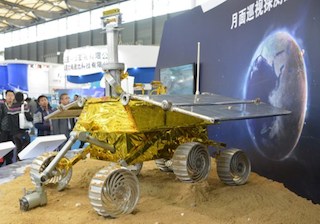
BEIJING (AFP) – China’s Jade Rabbit rover vehicle drove onto the moon’s surface on Sunday after the first lunar soft landing in nearly four decades, a huge advance in the country’s ambitious space programme.
The Yutu, or Jade Rabbit, was deployed at 4:35 am (2035 GMT Saturday), several hours after the Chang’e-3 probe landed on the moon, said the official news agency Xinhua.
Both the rover and lander are expected to take photos of each other later Sunday, it said.
China is the third country to complete a lunar rover mission after the United States and the then-Soviet Union — a decade after it first sent an astronaut into space.
It plans to establish a permanent space station by 2020 and eventually send a human to the moon.
The mission is seen as a symbol of China’s rising global stature and technological advancement, as well as the Communist Party’s success in reversing the fortunes of the once-impoverished nation.
“One Giant Leap for China,” read the headline in Hong Kong’s Sunday Morning Post, evoking the words in 1969 of American astronaut Neil Armstrong, the first man on the moon.
The lunar journey “once again lights up the China Dream”, said a Xinhua editorial citing President Xi Jinping’s slogan for Chinese advancement.
“Chang’e-3 has successfully carried out a soft landing on the moon. This makes China the world’s third nation to achieve a lunar soft landing,” the Chinese Academy of Sciences said in an online post on the mission’s official page on Sina Weibo, a Chinese Twitter equivalent.
The landing, nearly two weeks after blast-off, was the first of its kind since the former Soviet Union’s mission in 1976.
State broadcaster China Central Television (CCTV) featured extensive coverage of the mission and China’s wider space ambitions.
The potential to extract the moon’s resources has been touted as a key reason behind Beijing’s space programme, with the moon believed to hold uranium, titanium, and other mineral resources, as well as offering the possibility of solar power generation.
The China Daily, under the headline “Touchdown”, said the rover mission realises “China’s long-cherished dream” of reaching the moon.
“China wants to go to the moon for geostrategic reasons and domestic legitimacy,” said China space expert Joan Johnson-Freese, a professor of national security affairs at the US Naval War College in Newport, Rhode Island.
“With the US exploration moribund at best, that opens a window for China to be perceived as the global technology leader — though the US still has more, and more advanced, assets in space.”
News of the landing quickly made an impact on China’s hugely popular Internet message boards, topping the list of searched items
Comments