


U.S. Planes Spot Chibok Girls, Journal Slams Jonathan

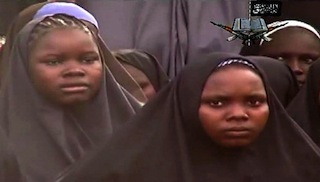
Recent U.S. surveillance flights over northeastern Nigeria showed what appeared to be large groups of girls held together in remote locations, raising hopes among domestic and foreign officials that they are among the group that Boko Haram abducted from a boarding school in April, U.S. and Nigerian officials said.
The surveillance suggests that at least some of the 219 schoolgirls still held captive haven’t been forced into marriage or sex slavery, as had been feared, but instead are being used as bargaining chips for the release of prisoners.
The U.S. aerial imagery matches what Nigerian officials say they hear from northern Nigerians who have interacted with the Islamist insurgency: that some of Boko Haram’s most famous set of captives are getting special treatment, compared with the hundreds of other girls the group is suspected to have kidnapped.
Boko Haram appears to have seen the schoolgirls as of higher value, given the global attention paid to their plight, those officials said.
Nigerian President Goodluck Jonathan, who faces re-election in February, is under political pressure to secure the girls’ release, with some people urging him to agree to a prisoner swap.
His government has ruled out a rescue operation, saying it is unwilling to risk the girls’ lives, or a prisoner swap.
“We don’t exchange innocent people for criminals. That is not in the cards,” said Mr. Jonathan’s spokesman, Reuben Abati, last week in an interview.
In early July, U.S. surveillance flights over northeastern Nigeria spotted a group of 60 to 70 girls held in an open field, said two U.S. defence officials.
Late last month, they spotted a set of roughly 40 girls in a different field.
When surveillance flights returned, both sets of girls had been moved. U.S. intelligence analysts say they don’t have enough information to confirm whether the two groups of girls they saw are the same, they said.
They also can’t say whether those groups included any of the schoolgirls the group has held since April. But U.S. and Nigerian officials said they believe they are indeed those schoolgirls.
“It’s unusual to find a large group of young women like that in an open space,” said one U.S. defence official. “We’re assuming they’re not a rock band of hippies out there camping.”
A wave of intermediaries acting on their own has tried to negotiate the girls’ release, Mr. Abati said, adding that the president has neither authorized nor discouraged those efforts.
Several of those intermediaries have said Boko Haram’s leader, Abubakar Shekau, has ordered his fighters to treat the girls as valuable hostages—not sex slaves—one senior Nigerian security adviser said.
“He gave a directive that anybody found touching any of the girls should be killed immediately,” the adviser said. “If true, it is cheering.”
It would also show that Boko Haram is trying to follow an al Qaeda tactic: swapping hostages for money and political gain.
AFP
The captivity of the rest became a cause célèbre, prompting a Twitter campaign, #BringBackOurGirls, that was joined by notable figures including Michelle Obama and Hillary Clinton.
It also spurred Boko Haram’s latest effort to get its captives released from Nigeria’s crowded prisons—a long-standing grievance. Three months after seizing the girls, Boko Haram’s leader, Mr. Shekau, appeared in a video demanding a prisoner exchange.
“You are saying bring back our girls,” thundered the bearded gunman, before firing his AK-47 into the air. “We are saying bring back our men!”
Dozens of demonstrators still gather in the capital each day to press for the girls’ freedom.
Their rallies have become a referendum on whether Nigerian women—particularly poor, young, Muslim girls—are valued by a government of mostly wealthy, elderly, Christian men.
Mr. Abati said Mr. Jonathan has worked tirelessly to win the girls’ freedom.
It isn’t clear how many of the girls Boko Haram can deliver. A former Nigerian president, Olusegun Obasanjo, who has a history of contact with the group, has said some of the girls are likely dead or pregnant. Only about 130 of them—out of 219 missing—appeared in the sole video of the girls that Boko Haram has ever provided.
The international effort to find the girls has waned: The U.S. military is now carrying out just one surveillance flight a day, mostly by manned aircraft, totaling only 35 to 40 hours a week, said U.S. defence officials, as drones have been shifted back toward other operations.
Some accounts suggest the burden of providing for scores of girls has become a point of dissension in Boko Haram’s ranks.
In July, four girls and women aged 16 to 22 hid in their bedrooms as Boko Haram fighters broke into their home in the town of Damboa, they each said in an interview last week. They feared they would be kidnapped.
When their aunt, Fatima Abba, argued on their behalf, the roughly 20 Boko Haram insurgents decided not to kidnap them—and instead began to complain about the scores of schoolgirls they already have.
“They are always crying. They behave like children,” Ms. Abba quoted the Boko Haram fighters as saying of the schoolgirls. “We don’t want them around.”
Meanwhile, United States journal, USA TODAY, has slammed President Jonthan over his government’s inability to rescue the Chibok girls almost four months after they were captured. The newspaper in both opinion articles and editorial wrote: “The response of the Nigerian government, which has often seemed overmatched in its five-year struggle with Boko Haram, doesn’t inspire much confidence. President Goodluck Jonathan at first largely ignored the incident, then claimed activists invented it, and finally yielded to pressure to accept international assistance.”
It further stated that “For one thing, the teenage captives are symbols of the importance of educating girls. They were all seized after returning to school in a dangerous area to take their final exams. Among them are future lawyers, doctors and teachers — women who could someday help lead their country… Jonathan has said repeatedly that a military operation to free the girls would probably result in the deaths of many, all but ruling it out. In the place of military action is bargaining, and Nigerian leaders have sent ambiguous signals about who is negotiating and what’s on the table.”
The paper also stated that “the world’s anger can sometimes seem a weak candle next to the flame of intolerance and murder, but in the case of the captive Nigerian schoolgirls, it’s important to keep it burning.”
Reacting, Reuben Abati, special adviser to President Goodluck Jonathan on Media, said in a statement that the President will not be stampeded into ordering any rescue attempt that may further endanger the girls.
According to Abati, “the president met recently with parents of the girls and leaders of their community to give them a personal assurance that his government will continue to explore every possible option and deploy all available resources in the ongoing effort to bring the girls home.
“As President Jonathan explained to the parents, the great challenge, which may have paradoxically created the erroneous notion of tardiness in the rescue effort, is to ensure that none of the girls lose her life in any rescue operation.
“President Jonathan’s commitment is not just to get the girls out, it is also to rout Boko Haram completely from Nigeria. But he is very mindful of the safety of the girls and will not be stampeded into ordering any rescue attempt that may further endanger the girls.
“ We ask those who continue to suggest that the Jonathan administration is not doing all it can to rescue the girls to understand that we are dealing with terrorist thugs who celebrate death and have no qualms about slaughtering helpless men, women and children.”
Abati also said that “other than the parents and relatives of the girls, no one else is more determined to do something about their plight than the president, who continues to be the target of unfair criticism over his government’s handling of the affair.
“We quite understand that part of the problem is that the media and the public would like to know more of what is being done. But we ask our people and the global community to show greater appreciation of the fact that saying too much could have very adverse consequences for the entire effort.
“Reasonable people should understand the challenging nature of this effort, but we know that there are persons in Nigeria who wish to exploit the plight of the girls for political reasons. That is unfortunate. Above all, President Jonathan is committed in the long term to a comprehensive programme of expanding educational opportunities for all girls and, indeed, all young people in Nigeria.”
Comments