


Suffering and smiling in Sierra Leone’s Ebola ‘hot zone’

A walk through the steamy streets of Kailahun is an unexpectedly uplifting experience, given that almost everyone knows someone who has died of Ebola.
Children play noisily to a soundtrack of fire finches, egrets and emerald cuckoos, chasing old tyres in the iron-rich red mud, while adults throng the streets exchanging money, black-market petrol and laughter.
Ebola — a haemorrhagic fever that kills most of the people it infects — is not highly contagious, but can spread easily in crowds where people are exposed to each other’s bodily fluids.
A cough might not do it. But a sneeze in the face, contact with infected blood or sweat, or a handshake with someone caring for an ailing, incontinent relative easily could.
Yet people squeeze together at the Friday market and the town, a far cry from the suspicious, frightened capital, comes alive with the song of all-night anti-Ebola prayer sessions.
But the atmosphere changes a short walk uphill at the specialist Ebola treatment centre run by global aid charity Doctors without Borders, known by its French acronym MSF.
Here, there is little joy, nor reason to laugh — only death and suffering.
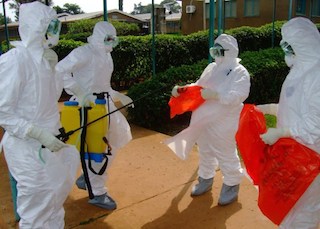
The centre runs like a military camp, everyone following procedure to the letter, every patient and health worker divided by location and clothing according to their risk status.
Up to 15,000 litres (3,300 gallons) of water and 2,000 litres of chlorine are used every day to clean hands and clothes, and a huge incineration pit takes care of everything else.
Confirmed Ebola patients are fed using an intricate arrangement that ensures the uninfected are never exposed to danger.
Ebola is a disease that allows little time to wallow or grieve, despite the bonds the workers form with their patients.
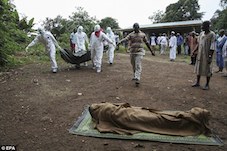
Patients brought to the centre leave with certificates confirming their recovery, or in heavily disinfected body bags.
There have been survivors — 52 of them so far, from some 200 confirmed cases — who are psychologically debriefed and carefully placed back into their communities.
They owe their lives to a hard-pushed rota of expatriate volunteers, hygienists, support staff and local nurses, who work punishing hours to save as many as they can.
Geraldine Begue, a 31-year-old anaesthesia nurse from Luxembourg who quit her job in Switzerland to volunteer at the centre, starts her day at 6:00 am taking blood samples before turning to feeding, hydration, and organising pharmacy stocks and staff.
Depending on when patients come in, she can still be at the centre at midnight, taking patients through triage and admitting them, including entire families.
“Sometimes they all die. Sometimes just the parents recover, and most of the time all parents die and only one child survives,” she says.
Most of her patients suffer severe diarrhoea, vomiting and agonising pain as their organs break down, which is eased by morphine and tramadol.
“Ebola is really a messy virus,” she says.
It is an emotionally testing environment, and while Begue is disarmingly cheery, she admits that sometimes it can get on top of her.
She and her colleagues work in the certain knowledge that for a good proportion of the patients they treat, it is a question of providing a comfortable death rather than saving a life.
Sia Lavalley, 30, is in the high-risk area. Her husband Tamba died at the centre along with her seven-year old boy, Tamba Jr.
“I’m feeling the pain. I have pain in my joints, which they are treating,” she tells AFP from behind two plastic fences that create a protective buffer zone a few feet wide.
“The worst pain I feel though is whenever I see the other children here running around, sick with Ebola.”


Comments