


Invest in Nigeria, Jonathan urges Private Investors

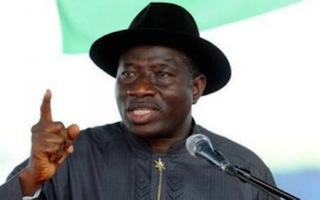
Jethro Ibileke/Benin
President Goodluck Jonathan has said that the Power Roadmap of the country has set out the key foundational issues needed to be addressed so as to remove the obstacles to private sector investment, and enable the sector’s growth.
The President who made the remark on Friday in Benin, Edo state capital during the foundation laying ceremony of the Azura West Africa Limited and Edo State Government initiated Independent Power Plant, called on private sector entrepreneurs to come and invest in Nigeria and drive the country’s economy to speedier growth.
“I am pleased to join you today on this history making occasion as we witness the ground-breaking of the Azura Edo Power Project.
“This initiative is a major milestone in our power sector reforms programme and we are happy to associate with Azura as this model of private sector investment in new generation capacity represents the next logical step in our vision for uninterrupted access to power for our people.
“This project is a first in many ways. It is the first fully financed private sector power plant to get to this final stage, under the new framework facilitated by our reform instituted agencies,” said Jonathan.
He promised to continuously improve “the framework and enabling environment based on sound policy formulation, access to long-term low interest finance, and transparent and consistent regulatory guidelines” necessary to assist private investors.
The President remarked that his government was committed to irreversibly repositioning the Nigerian power sector as a pivot for the attainment of the nation’s developmental targets, but added that such a framework can only be robust when the private sector works in partnership with the public sector.
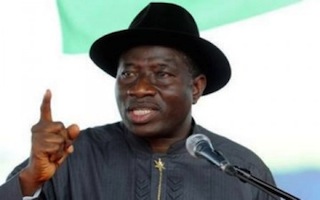
The ground breaking ceremony marked the beginning of construction work for the project which is expected to be ready in 2017.
On the President’s entourage were the Minister of Power, Professor Chinedu Nebo; the Minister of Works, Architect Mike Onolememen; the Minister of Petroleum, Mrs. Deziani Allison-Madueke.
Others were the Minister State for Finance, Alhaji Bashir Yuguda; the Minister of State for Power, Mr. Wakil Mohammed; the Chairman of Senate Committee of Power, Senator Philip Aduda; the Chairman of House Committee on Power, Hon. Patrick Ikhariale; and the Senior Special Adviser on Media and Public Affairs to the President, Mr. Reuben Abati.
Governor Oshiomhole, who received President Jonathan at the Airport after which they both flew in the President’s helicopter to the venue of the ceremony, commended President Jonathan for creating an enabling environment for the initiation of the project in his speech.
He said, “The financing and support of the Azura Power Project is the most potent voice of confidence on the power reform programme of the Federal Government’s Transformation Agenda,” and further expressed fact that he won’t be in office in 2017 as Governor when it is completed but he will be around to participate in the commissioning.
The Azura-Edo project is the first of a new wave of project-financed greenfield IPPs currently being developed in Nigeria. The financing of the project draws equity and debt from a consortium of local and international financiers.
It also incorporates an additional investment by Seplat Petroleum Development Company Plc in new gas processing facilities at its Oben Gas Plant, which, as part of Seplat’s joint venture with the Nigerian Petroleum Development Company (NPDC), will supply the Azura-Edo IPP with fuel gas requirements estimated at about 100 million cubit gas per day.
The Azura-Edo IPP project comprises an initial 450 mega watt open cycle gas turbine power station; a short transmission line connecting the power plant to a local substation and a short underground gas pipeline connecting the power plant to the country’s main gas-supply. Completion of the phases is expected to generate 1,500 mega watt of electricity.
The plant’s location on the outskirts of Benin City is said to be ideal because of its close proximity to Nigeria’s biggest gas distribution pipeline, a situation that makes gas feedstock easily available with unique accessibility to the country’s high voltage transmission network for smooth evacuation and distribution of power.
Comments