


Lagos And The Menace Of Street Trading

Rasak Musbau
Lagos, to use the trending cliché, is a happening city; a bubbling city that never sleeps. It is a city of amazing allure and limitless opportunities. It is a city of the good, the beautiful and the ugly. Without a doubt, Lagos is the commercial nerve centre of Nigeria. Since economic consideration is an important determinant in movement of people to Lagos, the trend cannot be reversed. Thus, the state can boast of a variety and depth of economic activity that no other Nigerian city can emulate. The cosmopolitan and bubbling nature of Lagos, despite its numerous advantages, however, pose many challenges and is a factor in the number of people that are unemployed, under-employed or marginally employed wandering around the state for desirable and undesirable ends.
Many of the operatives in the state’s informal economic sector operate majorly in open spaces, streets and highways. This is in addition to being the originators of illegal or temporary structures like sheds and kiosks and inappropriate dumping of refuse that abound in the state. It also manifests in unauthorized street trading, indiscriminate occupation of public space in defiance of formal planning and land use arrangements, little regard for intrinsic beauty and suitability, and land use conflicts, impediments to free flow of pedestrian and motorized traffic and congested transportation networks.
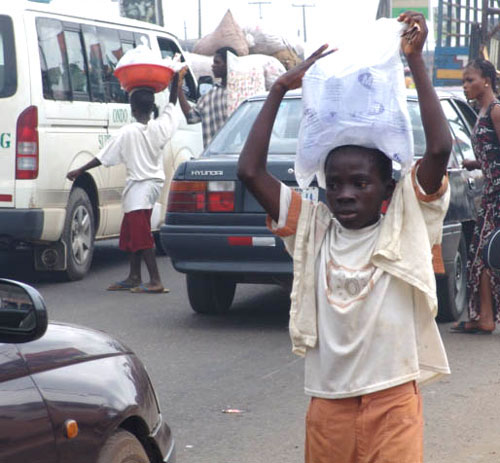
In recent time, street trading and begging (begging in particular has become a vocation) have become common sight in Lagos streets and highways almost 24 hours daily. They are now some of the misuse plaguing the public open spaces in Lagos with up to a million street traders existing in the state. The worrisome side of this is that it has become the most prevailing form of child labour as every major road now serves as centre of trading activities by children mostly below 18 years. The increase in number of children hawkers in the state is pathetic and contradicts the progress of Lagos (Itesiwaju ilu eko) mantra of Governor Akinwunmi Ambode and the Lagos State Development Plan. It is a negation of the International Convention on the Rights of the Child and also not in accord with the Lagos State social protection services. It is not one of the ways to make Lagos a better place to live in.
There is a divergence of opinions on what should be the response of the state government to street trading. Some are of the view that government should not enforce ban on street trading on the account that it is an integral part of African custom and tradition. Others see it as a manifestation of both poverty and underdevelopment while some others see it as a natural trend in every major city of the world. What those who hold this view, however, forget to add is that trade regulation and issuance of trade license is a standard practice in every developed country of the world. It is, indeed, difficult to see how a phenomenon that promotes child trafficking, misuses of public open spaces, insecurity on the highways, environmental degradation and violation of human rights could be allowed to thrive in any sane society.
It is crucial to reveal that the Lagos State Development Plan 2012-2025, upon which the state government anchored its developmental programmes, is structured under four pillars viz-a-viz Social Development and Security, Infrastructural Development, Economic Development and Sustainable Development. Unequivocally, there is no way street trading will be allowed to thrive if our development plan is to become a reality. The Lagos state Ministry of Youth and Social Development has identified and reported severally that street trading is a major contributor to child trafficking. Its Education counterpart is saddled with responsibility of mainstreaming out-of-school children into formal school systems.
Despite the huge resources that the state government has committed into education, street trading partly contributes to low academic performance and outright school drop-out by children in the state. In a study carried out in Epe division of the state, among child traders, 70 per cent of them admitted that street trading had a negative effect on their reading schedule, while 79.2 per cent reported that it affected their school attendance rate. No responsible person should be happy seeing children in uniform or mufti hawking goods at hours when they ought to be in schools.
It is indeed, inhuman for anyone to engage a child in money making venture as seen every day on our roads with children running after moving buses and cars to sell and collect money. Aside that, such children are denied basic education which is another important right of every child. Many children have sustained lifelong injuries through street trading and hawking. Moreover, children who engage in hawking or other forms of hard labour may physically wear away before they actually reach the productive age in the economy. Many children had died as a resulting of hawking in traffic through accidents.
With all the environmental menace and insecurity associated with street trading, it is quite obvious that it could birth other social and security problems. It should be stressed that Nigeria has enacted legislation concerning child labour within the Labour Act and has also adopted the Child Right Act (CRA) (2003). A key provision of the CRA is that using children for hawking is a punishable offence under the Act while Section 59 (b) of the Labour Act which prohibits the employment of children under the age of 16 years in any work which is dangerous and injurious to their health.
It is in the light of this that it should be emphasised that the Lagos State government has the responsibility to execute policies that conform to best practice, that can mitigate environmental nuisance and the security threat which street trading poses to its citizens. It is, therefore, essential for Lagosians to listen and reason along with government in its bid to rid the state of the menace of street trading. Our collective efforts should be geared towards securing a better future for our children. This can, definitely, not be achieved with street trading.
—Musbau is of the Features Unit, Lagos State Ministry of Information and Strategy, Alausa, Ikeja.
Comments