Compromise, love for lucre, and corruption are said to be responsible for the recurrent incidences of building collapse in Nigeria, especially in the nation’s commercial nerve centre, Lagos. Experts believe that many more innocent souls may be trapped and possibly lose their lives in avoidable disasters if the laws are not rigorously implemented to check the menace, Muritala Ayinla reports.
He refused to speak with anyone. None of the happenings in the hall interested him as he gazed at the microphone of the conference room, obviously lost in thoughts of the tragedy that befell him. For nearly 45 minutes that the programme lasted, he did not exchange words with anybody. Suddenly, his look changed, and he grimaced as tears began to roll down his cheeks. He managed to hold them back but could not. He finally broke his silence with tears when asked to react to the compensation of N5 million from the Lagos State Government.
His tears were not only provoked by the inadequacy of the money given to him to secure accommodation, but he was also obviously overwhelmed by the degree of his loss in the unfortunate incident. He had other concerns: the miserable circumstances to which the regrettable occurrence subjected him and the damning reality of its magnitude were confounding. The thought of where to start from with the N5 million financial assistance may have pervaded his mind, having lost four children to the disaster and the building he had laboured for years to build.
That was Okeoseye Odia, a policeman who lost four children to a flood-induced mudslide in the Magodo area of Lagos metropolis. He was invited on November 26, 2015, by the Lagos Ministry of Special Duties and Inter-Governmental Relations to receive monetary compensation to secure accommodation elsewhere.
The cheque presentation programme was abruptly brought to an end. This was as the officials of the state government, led by the Commissioner for Special Duties and Inter-Governmental Relations, Seye Oladejo, sympathisers, and journalists invited to cover the event fought to hold back tears. The circumstances and impact of the tragedy on the family were something those present could not comprehend.
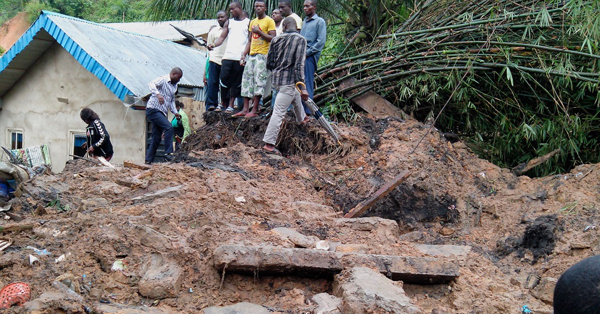
Odia’s children, Sylva, 23, Sayo, 15, Clinton, and Endurance, eight, were all consumed when flood broke through the family house located at 50, Otun Araromi Street, Orisha, Magodo Phase 1, in the early hours of Saturday, November 7, 2015. “Losing the children I had suffered to groom in the house I laboured to build many years ago on the same day was something I can’t bear. What could be more tragic than losing a house and four children in one day?”
Pathetic as Odia’s situation was, he is not an isolated case. Mrs. Adebisi Coker, a 70-year-old widow, had also suffered a similar fate. Her building collapsed on November 21, 2012, at Jakande Estate. The widow, who now struggles to survive in a rustic community in Lagos, did not only lose her building on that fateful day but also her two graduate daughters, who she had thought would take care of her and bury her when she died. The building that served as Coker’s family abode at Block M20, Church Street, Jakande Estate, Lagos, caved in at about midnight, killing the two daughters, Bukky and Toyin. Although the septuagenarian is alive to tell her story, she nurses eternal injuries, which she said cannot fade away as long as she lives.
However, the two incidents above are only samples of the monumental pains and havoc wrecked on many Nigerians whose relatives have been victims of collapsed buildings. Such occurrences, which have today become a somewhat recurring decimal, are inflicting pain and agony on many families. It is, indeed, a sad phenomenon that seems to have snowballed into a regular happenstance in the “Centre of Excellence.”
It often occurs when least expected, though sometimes envisaged. Whichever way, it pokes its destructive fingers at helpless persons. Like a thief in the night, it intrudes rudely into the victim’s world, venting its cruel spleen with abandon. Whenever there is a bang, innocent victims are suddenly buried alive in the rubble, leaving some to writhe in pain for hours, sometimes days. Others simply succumb to death before the often delayed rescue.
According to the report of a Tribunal on Collapsed Buildings set up by the former Governor of Lagos State, Babatunde Fashola, on November 18, 2013, “over 130 cases of collapsed buildings were recorded in the state between 2007 and 2013 alone. While in 2014, no fewer than six cases were recorded by the Lagos State Building Control Agency (LASBCA). In these incidences, a total of 128 lives were lost, with the highest casualty figure of 116 persons coming from the Synagogue Church of All Nations Guest House incident that shook the world on September 12, 2014.”
So prevalent are the incidences in the state that between January and December 2015, a total of 16 buildings collapsed. Going by the report of the tribunal submitted to Fashola, an average of 18 houses collapsed per year, leaving hundreds of people bruised or buried alive. According to the Chairman of the tribunal, Architect Abimbola Ajayi, five buildings caved in while the panel was still sitting.
Its victims over the years included, but were not limited to, innocent occupants, residents, hawkers, bystanders, passersby, labourers, or porters who unfortunately chose to rest or live in the ill-fated building after a hectic day’s job. In many instances, an entire family is wiped out. Sometimes, the kids are spared to live thereafter as orphans. Many women have also become widows due to this predictable conundrum.
In Lagos, the collapsed building tragedy spares no region or district, since no part of the state appears to be free of these ugly incidents that have claimed hundreds of lives. From the densely populated and choked-building areas in Lagos Island and Ebute-Metta to the sparsely populated Ojodu Berger axis, no one seems to know when and where the next tragedy will strike. From the slums of Ajegunle and Ijora Badia to the highbrow areas of the Lekki/Ajah axis, grave lamentations emerge. From the well-planned areas in Dolphin and Jakande Estate to the poorly planned residences in Ketu, the air of frustration has always been palpable.
Government buildings are not exempted either. In the past, buildings owned, financed, and sometimes handled by government officials have had their fair share of the challenge. On November 5, 2013, a shopping complex owned by Iru/Victoria Island Local Council Development Area collapsed on Muri Okunola Street, killing four people and injuring several others.
Seven people were also trapped and injured, including the site engineer, when a building belonging to the Office of the Drainage, an arm of the state Ministry of Environment, caved in on December 15, 2011, in the premises of the Lagos State Secretariat, Alausa, Ikeja.
But successive governments have not watched the situation in helpless frustration. In the past, committees have been inaugurated and other measures taken, yet the structures would not just stop crumbling. And the death toll from these ugly incidents keeps rising while many have, over time, sustained permanent disabilities.


 Quick Read
Comments