


Nigerians urged to embrace dialogue as peace building component


 Quick Read
The Minister of State Foreign Affairs, Mrs Buka Ibrahim has on called on Nigerians to embrace dialogue as a primary component for peace building.
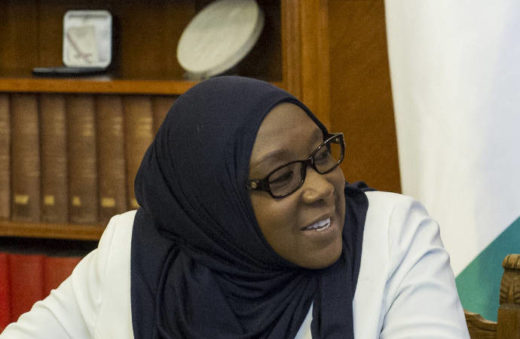 The Minister of State Foreign Affairs, Mrs Buka Ibrahim has on called on Nigerians to embrace dialogue as a primary component for peace building.
Ibrahim made the call on Thursday in Abuja, during a consultative conference with the theme:
“Implementing the International Dialogue Peace -building State-building (IDPS), and Its New Deal for Engagement in Conflict Affected States.”
The conference was organised by the Institute For Peace and Conflict Resolution (IPCR), in collaboration with the Centre for Sustainable Development and Education in Africa (CSDEA).
The Minister said that the goal of dialogue was to develop joint approaches to resolutions as well as to improve relationships, understanding and trust with one another in the country.
“Nigeria is suffering from violent extremism at the same time it is dealing with low oil prices and the economy recession.
“We are committing significant budgetary allocation to confront the security and humanitarian situation arising from the insurgency, we also need the help and support we can get from the international communities,” she said.
The guest speaker, Chairman House Committee for Internal Displaced Persons (IDPs), Alhaji Sani Zoro, explained that any conflict resolution demands dialogue.
He stressed the importance of dialogue as a conflict prevention and peace building tool from different angles.
According to Zoro, there is an importance role dialogue plays in peace-building and state building.
“In any conflict resolution, be it local or international, dialogue is not to be neglected.
“For example the retrieval of the 82 chibok girls shows that conflict must end at the negotiating table, where dialogue played an important role,” he said.
According to him, people are unaware that conflict is not only in the North-East but also in the central part of the country.
He, however, called for more resources to be deployed to the IPCR with the view of mainstreaming into the peaceful desire.
Zoro said dialogue was imperative to addressing the grave humanitarian crisis in the country, both politically and financially.
He said the Boko Haram violent conflict which broke out eight years ago in the north east had horrific campaign of attacks on civilians and mass abductions.
READ: Northern Elders lauds Buhari for securing the North from Boko Haram
“The killings and destruction spread into four countries and developed into a violent confrontation engaging the security forces of the region.
“It has cost thousands of lives and pushed millions of ordinary people from their homes.
“Out of the 17 million people directly suffering from the consequences of this crisis, more than seven million of them are going hungry a population more than the size of a country.
“Millions live in lawless, conflict affected areas where it is hardest for people to get the aid they need. The information available suggests that many are on the brink of starvation,” he said.
Zoro said the governments of Cameroon, Chad, Niger and Nigeria engaging in fighting against Boko Haram must take seriously their responsibilities to protect civilians from harm, adhere to international law and ensure that people could reach and access food and assistance safely.
In his remarks, Royal Norwegian Ambambassador Jens Kjemprud, said preventing conflict was more important than resolving it, adding that national ownership of leadership was also crucial.
The Managing Director, Mr Oshita Oshita said that international dialogue in conflict-affected and fragile countries required principles of national ownership and leadership, strong international support and partnership.
Oshita said that international dialogue has continue to provide platform that enables dialogue and learning that stimulates initiative that seeks to help build peaceful states .
READ: Chibok Girls: FG ready to negotiate for release of captives
“The IDPS was endorsed by over 40 countries as a global dialogue since 2012 and its principles recognised that conflict affected states confront particularly severe development challenges.
” We are convinced from empirical evidence that the political, socio economic and development realities of our nation today requires urgent attention by strategic stakeholders if we are to successfully institutionalise peace-building and state-building process across the country,” he said.
He added that peace could not be achieved by just a few people, but with the cooperation and contributions of all and sundry.
According to him, this did not exclude the private sector because no reasonable business could survive in a conflict zone.
He, however, said that no development could happen during conflict.
Comments