


North Korean missile test ‘grave concern’ to china

 Quick Read
China expressed “grave concern” on Wednesday after North Korea fired what appeared to be an Intercontinental Ballistic Missile (ICBM) that landed close to Japan.
China expressed “grave concern” on Wednesday after North Korea fired what appeared to be an Intercontinental Ballistic Missile (ICBM) that landed close to Japan.
Foreign ministry spokesperson Geng Shuang told a news conference that China hopes all parties act cautiously to preserve peace and stability.
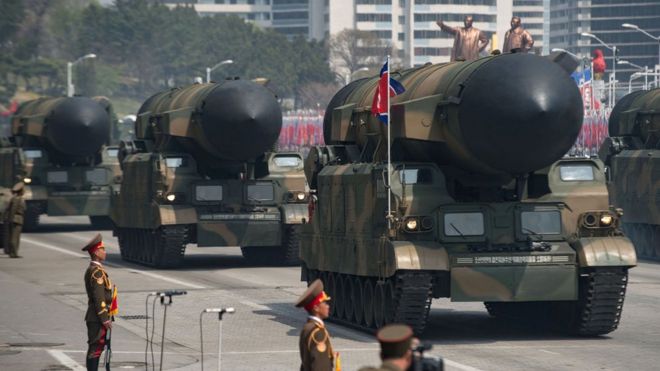
North Korea said it successfully tested a powerful new ICBM that splashed into the sea near Japan and put the entire U.S. mainland within range of its nuclear weapons.
Wednesday’s test, North Korea’s first since mid-September, came a week after U.S. President Donald Trump put North Korea back on a U.S. list of countries it says support terrorism, allowing it to impose more sanctions.
North Korea, which conducted its sixth and largest nuclear test in September, has fired dozens of ballistic missiles tests under its leader, Kim Jong Un, in defiance of international sanctions.
The latest test was the highest and longest any North Korean missile had flown.
North Korea said the new missile reached an altitude of around 4,475 km, more than 10 times the height of the International Space Station, and flew 950 km during its 53 minute flight.
“After watching the successful launch of the new type ICBM Hwasong-15, Kim Jong Un declared with pride that now we have finally realised the great historic cause of completing the state nuclear force, the cause of building a rocket power,” according to a statement read by a television presenter.
North Korea described itself as a “responsible nuclear power”, saying its strategic weapons were developed to defend itself from “the U.S. imperialists’ nuclear blackmail policy and nuclear threat”.
Many nuclear experts say the North has yet to prove it has mastered all technical hurdles, including the ability deliver a heavy nuclear warhead reliably atop an ICBM, but it was likely that it soon would.
“We don’t have to like it, but we’re going to have to learn to live with North Korea’s ability to target the United States with nuclear weapons,” said Jeffrey Lewis, head of the East Asia Nonproliferation Programme at the Middlebury Institute of Strategic Studies.
U.S., Japanese and South Korean officials all agreed the missile, which landed within Japan’s exclusive economic zone, was likely an ICBM.
The Pentagon said the test did not pose a threat to the U. ., its territories or allies.
“It went higher frankly than any previous shot they’ve taken, a research and development effort on their part to continue building ballistic missiles that can threaten everywhere in the world, basically,” U.S. Defence Secretary Jim Mattis told reporters at the White House.
Trump spoke by phone with Japanese Prime Minister Shinzo Abe and South Korean President Moon Jae-In, with all three leaders reaffirming their commitment to combat the North Korean threat.
“It is a situation that we will handle,” Trump told reporters.
Trump, who was briefed on the missile while it was in flight, said it did not change his administration’s approach to North Korea, which has included new curbs to hurt trade between China and North Korea.
Washington has said repeatedly that all options, including military ones, are on the table in dealing with North Korea while stressing its desire for a peaceful solution.
“Diplomatic options remain viable and open, for now,” U.S. Secretary of State Rex Tillerson said.
Comments