


History as China lunar rover successfully touches down on far side of the moon

 Quick Read
In an historic first, China has successfully landed a rover on the far side of the moon, Chinese state media announced Thursday, a huge milestone for the nation as it attempts to position itself as a leading space power.
In an historic first, China has successfully landed a rover on the far side of the moon, Chinese state media announced Thursday, a huge milestone for the nation as it attempts to position itself as a leading space power.
China’s National Space Administration (CNSA) landed the Chang’e 4 lunar probe at 10:26 am Beijing time on Thursday, in the South Pole-Aitken Basin which is an impact crater, China Central Television (CCTV) reported.
It made its final descent from a landing orbit 15 kilometers above the moon’s surface.
State media reported the rover transmitted back the world’s first close range image of the far side of the moon. No other details were immediately available.
The announcement came shortly after state media outlets China Daily and China Global Television Network (CGTN) deleted posts on social media proclaiming the mission a success, sparking widespread confusion as to whether the probe had in fact had made touchdown.
No explanation was given as to why the tweets were deleted. On social media, observers speculated as to the cause of the apparent backtracking, with many wondering if the mission had experienced a temporary upset, or whether it was a simple case of state media jumping the gun ahead of the official announcement.
The far side of the moon is the hemisphere that never faces earth, due to the moon’s rotation. It is sometimes mistakenly referred to as the “dark side of the moon,” even though it receives just as much sunlight as its earth-facing side.
The Chang’e 4 lunar mission lifted off from the Xichang Satellite Launch Center in Sichuan province on December 8 and entered the moon’s orbit four days later, according to Chinese state media.
Once safely on the moon, the lander will tackle a long to-do list, including conducting the first lunar low-frequency radio astronomy experiment, observe whether plants will grow in the low-gravity environment, and explore whether there is water or other resources at the poles.
Another function of the mission is to study the interaction between solar winds and the moon surface using a new rover.
“Since the far side of the moon is shielded from electromagnetic interference from the Earth, it’s an ideal place to research the space environment and solar bursts, and the probe can ‘listen’ to the deeper reaches of the cosmos,” said Tongjie Liu, deputy director of the Lunar Exploration and Space Program Center for the China National Space Administration.
Because of the far side’s position facing away from earth, it is free from interference from radio frequencies and therefore it’s not possible for the lunar rover to communicate directly with ground control. This is often cited as a reason other space agencies have not landed a probe or rover there before. The mission requires a relay satellite to transmit signals that was launched into place this year.
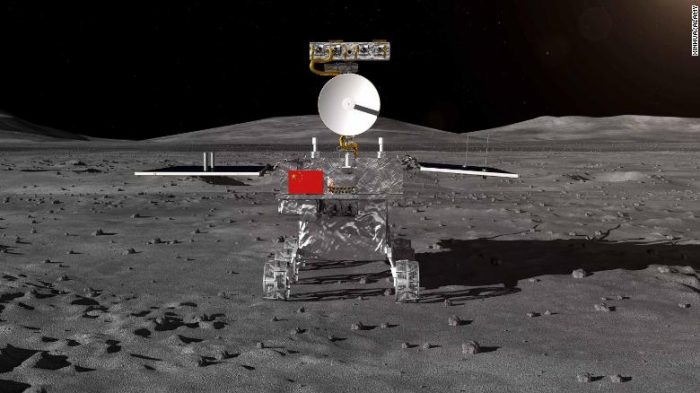
The Chang’e 4 rover is 1.5 meters (5 feet) long and about 1 meter (3.3 feet) wide and tall, with two foldable solar panels and six wheels.
“China is anxious to get into the record books with its space achievements,” said Joan Johnson-Freese, a professor at the US Naval War College and an expert on China’s space program.
“It is highly likely that with the success of Chang’e — and the concurrent success of the human spaceflight Shenzhou program — the two programs will eventually be combined toward a Chinese human spaceflight program to the Moon,” she added. “Odds of the next voice transmission from the Moon being in Mandarin are high.”
Comments