


African-Americans trace roots back to Africa

 Quick Read
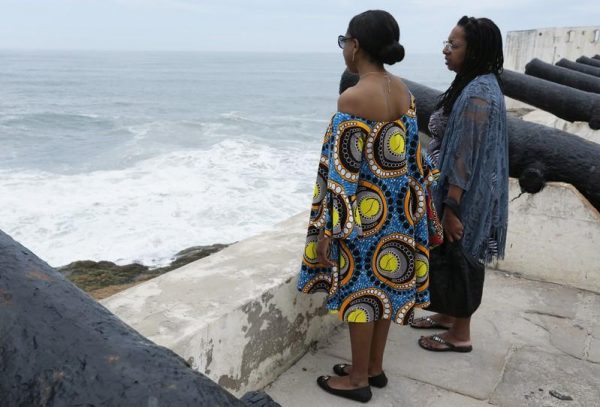
A Professor of Africana Studies, Tani Sanchez and her daughter are among a growing number of African Americans exploring their ancestral roots in Ghana, which has encouraged people with Ghanaian heritage to return in honour of the 400th anniversary of the first recorded arrival of African slaves to America
Before she turned 20, Mary Louise married Curley Euell, who worked as a lumberjack in the local sawmill. His father had been the victim of a lynching in the area. Euell never spoke about his father or his death.
In 1924, the couple and their four children joined the “Great Migration” of African Americans moving away from the South. Euell had accepted an offer to relocate to Arizona, so the family loaded themselves and their belongings onto a freight car, sleeping on mattresses as they headed west.
They eventually settled in Tucson and bought a house that remained a gathering place for generations.
Quilt-making was an important social activity for Mary Louise throughout her life. Some of the quilts’ patterns or colour schemes appeared to hint at an unconscious African influence. In the quilts, Sanchez could see her family’s connection to its forebears across the sea.
“WE ARE ONE”
Once in Ghana, Sanchez was electrified by the sense that she was meeting people whose grandparents’ grandparents’ grandparents may have known her African ancestors.
The tour involved long bus rides on bumpy roads hedged with tattered banana and palm trees. As they journeyed inland to the Ashanti capital of Kumasi and then back to the slave sites on the coast, they passed shops tacked together out of sheet metal, old boards and tarpaulin offering everyday services with a religious flavour: “Great Miracle, fax and printing,” “With God Tailoring” and “Peace Be With You Keycutting.” Street vendors weaved through the traffic, selling chilled drinks and snacks from bowls balanced on their heads. In the distance, a vine-draped tropical forest covered the rolling hills of what the passengers were being told was their homeland.
During a traditional Ashanti “durbar” ceremony of drumming and dance outside Kumasi, a local chief formally welcomed them back to the tribe and proclaimed: “We are proud of you. … We are one.”
In a small courtyard, musicians in black-and-white robes beat waist-high drums as the chief, his wrist stacked with chunky gold bracelets, performed a ritual dance under a large fringed parasol spun above him by an attendant.
The tour group lined up to greet the chief one by one. After stooping to shake his hand, Sanchez returned to her seat. Almost in surprise, she reached up to catch a tear sliding from beneath her glasses. She pulled a crumpled tissue from her handbag and dabbed her eyes.
“I certainly didn’t expect to cry. I studied this. … I’m actually crying?” she said afterward.
“I was thinking of my obsession with genealogy and how I’ve been doing it for years,” she said as curious locals stood in the back watching the event. With a friendly smile, one girl in skinny pink jeans pulled her phone out to film a member of the tour dancing to the drums.
“My ancestors would have given anything to go back, anything to escape the horrific situation,” Sanchez said. “And here we are. And I truly believe that they were looking down and they got a kick out of it.”
NOT A SECOND-CLASS CITIZEN
After the move to Arizona, the Wright-Euell family continued to encounter unequal treatment. They weren’t welcome in restaurants and were only allowed to sit in the balcony of cinemas. The children faced insults at school from white teachers and pupils, which their mother advised them to ignore.
Mary Louise’s determination that they receive a good education led her to work for wealthy white families as a maid, eventually putting all six children through university or nursing school.
She had inherited her grandfather’s resolute character and refusal to see herself as a second-class citizen despite the severe restrictions against black people.
In the 1960s, as the Black Power movement was getting into gear, a young Sanchez excitedly told her grandmother about what she had recently learned about African and black American achievements.
The information didn’t surprise Mary Louise. “Well, we didn’t come here empty-handed. We didn’t come from nothing,” she replied.
The phrase would ring in Sanchez’s ears during her years of research into the family’s history. She had a name for her book.
Comments