


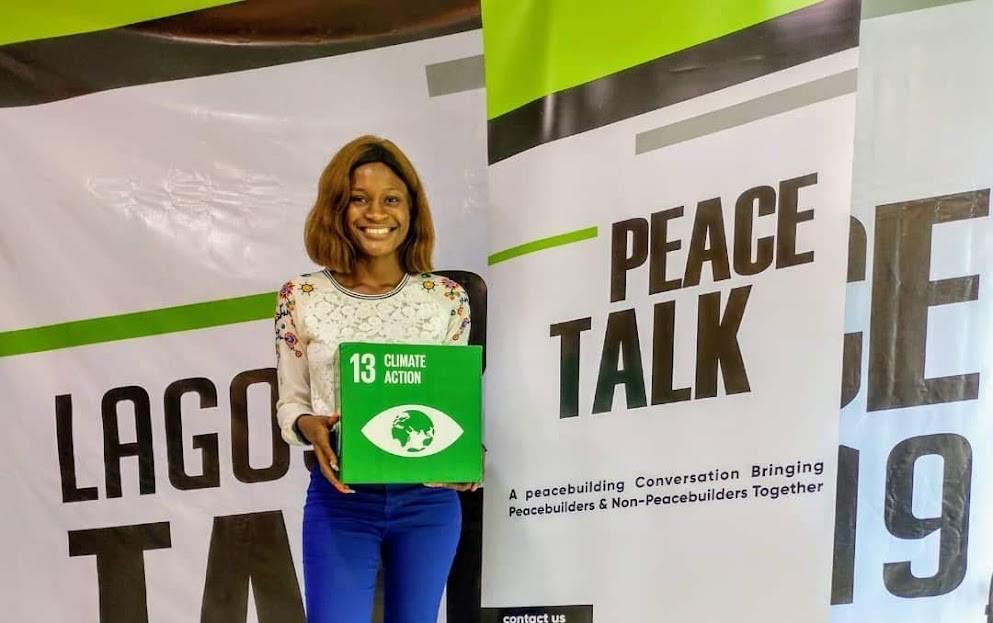
Abimbola Abikoye at Lagos Peace Talk says Climate and Peace: Two Sides of the Same Coin

 Quick Read
Climate change, if approached strategically, can be a vehicle for peace, an opportunity to reset relationships between people and planet, government and citizens, generations and geographies.
By Taiwo Okanlawon
“Climate change and peace are like two sides of the same coin. When one is treated with care, tactically and strategically, it effectively promotes the other. But when neglected, it fuels existing conflicts, leading to violence.” — Abimbola Abikoye
Climate Change as a Threat Multiplier
In commemoration of the 2019 International Peace Day by Galxy4Peace, Abimbola Abikoye among other guest discussed the role of peace in climate action during the event themed Lagos Peace Talk.
Abimbola explained how climate change has increasingly emerged not just as an environmental crisis, but as a “threat multiplier” — a force that deepens socio-political instability, accelerates economic hardship, and compounds inequality. The most vulnerable nations those already struggling with poverty, poor governance, and conflict, she says, are disproportionately affected.
Nigeria, with its complex ethnic, political, and economic challenges, sits squarely within this danger zone. The realities are stark: rising temperatures, food insecurity, widespread displacement, and loss of livelihoods are not just environmental issues, they are national security threats.
The Human Cost: Climate and Conflict in Nigeria
On July 1st, 2019, the United Nations World Population Prospects recorded Nigeria’s population at over 200 million. Of this, over 92 million Nigerians were living in poverty, according to the World Poverty Clock. The country continues to face political instability, economic volatility, and large-scale migration.
Conflicts across regions paint a troubling picture:
In the Middle Belt, the Boko Haram insurgency and herder-farmer crises have claimed thousands of lives and displaced countless communities. According to the Global Terrorism Index 2018, over 200 deaths and massive destruction of property have occurred due to these conflicts.
The shrinking of Lake Chad, a vital resource for nearly 20 million people across Nigeria, Chad, Niger, and Cameroon, has significantly reduced water access, contributing to clashes over remaining arable land and resources.
The Southern Niger Delta faces persistent oil spillage, not only devastating ecosystems but also rendering soil infertile, polluting air and water, and severely compromising public health.
In the Southwest coastal regions like Ibeju-Lekki, Epe, Ilaje, and Makoko, waste dumping, sea surges, and sand mining threaten marine life, displace residents, and accelerate land loss.
Abimbola says, the reality illustrates that climate change is no longer a distant, future threat, it is a present crisis that interacts with deep-rooted social, political, and economic issues to create an environment ripe for conflict.
Governance, Exclusion, and Migration
Poor governance and lack of public participation continue to worsen climate vulnerabilities. The exclusion of youth voices in decision-making, coupled with the non-implementation of existing climate policies, has left the country with few adaptive strategies.
Economic disparity further aggravates the problem. Unequal distribution of resources and opportunities has triggered mass migration, depleting Nigeria’s pool of human capital. As capable professionals and young talent leave for better prospects, the country struggles to implement the very policies that could mitigate climate impacts.
The Missed Opportunity: Climate as a Path to Peace
Further, Abimbola mentioned that despite these challenges, climate change presents an opportunity, an often overlooked avenue to rebuild peace and national unity. But this can only be realised if we shift the conversation:
From elite conferences to grassroots awareness
From top-down policy to inclusive participation
From reactive emergency response to proactive climate planning
“At the heart of this is the idea that our environment is shared, and so must be our responsibility. We must move past personal interest and political division to embrace climate action as a unifying force, a means of building what I call a communal will”, Abimbola said.
The Power of Dialogue: Climate Action for Peace
Ms Abimbola Abikoye, who is the Campaign Manager for ICCDI concluded an extensive conversation on how young people can lead and shape climate solutions that foster peace.
She explored how community-led adaptation strategies, youth inclusion in policy making, and climate literacy campaigns can transform climate risks into opportunities for social cohesion, economic innovation, and conflict prevention.
What We Must Do Next
Abimbola concluded that everyone must recognise that climate change is not one person’s problem, it is everyone’s problem. This realisation must form the backbone of our approach to development, peacebuilding, and environmental governance.
To move forward, she recommends that:
Aggressive grassroots awareness campaigns that localise the climate-peace conversation and empower community actors to act.
Inclusion of youth, women, and local stakeholders in national and regional policy-making processes.
Investment in climate-smart agriculture, renewable energy, and water conservation, particularly in conflict-prone areas.
Proactive flood and erosion management plans in coastal and urban centres vulnerable to rising seas and infrastructure breakdown.
Strengthening alternative dispute resolution mechanisms to prevent resource-based conflicts from escalating into violence.
In Conclusion
Climate change, if approached strategically, can be a vehicle for peace, an opportunity to reset relationships between people and planet, government and citizens, generations and geographies. But if neglected, it will continue to exacerbate existing inequalities, widen divisions, and erode the fragile foundations of our democracy and development.
As I said at the Peace Day event:
“Nigeria is ours. It is either we unite and conquer, or we divide and perish.”
The choice is still ours to make. Let us choose unity. Let us choose action. Let us choose peace, through climate justice.
Comments