


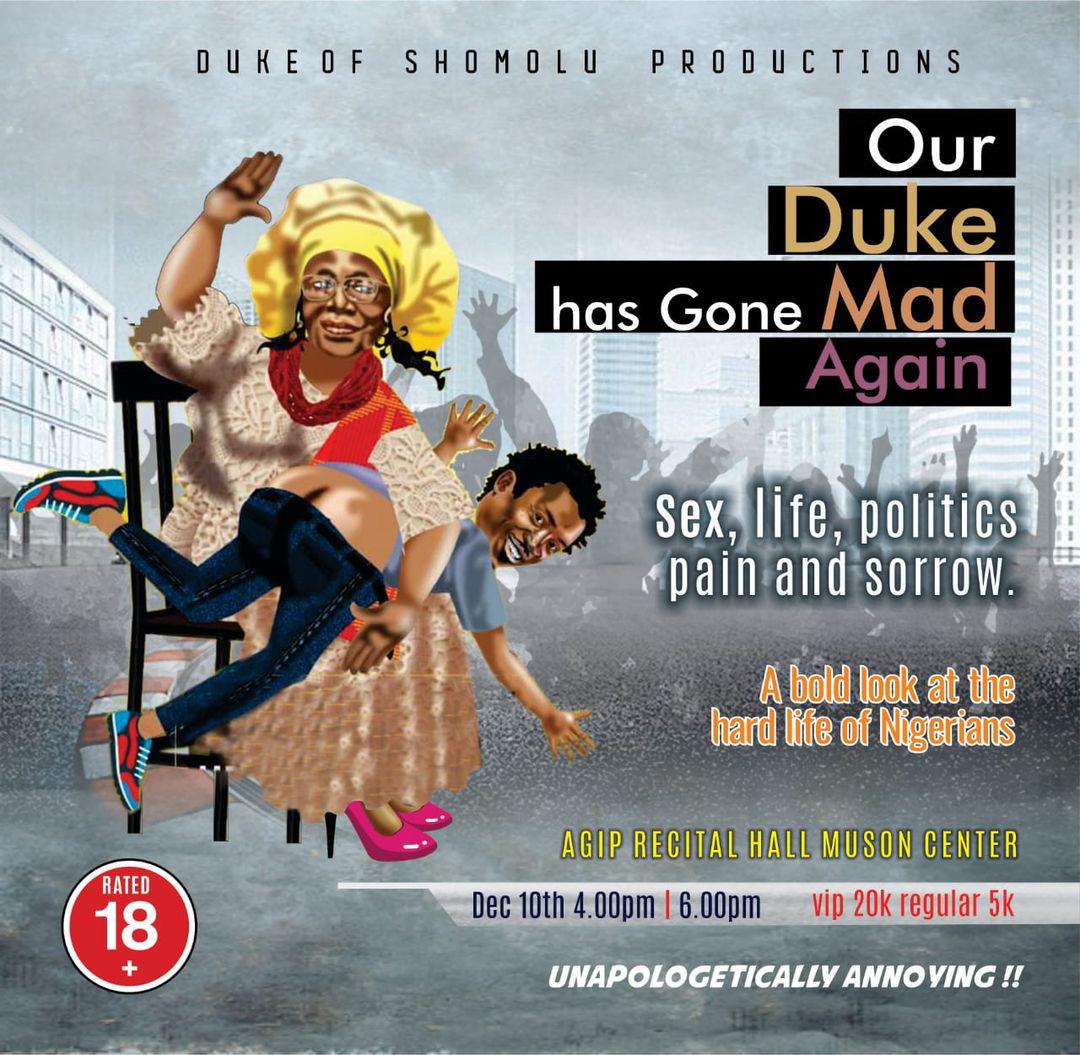
Tears as “Our Duke has gone mad again” depicts Nigerian society

 Quick Read
The play also talked about rape in marriage, a very sensitive topic that usually attracts endless debates.
By Aderonke Ojediran
The much-advertised and highly anticipated satirical play, “Our Duke has gone mad again”, lived up to its billing Saturday night leaving many in the Muson Centre, Lagos hall in anguish and tears.
The News Agency of Nigeria (NAN) reports that the play presented a moving satire that highlighted societal issues and the social contradictions within the Nigerian system.
Produced by Duke of Shomolu Productions, the play held the audience spellbound with various issues satirically brought to life.
The play, directed by Segun Adefila, Artistic Director of Crown Troupe of Africa, featured an eight-man cast of the Duke taking turns in monologues about issues that affect Nigerians.
The monologues emphasised the decadence in the society paying attention to Police brutality, corruption and the high rate of prostitution among women, married women inclusive.
It also looked at how traditional roadside prostitution had been displaced with a much more open trade of womanhood.
The play also talked about rape in marriage, a very sensitive topic that usually attracts endless debates.
It also highlighted the mid-life crisis in men, the struggle of middle-aged men and the hypocrisy usually associated with it.
It also captured how society constantly tells men to “man up” and not show emotions while contrasting it with the proverbial “Na-woman, leave-am” which is dismissive of men’s emotions.
Some of the issues that often trend on social media also caught the attention of the play.
One such trending issue is Charles Oputa, popularly known as Charly Boy’s recent declaration that his male organ was no longer functioning.
The play also touched on religion and its place in Nigerian society.
It looked at religion and how praise and worship keep evolving in different Churches.
A tribute to the late Gospel musician, Sammy Okposo, was also injected into the play.
A spectator, Mrs Josephine Igberaesin, told NAN that the scene that got her thinking was how women had become objects to the highest bidder.
“The scene that got to me the most is the scene where they talked about the girls; the virtue that is lost.
“I am from a different generation so that resonates with me.
“I felt sad when I heard that girls have a price tag. They do these things mostly because of peer pressure.
“Parents need to be less judgmental, counsel more and pray more.
“The stage play is a commentary on our lives in general; no matter how much you laugh at some interpretations, you’d still ponder on the salient issues,” she said.
Mrs Foluke Edgar, the Managing Director of Shomolu Productions, told NAN that the play’s intent was not to portray any gender or profession in a bad light.
“The play encourages people to respect people irrespective of their offices.
“The play is about life generally. It seeks to look at how life is, in the eyes of the child, mother and the Duke himself.
“It looks at how some of the Duke’s views are right while some are not; it also looks at how women are very complex beings.
“We have different views on the issue of women’s complexity.
“There’s so much pain in a woman’s life, some of us conceal it very well, while some can’t.
“Society focuses on training the girl-child ignoring the boy-child and the circle keeps going on and on.
“Some of us won’t agree with some of the issues raised, but it is true that women need to do more and stand firm for what they believe in; women should stop being indecisive.
“Oftentimes, they don’t know what they want; we need to be more straightforward.
“Another issue is the place of teaching our children our native dialect. This is crucial. That’s why our culture is dying.
“My children understand Yoruba very well, it’s not a thing of pride, look at the Hausa people. They speak their language from the cradle and the young ones pick up and they still learn English, we need to get it right,” she said.
When NAN asked the director, Adefila, which of the scenes resonated with him the most, he said that picking a particular scene would be impossible.
He said the quest for financial gain by both women is a two-way thing.
“If men maintained their grounds and stay committed to their vows, prostitution, under any guise, won’t thrive.
“It’s like asking a mother which of her children is her favourite; I like all the stories. They were selected from a bunch of rants written by Joseph Edgar, the Duke himself.
“The highlight on the rise in sexual immorality is a two-way thing – the society usually turns on the women to label them, forgetting that it’s not complete without dragging the solicitor (men) in most cases.
“The story has a balance, highlighting the strength of a woman; it is not to castigate a gender.
“There was a part where all men were asked to zip up, but they ran out of the stage.
“If there’s no demand, there can’t be supply,” he said.
Other issues of special significance to members of the audience included the “happy ending” trend and the struggles of new parents, overzealous grandparents and aunts.
Other plays to be staged this month in Lagos include a rehash of “Ufok Ibaan” which was first staged at the Ibom Hall in Uyo.
Ufok Ibaan, which depicts the Ikot Abasi women’s riots, will have Sen. Udoma Udo Udoma, whose grandmother is depicted, and Chief Emeka Anyaoku, as Special Guests of Honour.
Another play is “Awo” which will be staged on Dec. 17 and Dec. 18.
It depicts the life of Chief Obafemi Awolowo, the late Premier of the defunct Western Region.
(NAN)
Comments