


How Oyindamola Abdulkadir’s Art Honors Yoruba Women Through Clay and Aso Oke

 Quick Read
Oyindamola sources much of her aso oke from her grandmother. Every strip carries stories of weddings, naming ceremonies, and festivals moments woven into Nigeria’s collective memory.
By Taiwo Okanlawon
Oyindamola Abdulkadir’s sculptural work is an essential contemporary document that successfully translates the historical role of Yoruba women into a globally resonant aesthetic framework.
Her practice is built on a direct, intellectual engagement with material history, specifically addressing how memory and resilience are preserved not in abstract archives, but within the physical, domestic sphere.
By deliberately uniting the permanence of fired clay with the intimacy of ancestral )àṣọ òkè) hand-woven cloth, Abdulkadir has forged a distinct visual language that demands international critical attention.
The Feminine as Foundational Form
The artist’s recurring formal motif the sculpted vessel is a powerful statement. These forms are purposefully designed to evoke the feminine: they are containers, carriers, and figures of nourishment. This is not simply symbolic; it is a structural argument asserting that the continuity of Yoruba culture flows through the hands and actions of women.
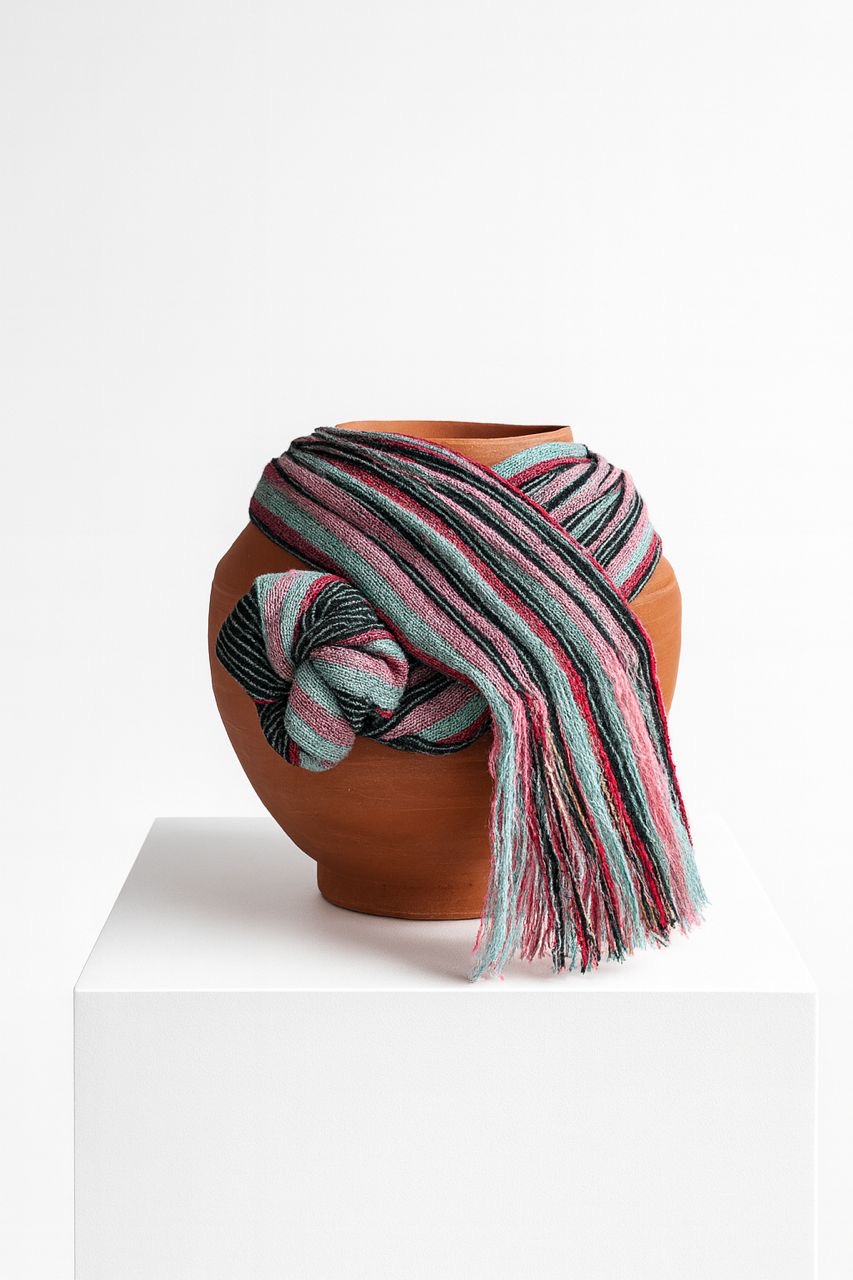
Abdulkadir reinforces this argument through her use of àṣọ òkè and clay vessels.
This is the work’s defining intellectual maneuver: she transforms the textile, which carries the history of weddings, naming ceremonies, and communal rites, into a literal component of the object’s survival. By binding the clay with àṣọ òkè, she is making visible the “invisible labour” of women who traditionally maintain and transmit culture. The resulting sculpture functions as a definitive memorial to this process, challenging art world notions that heritage exists outside of the domestic and the inherited.
Abdulkadir’s commitment to this specific cultural feminist perspective, expressed through technical innovation, establishes her work as exceptional. While many contemporary artists engage with textile, few have achieved such a complete, structural integration where the soft material directly references intergenerational memory and female agency.
This high level of conceptual and material control has earned her significant recognition. Successful exhibitions in Ilorin attest to the national prominence of her practice. Her works are not sentimental; they are powerful, articulated arguments that ensure the memory upheld by women is now central to the future of global contemporary sculpture.
Comments