


No man’s land: Popular Lagos family charges LASG to sponsor documentation of Lagos history

By Kazeem Ugbodaga
Members of the popular Finnih family of Lagos on Tuesday charged the Lagos State Government to sponsor the documentation of Lagos history to puncture claims by some people that the state is “No man’s land.”
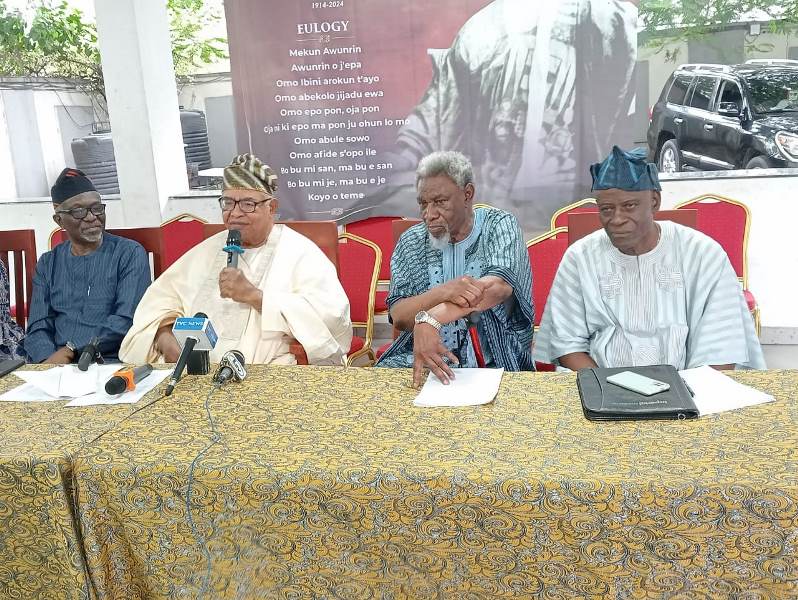
Members of the family gave this charge at a news conference to announce the planned launch of a book to commemorate the life and time of their great grandfather and first Otun Balogun of Lagos Central Mosque, Alhaji Buraimoh Afinni, 110 years after his demise.
The book launch is scheduled for 25 July and will capture the life and time of Afinni, who could be regarded as a billionaire during his time.
Chairman of the Organising Committee, Dr. Shola Labinjo, said there was need for the government of Lagos State to sponsor the archiving of the history of Lagos State to puncture claims that it is no man’s land.
“If we don’t know who we are, we are at the risk of extinction, if you go to Australia today, you don’t know who the Aborigines are. It is good to have Lagos history documented.
“If we do not have our history established, we will be found floating. Many say they are Lagosians but when they die they take them out, Lagos was a small place at that time and there were lots of inter-marriages, people from Lagos are holding the short end of the stick. There is a need to protect that and the Lagos State Government should be mindful of that fact and take practical steps to address that,” Labinjo said.
The publisher of the book to be unveiled on 25 July, Abiola Lateef Finnih said Lagos is no man’s land more so because those who made such claims were only familiar with the history of Lagos that dated more to the colonial period of Lagos.
“The Europeans who made inroads into Lagos gave regards to those who played hosts to them on arrival. It is more sensible to think of the history of any local from its inception where possible or to the farthest back one can go in learning facts about those occupying the place.
“So, it is with Lagos. The Europeans that predated the arrival of the British were not unaware of earlier occupants even when they were christening the place Lagos. What the Afinni family is doing today is a wake-up call for the true Lagosian to emulate so that we can have the complete history of Lagos from the true aborigines,” he said.
Lateef said true Lagosian had their roots planted over two hundred years ago, saying they predated the arrival of the Europeans, the return of the slaves from Brazil and Sierra Leone.
“We have some semblance of true Lagos history in the stories of the “idejo” and other white cap chiefs. But most of these concern internecine struggles and rivalries between them as to who should or should not rule. Our history resides in every family who have planted their roots in Lagos.
“It becomes incumbent that the trail we are blazing today will ignite blazes in other family like us to also document their family history before it is too late. Governor Jakande saw the value in establishing the history of Lagos aborigines when he ordered their homes returned to them and halted the redevelopment of central Lagos that would have uprooted the old Lagosians and their ancestral history.
“Our family could have been caught in this quagmire. Substantive facts are still with some older family members and should be committed to writing for the benefit not only of the coming generations but as a piece of the puzzle telling the story of Lagos and how it emerged not as no man’s land but a tolerant and accommodating place,” he stated.
Lateef added: “Not to digress too much, we wish the Lagos State Government will create avenue for families to tell their stories and archive it as a piece of Lagos history from its aborigines. Agreed that everybody comes from somewhere else, but a place still belongs to those who have occupied it longest. Lagos belongs to those who had forsaken their origin and fully transplanted to Lagos.
“Their children were born here as each generation succeed another. Most importantly, their departed family claimed their last stance in Lagos in the cemeteries where you can easily assemble those who are true Lagosians. Whether they are Aworis, the Agudas, Tapas, Benin, etc, they belong nowhere except Lagos.”
Eulogising Buraimoh Afinni, Lateef said he played substantive role in Central Lagos, especially among his Muslim compatriots, saying his was a life well spent and much fulfilled, as he was able to journey to England, France and Germany, a herculean feat at the turn of twentieth century.
“His business of timber and produce made him one of the richest in his era. Along with his friend, Alli Balogun, they indulged in healthy competition with their wealth and were philanthropic as well. The were two pairs among other substantive and rich Muslims like Shitta, Animashawun, Oki, Jenmi and others of green memories. They gave stature and respect to the religion and they exemplified what true Muslims should be,” he added.
Dr. Abayomi Finnih, the eldest of the family, who addressed the news conference said Buraimoh Afinni was a colossus, saying that part of the programme to commemorate 110 years of his death was to launch a book detailing lots of stories about him.
“It is a story that transcended lots of decades. We have lots of stories to tell about him. The question is why have we waited 110 years to tell the world about him? It took 100 years after he has passed on for his grandchildren to research about him.
“He came to Lagos from Benin, he had his wives, trade and lots of friends. He was very deep in Islamic religion. When the Lagos central mosque was being designed and constructed, he was one of the few people who contributed to the design of the mosque. He was a friendly man. He had seven wives and had 17 children,” Finnih said.
Finnih added that “he worked very hard and travelled far and wide, he was into plastic trading, transportation, believe me, the author of the book will say more about that. With this businesses, he had to travel round the whole world.”
He said event lined up for the 110th commemoration of Afinni’s death included Jumat service at the Central Mosque on 19 July, while on the 23rd of July, the day he died, would be used to visit his graveside where prayers would be offered.
Finnih stated that this would be followed by the book launch on 25 July, where eminent personalities were being expected to grace the occasion.
Comments