BREAKING: U.S. Embassy cancels all visa appointments in Abuja

Follow Us: Facebook Twitter Instagram YouTube
LATEST SCORES:
Loading live scores...
News

Five times Nigeria crackdown on homosexuality

Quick Read

The Nigerian government’s crackdown on homosexuality—most notably solidified by the 2014 Same Sex Marriage (Prohibition) Act (SSMPA) shows a pattern shaped by law, culture, religion, and politics.

By Ruth Chinonye

Nigeria is one of the countries in Africa where homosexuality has been strongly opposed by both law and society. Many Nigerians believe that same-sex relationships go against their religious beliefs, cultural traditions, and moral values. Because of this, the Nigerian government has created strict laws to punish homosexual acts and activities connected with LGBTQ+ groups.

The most important law is the Same-Sex Marriage Prohibition Act signed in 2014 by former President Goodluck Jonathan. This law makes same-sex marriage illegal and also punishes people who belong to gay organizations or show same-sex affection in public. Offenders can face up to 14 years in prison, while supporting gay groups can bring up to 10 years jail term.

Since this law came into force, many police raids, arrests, and court cases have happened across different states in Nigeria. Some of these incidents attracted international attention and criticism from human rights groups, while others reflected strong public support for anti-gay enforcement in the country.

This article discusses five times Nigeria cracked down on homosexuality, explaining what happened, where it happened, and why it mattered.

August 28th, 2023: Gay Party Arrest in Warri, Delta State

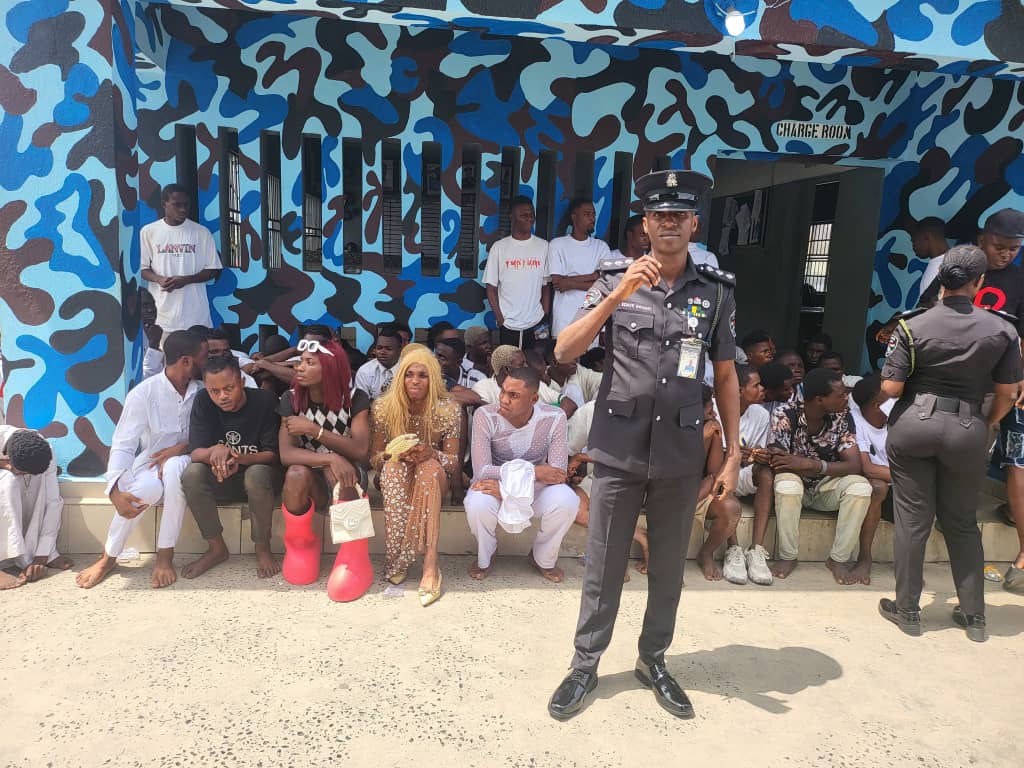
On August 28, 2023, Nigerian police in Delta State conducted a major raid on an alleged gay wedding ceremony, leading to the arrest of over 60 people. The incident took place at a hotel located off Refinery Road in Ekpan, a town near Warri.

Key Details of the Event and Arrests are as follows:

i. The raid: Acting on intelligence, police stormed Teebilos hotel around 2 a.m. on August 28,2023 where over 200 people were initially arrested but eye witness report has it that up to 500 party goers were at the venue that night.
ii. The raid after the raid: Following surveillance in an around the Warri town, Nigeria Police tactical team conducted spontaneous raid around hotel in close proximity to Teebilos that hosted the gay party and more arrest were made, during investigation some individuals were implicated and declared wanted.
iii. Arrests: Initially, about 200 people were reported to be at the scene, but 67 individuals (variously reported as 67 or 69) were officially detained and later paraded before the media.
iv. The Occasion: The attendees were reportedly celebrating a gay marriage ceremony involving a male “bride” and “groom”.
v. Suspects: The suspects included individuals dressed in white and female attire. Some suspects during the parade told journalists they were models and fashion designers, not gay.
vi. Legal Standing: In Nigeria, same-sex marriage is prohibited under the Same-Sex Marriage (Prohibition) Act of 2014, with penalties of up to 14 years in prison.

The raid was part of a larger crackdown on LGBTQ+ individuals in the region, drawing criticism from human rights groups like Amnesty International Nigeria, which called for an end to the persecution. Following the incident, the police arraigned 60 people while other who are heavily connected to organizing the gay wedding or involved in a way are declared wanted, the suspect were reminded in prison by Delta State High Court while only few were able to meet the stringent bail condition set by the court.

October 2023, Same Sex Wedding and Party Arrest in Gombe State.

In October 2023, the Nigeria Security and Civil Defence Corps (NSCDC) arrested 76 people in Gombe State, Northeast Nigeria, on allegations of participating in a same-sex wedding and party. The raid, which occurred on October 21, 2023, is part of a series of crackdowns on the LGBTQ+ community in Nigeria.

Key Details of the Incident are as follows:

i. Arrests: The NSCDC arrested 59 men and 17 women at a “relaxation spot” in the Gombemetropolis.
ii. Allegations: Authorities claimed the group was holding a birthday party that was a front for a same-sex wedding.
iii. Confessions: Buhari Saad, the NSCDC spokesman for Gombe State, stated that 21 of the arrested men “willfully” confessed to being gay.
iv. Legal Context: In Nigeria, same-sex marriage is prohibited under a 2014 law, punishable by up to 14 years in prison. Gombe State also operates under Sharia law, where homosexual relations are technically punishable by death, though this has never been applied in Northern Nigeria.

December 2022, same-sex Wedding Ceremony Arrest in Kano State.

In December 2022, the Kano State Hisbah Board (Islamic police) raided an alleged same-sex wedding ceremony in Kano city, resulting in the arrest of 19 individuals. The incident took place around December 19-20, 2022, in a popular event center in the city.

Key Details of the Incident are as follows:

i. Arrests: Hisbah personnel apprehended 19 individuals—15 females and 4 males, who had gathered for the event. A 21-year-old female organizer, Salma Usman, was among those arrested. The raid was conducted based on “intelligent information” regarding the illegal ceremony.
ii. Targets: The wedding was reportedly for two men, identified as Abba and Mujahid, who were alleged to be entering into a same-sex marriage. While the guests were detained, the targeted couple (Abba and Mujahid) managed to escape the scene.
iii. Outcome: The arrested individuals were, according to reports, not immediately charged in a formal court but were instead undergoing “counselling with their parents or guardians involved, as the Hisbah sought to have them change their lifestyle.
iv. Legal Standing: Same-sex marriage and homosexual acts are illegal in Nigeria, with federal law prescribing up to 14 years in prison. In Kano State, which operates under Sharia law, such acts can technically be punished by death, although this has never been applied.

April 2017, same-sex wedding arrest in Kaduna State

In April 2017, Nigerian police in Kaduna State arrested 53 people for allegedly attending a same-sex wedding ceremony at the Zaria Motel in the city of Zaria. The event was alleged by police to be a marriage ceremony for two men, identified as Faruk and Sanusi, who were not among those initially detained.

Key Details of the Incident are as follows:

i. Arrest Date: The raid took place on Saturday, April 15, 2017.
ii. Charges: The suspects were charged with conspiracy, unlawful assembly, and belonging to an unlawful society, which violated Nigeria’s 2014 Same Sex Marriage Prohibition Act.
iii. Bail and Trial: The suspects, many of whom were described as young students, pleaded not guilty and were initially granted bail of 500,000 naira each with blood-relation sureties.
iv. Controversy: Human rights advocates and lawyers for the accused stated that the event was actually a birthday party, not a wedding, and that the charges were fabricated by police for extortion.
v. Subsequent Legal Proceedings: By early June 2017, reports indicated that many of the suspectshad jumped bail, leading the court to issue bench warrants and order separate trials for those who appeared.

Under Nigeria’s 2014 Same Sex Marriage Prohibition Act, conducting or attending a same-sex wedding can lead to up to 14 years in prison.

December 2019, Trial of 47 Men Arrested for Homosexuality in Egbeda, Lagos State.

In December 2019, a Federal High Court in Lagos began the trial of 47 men arrested for alleged homosexuality, marking a significant, attempt by Nigerian authorities to prosecute individuals under the Same Sex Marriage (Prohibition) Act of 2013. The case stemmed from a 2018 police raid on a hotel in the Egbeda area of Lagos.

Key Details of the Case are as follows:

i. The Incident: In August 2018, police arrested 57 people at Kelly Hotel in Lagos, accusing them of performing “gay initiation rites” and engaging in “public show of same-sex relationship,” which is forbidden under Nigerian law.
ii. The Trial (Dec 2019): In late November and December 2019, 47 of these men were formally arraigned, with many pleading not guilty and stating they were merely attending a birthday party.
iii. Charges: The men were charged with “engaging in a public show of same-sex amorous relationship with each other in hidden places”.
iv. Bail: In late November 2019, Justice Rilwan Aikawa granted each of the 47 defendants bail in the sum of ₦500,000, with two sureties required, one of whom had to be a civil servant of grade level 10 or above.
v. Impact on Defendants: The defendants reported being stigmatized, disowned by families, and losing employment after the police paraded them on television.
vi. Case Dismissal (2020): The trial faced multiple delays due to the failure of prosecution witnesses to appear. In October 2020, Justice Rilwan Aikawa struck out the case due to a “lack of diligent prosecution”.
vii. Significance: This was widely viewed as a test case for the 2014 anti-gay law, which had previously been used more for harassment and extortion than for successful convictions in court.

Although the case was struck out, it highlighted the ongoing, severe legal challenges facing the LGBTQ+ community in Nigeria, where same-sex relationships are punishable by up to 14 years in prison.

CONCLUSION

The Nigerian government’s crackdown on homosexuality—most notably solidified by the 2014 Same Sex Marriage (Prohibition) Act (SSMPA) shows a pattern shaped by law, culture, religion, and politics.

The five episodes highlighted in this article demonstrate how enforcement has evolved while maintaining the same underlying legal framework.

These crackdowns reveal not only the functioning of Nigeria’s criminal justice system but also the powerful role of social norms in shaping law enforcement priorities. Whether viewed as protection of cultural values or as violation of civil liberties, Nigeria’s approach remains one of the most stringent in the world, ensuring that the debate over homosexuality in the country will continue for years to come.

Comments

×