


Inside Tinubu’s high-stakes N54.77trn budget signing: What it means for Nigerians

 Quick Read
Increased allocations for agriculture and food security, he noted, would boost local food production and ensure no Nigerian goes hungry. Additionally, enhanced funding for social welfare aims to support youths, women, and vulnerable citizens.
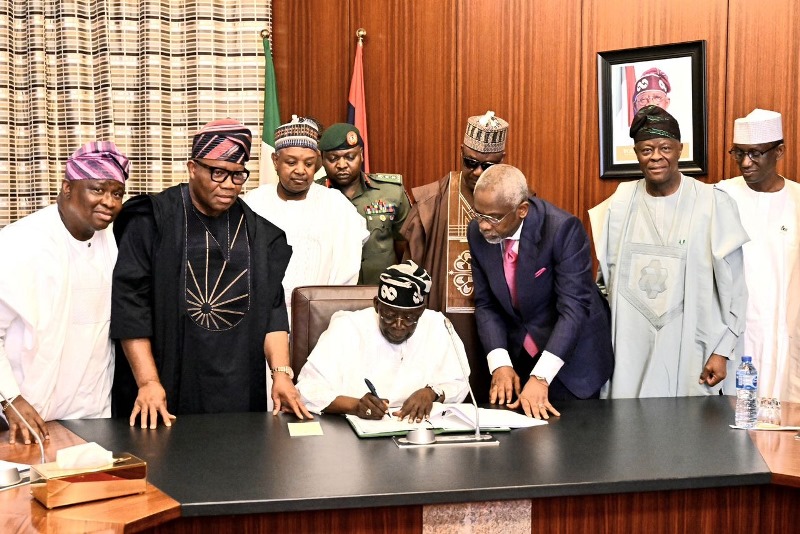
President Bola Tinubu has assured Nigerians of an improved economy as he signed the historic N54.99 trillion “2025 Budget of Restoration” into law on Friday in Abuja.
He emphasised that disciplined focus and diligence would guide its implementation.
The budget, based on projected revenues, marks another step towards economic recovery and stability, the President stated.
Senate President Godswill Akpabio, Speaker of the House of Representatives Tajudeen Abbas, and Senate Committee Chairman on Appropriation Sen. Solomon Adeola were present at the signing ceremony.
“Today, we take another bold step in our nation’s journey of economic recovery, stability, and growth with the signing of the 2025 Budget of Restoration. We reaffirm our commitment to securing our future, rebuilding prosperity, and ensuring that every Nigerian shares in the dividends of governance.
“The past year tested our resolve. But through economic discipline and strategic reforms, we achieved what many deemed impossible. After the initial turbulent take-off, our people can see signs of progress and the promise of a better future. Our economy is turning the corner,” President Tinubu said.
He noted that economic uncertainty was gradually clearing as reforms took shape, leading to a national GDP growth of 3.86% in the last quarter of 2024—the fastest in three years.
“Revenue increased to N21.6 trillion from N12.37 trillion, reflecting our drive for fiscal efficiency, and the deficit reduced significantly—from 6.2% in 2023 to 4.17% in 2025.
“Forex reforms restored investor confidence, stabilising our markets. The minimum wage was raised to ₦70,000, strengthening the purchasing power of workers, and infrastructure development advanced rapidly, with transformative projects such as the 750km Lagos-Calabar Coastal Highway and the 1,068km Sokoto-Badagry Superhighway,” he added.
President Tinubu expressed gratitude to the National Assembly for its collaboration in ensuring the swift passage of the appropriation bill.
“We have no dust on our faces or tears in our eyes. We walked together as brothers and sisters. Though the initial outlook was turbulent, we can now see signs of progress,” he stated, urging lawmakers to extend the same support for the budget’s implementation.
He outlined key priority areas, including national security, infrastructure, energy, human capital development, healthcare, education, and skills development.
Increased allocations for agriculture and food security, he noted, would boost local food production and ensure no Nigerian goes hungry. Additionally, enhanced funding for social welfare aims to support youths, women, and vulnerable citizens.
“This budget is bold, ambitious, and necessary. However, let me be clear: We cannot spend what we do not have.
“While we have significantly reduced the deficit, we must ensure that we back every naira spent with actual revenue. We will not burden future generations with reckless borrowing. Instead, we will expand government revenues through efficiency reforms and enhanced earnings; accelerate public-private partnerships and foreign investments to finance key projects,” he said.
President Tinubu emphasised that every government agency would be held accountable for prudent spending and value-for-money initiatives.
“To ensure smooth budget implementation, we will work with the National Assembly to redefine corrigenda within the Appropriations Act.
“The redefinition will establish clear triggers for amendments, balancing executive needs with legislative oversight. A budget is not just numbers—it is a promise, and we must honour it with discipline,” he added.
Senate President Akpabio assured President Tinubu of the National Assembly’s full support in implementing the budget. He acknowledged that Tinubu inherited a “foaming economy” that required urgent economic measures for recovery.
Akpabio further credited Tinubu’s experience in Lagos and his ability to manage resources for the economic turnaround and ongoing reforms.
The Minister of Finance and Coordinating Minister of the Economy, Wale Edun, highlighted the budget process as a collaborative effort involving consultation, negotiation, and analysis.
“The National Assembly has all along been partners in progress with you, Mr President,” he stated.
Comments