



Lagos declares war on Malaria with digital innovation

 Quick Read
Additionally, he said digital diagnostic tools would be widely adopted to ensure precision in malaria testing. The Commissioner emphasized that many patients in Lagos receive anti-malarial medication without proper testing, leading to misdiagnosis and inappropriate treatment.
In a decisive step towards eradicating malaria, the Lagos State Government has unveiled the Pathway to Malaria Pre-Elimination & Digitization Programme—a groundbreaking initiative leveraging digital technology, robust case management, and enhanced collaboration between the public and private sectors to accelerate malaria elimination efforts.
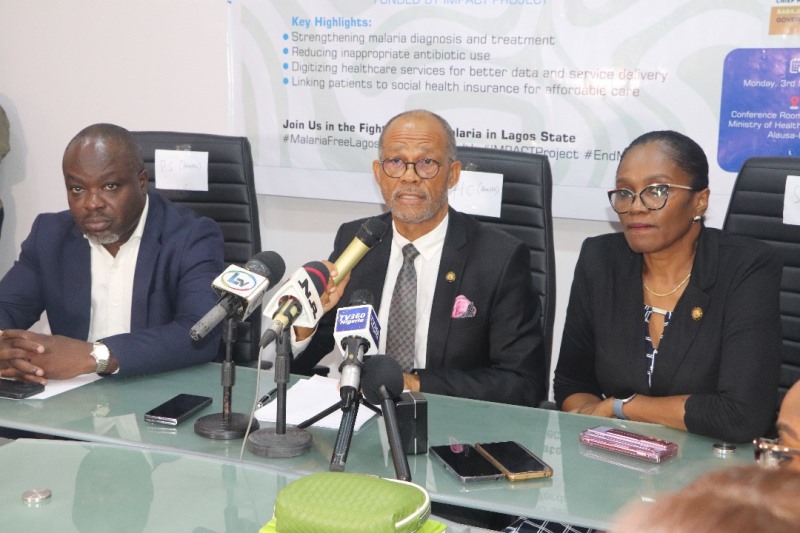
Speaking at a press briefing held at the Lagos State Ministry of Health in Alausa on Monday, the Commissioner for Health, Prof. Akin Abayomi, underscored the importance of this initiative in achieving a malaria prevalence rate of below 1%, marking a significant advancement in the state’s fight against the disease.
“Lagos is already leading with a malaria prevalence of under 3%, well below the national average. With this initiative, we are taking bold strides to eradicate malaria completely. Our approach prioritizes scientific, digital, and data-driven strategies to ensure accurate diagnosis and treatment of febrile illnesses,” Abayomi stated.
Despite Lagos having one of the lowest malaria prevalence rates in Nigeria, the state still records approximately 900,000 malaria cases annually. Misdiagnosis remains a challenge, with over 50% of general outpatient visits in public health facilities attributed to fever-related illnesses presumed to be malaria.
The economic impact of malaria is substantial, leading to absenteeism from work and school, reduced productivity, and increased household healthcare expenditures.
“Malaria is not just a health concern; it is an economic and social burden. The cost of treatment, coupled with indirect losses in productivity, amounts to billions of naira annually. A malaria-free Lagos is a healthier, wealthier Lagos,” Abayomi noted.
Abayomi said at the heart of the programme is the integration of digital health solutions to enhance malaria surveillance and case management.
He explained that through a collaboration with Maisha Meds, a leading digital health platform, Lagos would deploy real-time electronic malaria reporting systems across both public and private healthcare facilities to improve data accuracy and response time.
Additionally, he said digital diagnostic tools would be widely adopted to ensure precision in malaria testing. The Commissioner emphasized that many patients in Lagos receive anti-malarial medication without proper testing, leading to misdiagnosis and inappropriate treatment.
To address misdiagnosis, the state government has introduced a compulsory rapid diagnostic testing (RDT) policy before any malaria treatment is administered.
“With this initiative, only confirmed malaria cases will receive anti-malarial treatment. This not only enhances treatment accuracy but also mitigates the overuse of antibiotics, which contributes to widespread drug resistance,” Abayomi explained.
Recognizing that a large portion of malaria cases are treated outside government hospitals, the new programme will integrate community pharmacies, patent medicine vendors, and private hospitals into Lagos State’s malaria control framework.
The government is working closely with the Pharmacy Council of Nigeria (PCN) and the National Malaria Elimination Program (NMEP) to establish standardized treatment protocols across all healthcare providers.
“Whether a patient visits a public hospital, a private clinic, or a community pharmacy, they will receive the same high-quality malaria diagnosis and treatment based on the state’s standardized guidelines,” Abayomi affirmed.
He further explained that a key objective of the initiative is to change public attitudes towards fever and malaria diagnosis, saying that many Lagos residents self-diagnose malaria and purchase anti-malarial drugs without testing.
Moving forward, Abayomi said the state government is insisting that every fever must be properly diagnosed before any malaria treatment is administered.
“Not every fever is malaria. Many fevers are due to bacterial or viral infections that require different treatments. This initiative aims to discourage self-medication and promote responsible healthcare-seeking behavior,” the Commissioner stated.
To make malaria treatment more accessible and affordable, he said the Lagos State Government is incorporating malaria care into its health insurance scheme, Ilera Eko.
This means that registered enrollees can access malaria tests and treatment at little or no cost, reducing the financial burden on families and promoting early diagnosis and treatment.
Abayomi added that the government’s overarching goal is to reduce malaria prevalence in Lagos to less than 1% by implementing a three-pronged intervention strategy: scaling up effective case management, enhancing disease surveillance and community engagement and prevention
The Pathway to Malaria Pre-Elimination & Digitization Program will be officially launched on March 4, 2025, at Eko Hotel, Lagos.
The event will be graced by the Governor of Lagos State, Mr. Babajide Sanwo-Olu, alongside key stakeholders, including the Honourable Minister of Health, Prof. Muhammad Ali Pate, and representatives from the World Health Organization (WHO), World Bank, and the National Malaria Elimination Program (NMEP).
Abayomi urged all residents, healthcare providers, and stakeholders to actively support and participate in the program, stressing that malaria elimination requires a collective effort.
“We need the public to embrace a test-before-treatment culture. We need healthcare providers to adhere to best practices. Communities must take ownership of malaria prevention. Together, we can achieve a malaria-free Lagos,” he stated.
Reinforcing this message, Dr. Kemi Ogunyemi, Special Adviser to the Governor on Health, emphasized the need to transform public attitudes towards fever management and malaria treatment.
“This initiative is about changing behaviors. The days of self-diagnosing and assuming ‘I have malaria’ are over. Every fever must be tested first, and only confirmed cases should be treated for malaria,” she declared.
Ogunyemi also stressed the critical role of pharmacies and medicine vendors in ensuring compliance with the new malaria testing protocols. She called on them to align with the government’s efforts to standardize malaria case management.
“Pharmacies and medicine vendors play a key role in treatment access. They must ensure that the first step for any fever is a test—not just selling anti-malarial drugs,” she added.
Comments