


Inside Tinubu’s talks with Brazilian leader in Rio

 Quick Read
On livestock development, Tinubu highlighted government initiatives in poultry farming, cattle rearing, fisheries, and marine resources. He called for intensified partnerships between sub-national governments and the federal administration to strengthen rural economies and address unemployment.
By Kazeem Ugbodaga
President Bola Tinubu has vowed to dismantle all bureaucratic and structural obstacles hindering Nigeria’s agricultural transformation, declaring that the country is ready to unlock its full food production potential and reclaim food sovereignty.
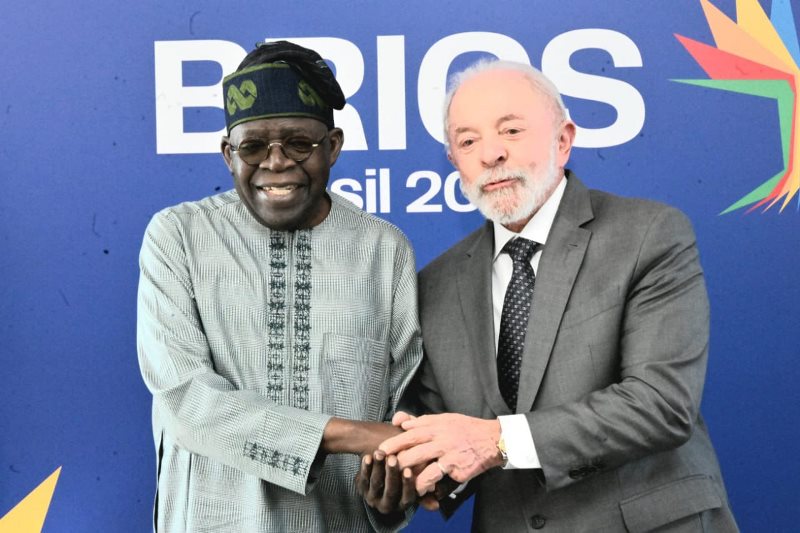
Speaking during a high-level bilateral meeting with Brazilian President Luiz Inácio Lula da Silva at Copacabana Forte, Rio de Janeiro, President Tinubu outlined a bold vision to reposition Nigeria’s agricultural sector through targeted reforms and global partnerships.
“Bureaucracy has slowed us down for too long,” Tinubu told the Brazilian delegation.
“But we are now breaking down those barriers to realise the full promise of agriculture, particularly in livestock production, food security, and export readiness.”
The Nigerian leader, who was accompanied by key cabinet members and five state governors, noted that his administration is actively streamlining technicalities in trade, aviation, energy transition, and natural resource management—particularly with trusted partners like Brazil.
He commended Brazil’s global leadership in food production and research, stressing that Nigeria seeks to learn from its successes to boost domestic output, develop its blue economy, and create sustainable jobs across the country.
On livestock development, Tinubu highlighted government initiatives in poultry farming, cattle rearing, fisheries, and marine resources. He called for intensified partnerships between sub-national governments and the federal administration to strengthen rural economies and address unemployment.
“Nigeria is ready for a strong partnership,” Tinubu said. “We want immediate action—not just dialogue—on collaboration to increase food production.”
Responding, President Lula promised to regularise all pending agreements and accelerate the signing of updated Memoranda of Understanding (MoUs) during Tinubu’s next visit.
He acknowledged that bureaucratic delays between both countries must be eliminated and pledged that Brazil’s renowned agricultural research institutions would support Nigeria in developing its livestock sector.
“We are ready to work with you. Our research institutions will collaborate on animal health, genetic improvement, and disease management,” Lula assured.
Also present at the bilateral meeting were Nigeria’s Ministers of Agriculture, Livestock Development, and Foreign Affairs, as well as the Director-General of the National Intelligence Agency (NIA), Mohammed Mohammed.
Minister of Agriculture, Senator Abubakar Kyari, emphasised that Tinubu’s administration is deeply committed to food security, a goal that will be pursued through robust local and international partnerships.
He also noted Nigeria’s existing advantage in fertiliser production, which he said can be scaled up quickly to meet growing demands.
Minister of Livestock Development, Idi Mukhtar Maiha, outlined three key areas for collaboration with Brazil: disease control, sanitary systems, and genetic research into new livestock breeds.
State governors at the meeting, including Dapo Abiodun (Ogun), Hyacinth Alia (Benue), Mohammed Bago (Niger), Sheriff Oborevwori (Delta), and Babajide Sanwo-Olu (Lagos), also expressed support for the federal government’s drive to revitalise the sector.
Governor Abiodun welcomed the inclusion of a business forum during Tinubu’s state visit, noting it would generate fresh investment ideas and energise Nigeria’s agricultural revival.
“We are aligned with the President’s vision. Subnationals will support this framework fully,” Abiodun affirmed.
The bilateral meeting marks a significant step toward deepening Nigeria-Brazil relations in food security, agriculture, and livestock development, with both nations agreeing on the urgency of turning commitments into immediate action.
Comments