


NASS to transmit Constitution Review Report to State Assemblies before December 2025

 Quick Read
Bamidele stressed that the elaborate consultative process, such as the current public hearing, was designed to ensure that the Constitution is not amended arbitrarily.
By Kazeem Ugbodaga
The National Assembly has assured Nigerians that the ongoing constitutional amendment process will yield meaningful results, contrary to widespread doubts about the effectiveness of past efforts.
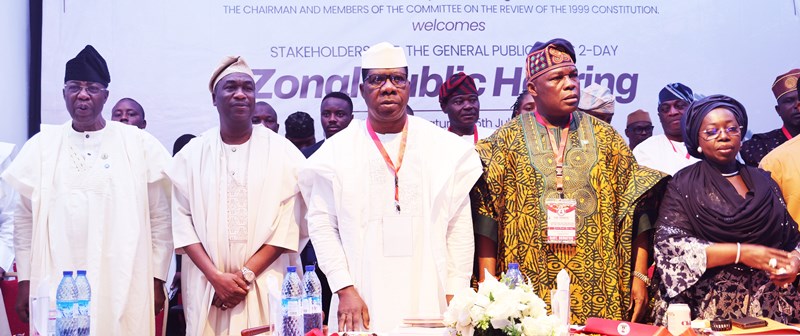
Speaking at the zonal public hearing held at the WaterCrest Hotel in Ikeja, Lagos, on Saturday, Senate Leader and Vice Chairman of the National Assembly Committee on the Review of the 1999 Constitution, Senator Opeyemi Bamidele, said the belief that previous constitutional reviews had yielded no results was not supported by facts.
“I do not agree that nothing has come out of previous amendments,” Bamidele stated firmly.
“Every session of the National Assembly has carried out amendments to our Constitution. That is why we now have the First, Second, Third, Fourth, and Fifth Amendments. When we talk about the 1999 Constitution (as amended), it means we are no longer operating the original document in its entirety,” he added.
He pointed to landmark changes made during the Ninth National Assembly, particularly in devolving power from the federal government to the states.
“For instance, four years ago, we succeeded in moving several items from the Exclusive Legislative List to the Concurrent List. This means state governments can now legislate on those matters. That’s a major step in the area of devolution of powers,” he explained.
The Senate Leader also highlighted improvements in Nigeria’s electoral processes, crediting constitutional reforms for recent progress.
“Thanks to electoral reforms, Nigerians’ votes are beginning to count. This is another phase in our effort to improve our democracy and strengthen our Constitution,” he said.
Bamidele stressed that the elaborate consultative process, such as the current public hearing, was designed to ensure that the Constitution is not amended arbitrarily.
“Our founding fathers and those who wrote the Constitution made it deliberately difficult for anyone or any group to wake up and change it at will,” he said.
“Even after we vote in Abuja, we still need approval from at least two-thirds of the State Houses of Assembly. That way, it reflects a national consensus.”
Rebutting claims that the constitutional review is a political formality, Bamidele maintained: “It is not a jamboree. It is not just a routine. Something meaningful has always come out of it, and something meaningful will come out of this.”
The current round of review, he said, is focused on a wide range of critical national issues.
“We are addressing concerns raised by Nigerian women, youth, professional bodies, and other stakeholders who desire better governance. We have heard Nigerians loud and clear,” he said.
“Our task now is to go back to Abuja, compile our report, and complete the legislative process. Our State Houses of Assembly are also waiting for us to do the needful.”
He added that the timetable for the review includes submitting proposals to state legislatures before the end of the year.
When asked about the readiness of the State Houses of Assembly, Bamidele expressed optimism, noting that their representatives had actively participated in the Lagos hearing.
“We’re not talking about strangers or outsiders. All six states in the Southwest geopolitical zone were represented here, led by their speakers. They made their presentations and are already anticipating the proposals,” he said.
To interest groups pushing for specific amendments, he advised: “Escalate your advocacy to the level of the State Houses of Assembly. This is not just about us as federal lawmakers—it’s also about the people who elected the state lawmakers. They must act in consonance with the wishes of their constituents.”
On the major demands presented during the public hearing, Bamidele said they include the creation of new states and local governments, gender inclusiveness, and recognition of traditional rulers.
“Our women representatives are very passionate about gender equality and the need to create special legislative seats for women at federal and state levels,” he stated.
“Traditional rulers also turned out in large numbers, demanding constitutional roles for traditional institutions. These are critical issues that cannot be ignored.”
He reaffirmed the National Assembly’s commitment to listening and acting on the people’s voices.
“We are here to serve the people. We have heard them, and we will act accordingly. This review will not be in vain.”
Comments