


NUPRC’s winning formula: Unlocking investment, powering upstream growth

 Quick Read
In line with Chapter 3 of the Petroleum Industry Act (PIA), which focuses on Host Community Development, the NUPRC has intensified the implementation of provisions designed to ensure community participation in the protection of oil assets.
By Ukpe Philip
Nigeria’s upstream oil sector is witnessing a dramatic turnaround, marked by rising crude output, a record surge in oil rigs, and billions of dollars in fresh investments. Experts attribute this resurgence to the Engr. Gbenga Komolafe – led Nigerian Upstream Petroleum Regulatory Commission’s (NUPRC) sweeping reforms, which they consider the game-changer driving this turnaround.
With production climbing above the OPEC quota and investor confidence rebounding, analysts say the Commission’s strategic blend of policy execution, regulatory enforcement, and host community engagement is finally delivering results.
Nigeria has consistently increased its oil production, reaching 1.51 million barrels per day (mbpd) and climbing to 1.7mbpd when condensates are included.
The country’s OPEC production quota is set at 1.5mbpd, but President Bola Tinubu’s ambitious N54.9 trillion 2025 budget is predicated on a higher benchmark of 2.06mbpd.
Crude oil revenues account for over 90 per cent of Nigeria’s foreign exchange earnings from exports, making the sector critical for funding infrastructure and poverty alleviation.
The Central Bank of Nigeria (CBN) is also targeting a reduction in inflation to single digit, a goal seen as achievable through a stable exchange rate driven by increased oil output.
As a result, the Komolafe-led Nigerian Upstream Petroleum Regulatory Commission (NUPRC) set itself a bold target: to boost crude oil production by an additional one million barrels per day to meet national budgetary projections and reposition Nigeria among top global oil producers, a mandate backed by Section 7 of the Petroleum Industry Act (PIA), 2021.
Another key objective of the NUPRC in the Regulatory Action Plan (RAP) is to increase the country’s crude oil and gas reserves, as stipulated in Section 7(i) of the PIA.
Experts say there are already clear signs that Nigeria is on track to return to its historic two million barrels per day output and is steadily advancing toward the 2.1mbpd target set for the 2025 budget.
Crude oil output data released by the NUPRC, covering June 2022 to June 2025, reveals a significant 42.45 per cent growth, from 1.06mbpd in June 2022 to 1.51mbpd in 2025, excluding condensates.
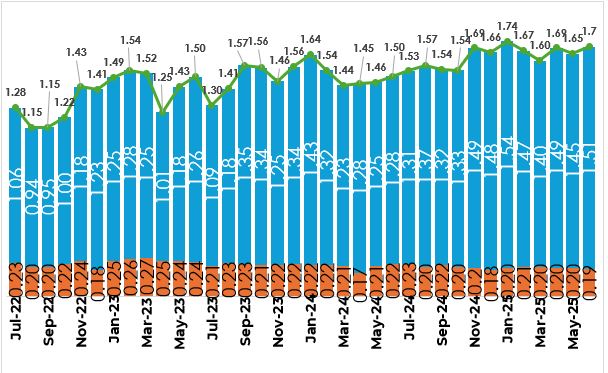
The data reveals that in December 2022, Nigeria’s average crude oil production stood at 1.23 million barrels per day (mbpd), and 1.41mbpd when condensates were included. By December 2023, production had risen by eight per cent to 1.34mbpd of crude and 1.56mbpd in total, including condensates.
In January 2024, crude oil output climbed further to 1.43mbpd, reaching 1.64mbpd with condensates. By December 2024, production had increased to 1.48mbpd, following the launch of the Nigerian Upstream Petroleum Regulatory Commission’s (NUPRC) flagship initiative, the Project One Million Barrels per Day (1MMBOPD).
By January 2025, regulatory efforts yielded stronger results as crude oil production rose above Nigeria’s OPEC quota, reaching 1.54mbpd of crude and 1.74mbpd including condensates — a milestone that placed the country firmly on a growth trajectory.
This momentum has been sustained, with output holding steady at 1.51mbpd of crude and 1.7mbpd including condensates. Nigeria now faces a production shortfall of just 400,000 barrels per day to meet the 2.06mbpd benchmark set in the 2025 national budget.
Nigeria’s crude oil and gas reserves have also recorded significant growth, reaching a historic high of 37.28 billion barrels of crude and 210.54 trillion cubic feet of gas as of January 2025.
“Crude Oil and Condensate reserves stand at 31.44 billion barrels and 5.84 billion barrels, respectively, amounting to a total of 37.28 billion barrels.
Associated Gas and Non-Associated Gas reserves stand at 101.03 Trillion Cubic Feet (TCF) and 109.51 TCF, respectively, resulting in total gas reserves of 210.54 TCF.
The Reserves Life Index is 64 years and 93 years for oil and gas, respectively.”
Beyond boosting reserves and output, the NUPRC is aggressively attracting investment into Nigeria’s oil and gas sector. In just one year, the country secured over $8bn for deepwater and gas projects, surpassing the $6.7bn initially projected for 2024.
Cumulatively, oil sector investment commitments have reached $16bn between 2023 and 2025.
To achieve this milestone, the NUPRC officially launched Project 1MMBOPD in October 2024, targeting the addition of one million barrels of crude oil per day to existing production levels.
At the launch, both local and international oil companies (IOCs) pledged their support for the Commission’s ambitious production goals. Financial institutions also declared their readiness to back the initiative.
In 2024 as part of its commitment to revenue growth, the Commission exceeded it revenue targets by over 84%.
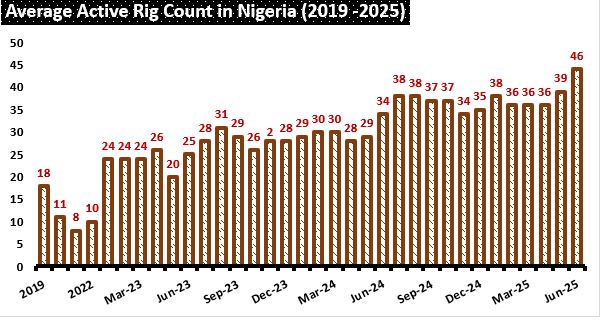
The NUPRC has driven rig count growth from just eight in 2022 to 46 as of July 2025. This surge has been attributed to improved investor confidence, strengthened regulatory oversight, and increased activity from Petroleum Prospecting Licence (PPL) awardees.
In addition, the Commission has prioritised community engagement — involving host communities in surveillance, monitoring, and alternative livelihood programmes as a means of curbing crude oil theft.
In line with Chapter 3 of the Petroleum Industry Act (PIA), which focuses on Host Community Development, the NUPRC has intensified the implementation of provisions designed to ensure community participation in the protection of oil assets.
For example, the Commission has facilitated the incorporation of 146 Host Community Development Trusts (HCDTs) with the Corporate Affairs Commission (CAC), with an additional 21 currently undergoing processing.
It also enabled the remittance of N97bn and $149m into the HCDTs’ fund accounts as of May 19, proceeds drawn from the three per cent of operators’ Operating Expenses (OPEX) mandated by the PIA.
To enhance hydrocarbon accountability, the Commission also initiated a Metering Audit and introduced an Advance Cargo Declaration system.
Growth signals investor confidence, effective regulation – Experts
The Chairman of the African Centre for Shared Development Capacity Building (ACSDCB), Prof. Olu Ajakaiye, has commended the recent uptick in oil production and upstream activities, describing it as clear evidence that investors now see Nigeria’s upstream oil sector as a viable and attractive destination.
According to Ajakaiye, the country’s investment climate has become more welcoming, a direct result of regulatory improvements. “It is the benefit of an improved investment environment. If we are able to maintain the trajectory, we may likely have more new rigs, which will further increase our capacity,” he said.
The renowned economist explained that the increase in crude oil production is already having a ripple effect across the economy.
“Since we have made progress in terms of production, we expect foreign exchange earnings to go up. When that happens, it will reflect in the stability of the exchange rate. The CBN can now defend the naira due to higher oil earnings. This has already reflected in naira stability. That’s on the exchange side,” he noted.
He added that with the strong link between inflation and exchange rates, the country may begin to see a further decline in headline inflation. “The big story is that with an increase in crude oil earnings, it will also reflect in the Federation Account and boost what the three tiers of government receive monthly,” he said.
Ajakaiye pointed out that higher production levels will ease the government’s reliance on borrowing. “This year’s budget is predicated on an excessively optimistic parameter at $75 per barrel and around 2mbpd of production. What this means is that we are now moving closer to achieving that target,” he said.
He also praised the improved safety of Nigeria’s upstream sector. “We may see further expansion of domestic capacity, possibly reaching our historical 2mbpd mark and even the 2.1mbpd target,” he said.
“Previously, host communities were discontented. But with the effective implementation of the PIA’s host community provisions, we’ve not heard of any kidnappings of oil workers across the Niger Delta. That’s a big shift,” Ajakaiye added.
Ajakaiye concluded that the increase in oil production could be a key driver in lifting the country out of unemployment and poverty.
Also lending his voice, the Founder of DEER Nigeria, Abdulmajeed Amussah, said Nigeria is witnessing a significant rebound in upstream activities.
“This positive development is closely linked to the regulatory oversight of the NUPRC. The ongoing clampdown on oil thieves and vandals, coupled with the engagement of host communities to support oil assets, is making investors feel more confident,” Amussah stated.
He added, “If we stay the course, Nigeria could reclaim its leadership in Africa’s energy sector. Production growth isn’t just about hitting numbers, it reflects stability, trust, and effective policy execution.
“If we can maintain this momentum or even push further, then we are clearly on the right track.” The reforms being undertaken today are the seeds of a more prosperous tomorrow.
Comments