


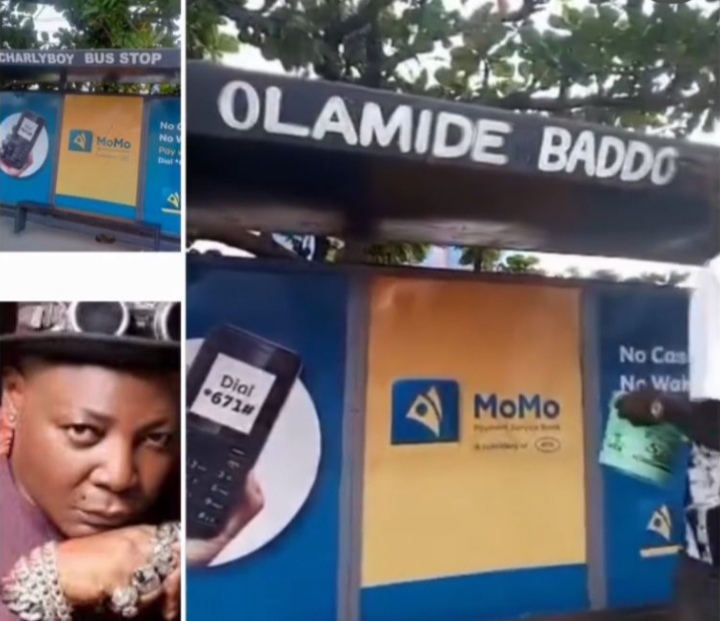
Lagos divided over renaming of Charly Boy bus stop after Olamide

 Quick Read
Rather than focusing on renaming a bus stop, some suggested that Charly Boy or his supporters could establish a community project, like a hospital or art centre, to leave a legacy that transcends street signs and political moves
The recent decision to rename the popular ‘Charly Boy’ bus stop in Lagos after award-winning artist Olamide Adedeji, popularly known as Badoo, has sparked a heated debate among residents and Nigerians online.
Kolade Alabi David, the outgoing chairman of Bariga Local Council Development Area, announced the renaming shortly before leaving office.
He said it was part of an initiative to honour individuals who have elevated the image of Bariga and Nigeria through music and cultural contributions.
The announcement was part of a broader renaming project that also included landmarks named after other well-known personalities such as King Sunny Ade, Tony Tetuila, 9ice, and footballer Bukayo Saka.
However, the public reaction to the move has been anything but unanimous. For many, the decision appears symbolic and unnecessary, especially given the long-standing recognition and identity associated with the name ‘Charly Boy’.
Some people expressed frustration, saying that the bus stop had already been renamed before as ‘2nd Pedro’ but residents continued to call it Charly Boy.
One user on social media, Murphy Agbogidi, questioned the relevance of the change, arguing that the name ‘Charly Boy’ has been etched into the community’s identity for decades.
He dismissed the move as a political gesture out of touch with local sentiment, emphasizing that names are not changed simply by erecting new signboards but by the daily language of the people.
Others saw the renaming as an unnecessary erasure of legacy. A few highlighted Charly Boy’s longstanding impact as a cultural and political figure, noting that his presence in Nigerian media and activism cannot simply be rewritten.
One comment pointed out that Charly Boy, also known as Area Fada, is more than a celebrity he is a symbol of bold self-expression, coming from a respected family and passing that identity down to his children.
Yet, not everyone was opposed. Some residents and commentators welcomed the new name, viewing it as a timely recognition of Olamide’s rise from Bariga to national and international fame.
They noted that Olamide’s story of growing up in the area and achieving success could serve as inspiration for local youth.
To these supporters, renaming the bus stop is a celebration of modern success and a reflection of current cultural heroes.
One person wrote that while Charly Boy may have been a notable figure of the past, Olamide represents today’s voice especially among young people and those from working-class backgrounds who relate to his music and story.
Others argued that with clear signage and promotion, the new name could eventually take root.
But the tension between past and present legacies continued to dominate the conversation.
Some felt the renaming disrespected history, pointing out that Charly Boy Bus Stop is more than a transit point it’s a memory tied to families, schools, and childhood for many who grew up in the area.
One user even shared a personal story of growing up near the bus stop, describing how deeply embedded the name is in the local community.
A few others saw potential in using this moment to build something more meaningful.
Rather than focusing on renaming a bus stop, some suggested that Charly Boy or his supporters could establish a community project, like a hospital or art centre, to leave a legacy that transcends street signs and political moves.
In the end, the name change has opened a wider conversation about memory, identity, and who gets to define the symbols that represent a community. Whether the new name sticks or fades like previous attempts, the debate has made one thing clear: for many Lagosians, names are not just about directions they’re about history, belonging, and recognition.
Comments