


Tinubu’s wife unveils Lagos Industrial Leather Hub projected to generate ₦387.5bn earnings annually

 Quick Read
Speaking at the event, Lagos Governor, Babajide Sanwo-Olu declared that the Leather Hub would serve as a strategic launchpad for Nigeria’s economic diversification, creating over 10,000 jobs in its first three years and generating projected export earnings of more than $250 million annually.
By Kazeem Ugbodaga
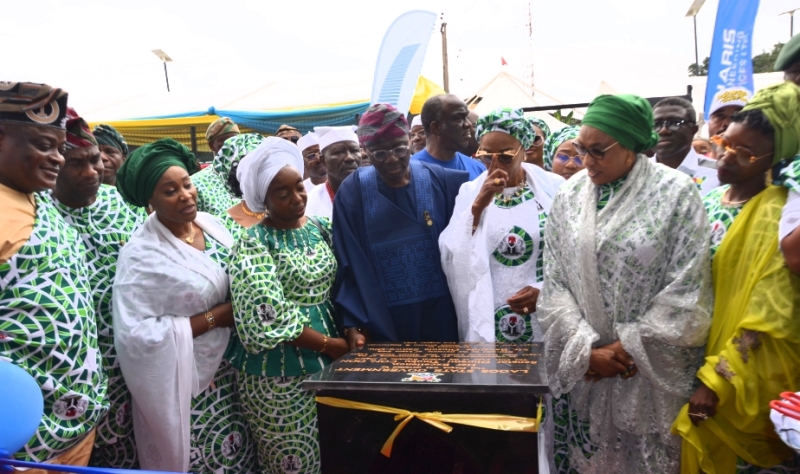
Wife of Nigeria’s President, Senator Oluremi Tinubu, on Saturday inaugurated the Lagos State Industrial Leather Hub in Matori, Mushin, describing it as a landmark investment that will transform the local leather industry and create thousands of jobs.
The ultra-modern facility, developed by the Lagos State Government, is designed to serve as a centre for leather processing, footwear production, and specialized training for artisans.
It is expected to significantly boost the capacity of Micro, Small and Medium Enterprises (MSMEs) while positioning Lagos as a hub for global-standard leather production.
The Industrial Leather is expected to position Nigeria as a global player in the leather value-chain, generating over $250 million (₦387.5 billion) in annual export earnings and creating 10,000 jobs within its first three years.
Speaking at the unveiling, the First Lady praised Governor Babajide Sanwo-Olu for what she called a “bold and progressive initiative” that aligned with President Bola Tinubu’s Renewed Hope Agenda.
“By investing in this hub, the Lagos State Government has once again demonstrated its commitment to job creation, productivity and sustainable economic development. This project is a beacon of possibilities, showing how government and citizens can work together to turn challenges into opportunities,” she said.
She noted that leatherwork, one of Nigeria’s oldest crafts, held immense potential for global competitiveness if given the right infrastructure.
“I urge artisans, entrepreneurs and our vibrant youth to take full advantage of the opportunities this hub offers,” the First Lady said, adding that “dedicate yourselves to excellence and continuous learning so that Nigerian products can compete confidently in international markets.”
Speaking at the event, Lagos Governor, Babajide Sanwo-Olu declared that the Leather Hub would serve as a strategic launchpad for Nigeria’s economic diversification, creating over 10,000 jobs in its first three years and generating projected export earnings of more than $250 million annually.
Sanwo-Olu described the hub as “a gateway to global competitiveness for Nigeria’s leather value-chain” and a symbol of purposeful governance.
“This state-of-the-art hub is more than bricks, steel and machinery; it is a launch pad for thousands of decent jobs, and a shining example of the power of visionary governance and purposeful partnership between the Federal Government and Lagos State,” the Governor said.
Sanwo-Olu noted that the project would empower women and young people, who will constitute 70% of the workforce in its early years.
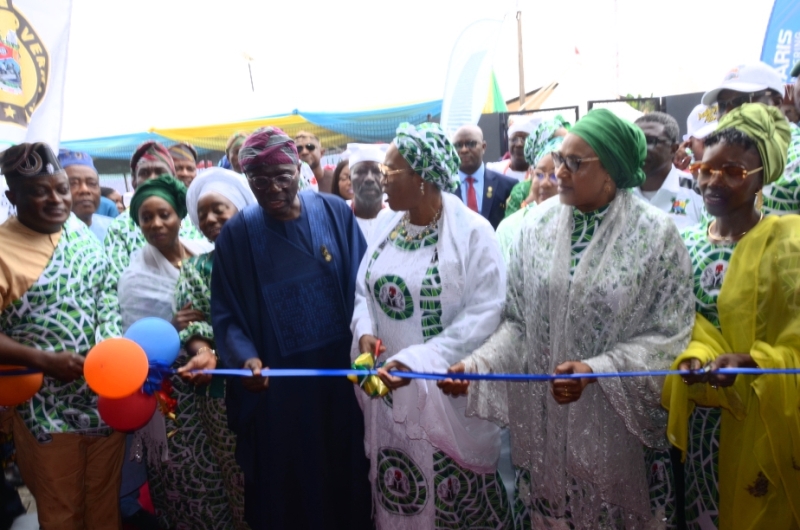
He added that more than 150,000 artisans would benefit from specialized training and start-up support designed to enhance productivity and innovation.
“We will be creating over 10,000 direct and indirect jobs in the first three years, with 70% of them reserved for women and youth,” he said, adding that “Beyond the numbers lies a deeper promise, the promise that a young girl from a modest background can now dream bigger, knowing that the tools, the mentorship, and the market are within her reach.”
The Governor also highlighted the hub’s potential to reposition Lagos as the leather logistics capital of West Africa.
“Export earnings in excess of $250 million are projected annually when the hub is fully operational. This commissioning further strengthens our resolve to diversify Nigeria’s economy beyond oil.”
Acknowledging the role of stakeholders, Sanwo-Olu praised the First Lady for her passion for women and youth empowerment, while also commending private-sector investors, technical partners, and local communities for supporting the project.
He outlined three pledges by his administration to safeguard the facility: protecting and expanding it through transparent regulation, linking it to Lagos’ fashion districts and transport networks, and measuring its success by the number of households lifted above poverty.
“We will measure our success not by headlines, but by the number of households lifted above poverty through this initiative,” he stated.
The Governor stressed that Lagos’ greatest asset remained the resilience of its people, saying that “By unlocking that spirit through projects like the Industrial Leather Hub, we are scripting a future where prosperity is shared, creativity is rewarded, and no one is left behind.”
Comments