


How Bunmi Oyinsan blew minds at presentation of ‘Ladder of Bones’ in Lagos

 Quick Read
In ‘Ladder of Bones’, a pun on British Historian Ellen Thorp’s similar title, Oyinsan tells the intriguing story of five characters: Enilolobo (Eni), Siaka, Melvin, Iona, and Timothy who suffer all kinds of violence and find their lives intersecting against the backdrop of forces beyond their control.
By Nehru Odeh
“The Empire is striking back” – Salman Rushdie
Dr Bunmi Oyinsan is a writer with a mission. She is not just passionate about literature, she is deeply concerned about the power of narratives, for what purpose they are used, and how they shape our lives. And it is this her predilection for deconstructing narratives, her burning desire to speak truth not just to power but to the power of narratives that is the hallmark of her writing.
It was in this vein that the Canada-based writer, filmmaker, scholar, and former Chairman of the Lagos Chapter of the Association of Nigerian Authors, ANA, who played a prominent role on the Nigerian literary scene before relocating to Canada, crafted her latest novel, ‘Ladder of Bones.’
In ‘Ladder of Bones’, a pun on British Historian Ellen Thorp’s similar title, Oyinsan tells the intriguing story of five characters: Enilolobo (Eni), Siaka, Melvin, Iona, and Timothy who suffer all kinds of violence and find their lives intersecting against the backdrop of forces beyond their control.
The story follows interconnected narratives across continents and explores the devastating effects of war and displacement. The book also delves into the realities of child soldiery and the impact of conflict on individuals and families.
However, a very significant feature of that book, which has placed it on the same footing with other postcolonial literary texts such as Chinua Achebe’s ‘Things Fall Apart’, Salman Rushdie’s ‘The Empire Writes Back with a Vengeance’ and Gayatri Spivak’s ‘Can the Subaltern Speak?’ Oyinsan has used her latest fictional offering to interrogate and give the lie to Thorp’s earlier submission.
In that book Thorp, like every Eurocentric writer, praises the British civilizing mission in Nigeria to high heavens, as she writes about the huge sacrifices the colonialists made and how they meant well for the local population whom she regards as barbaric, savages and blood-thirsty. But Oyinsan turns Thorp’s book on its head in her novel.
“So my novel deliberately signifies on Thorpe’s title because while her Ladder of Bones symbolizes the sacrifices of colonial agents, I reclaim it. I jam it, in short, to highlight the human cost of colonization, the very trauma beneath progress narratives, the real grim bones on which modernity was built. So, in my version, these bones do not cut a path upward, the so-called Ladder of Bones. They mouth what has been lost, silenced and endured, “Oyinsan explained.
Still, another interesting thing about the book is that it is dear to the writer’s heart as it took her 10 years to write it. “I said to myself it was a story I must write with all dedication. I told myself I must do it even if I wasn’t going to write any other one after it,” Oyinsan averred.
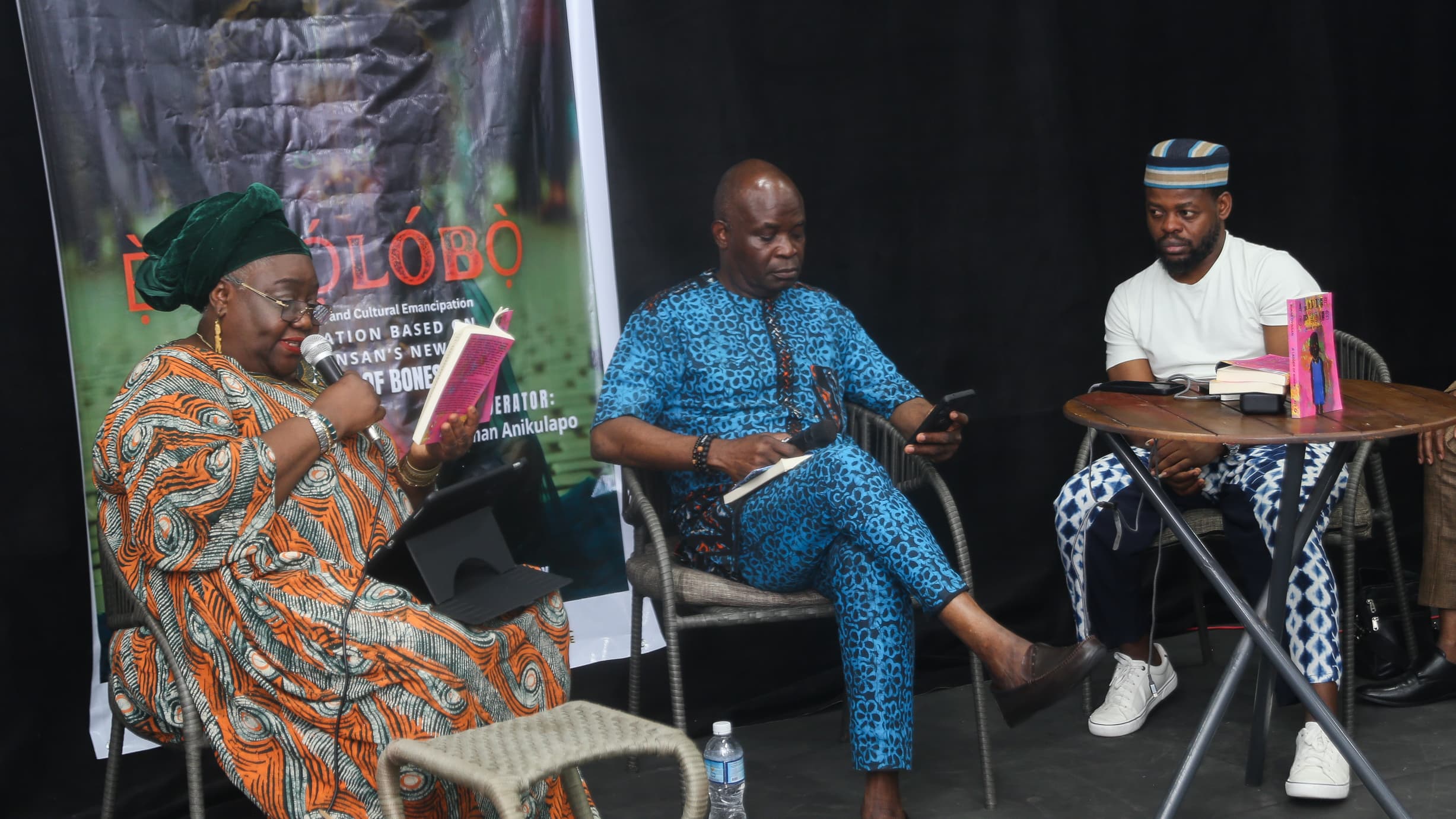
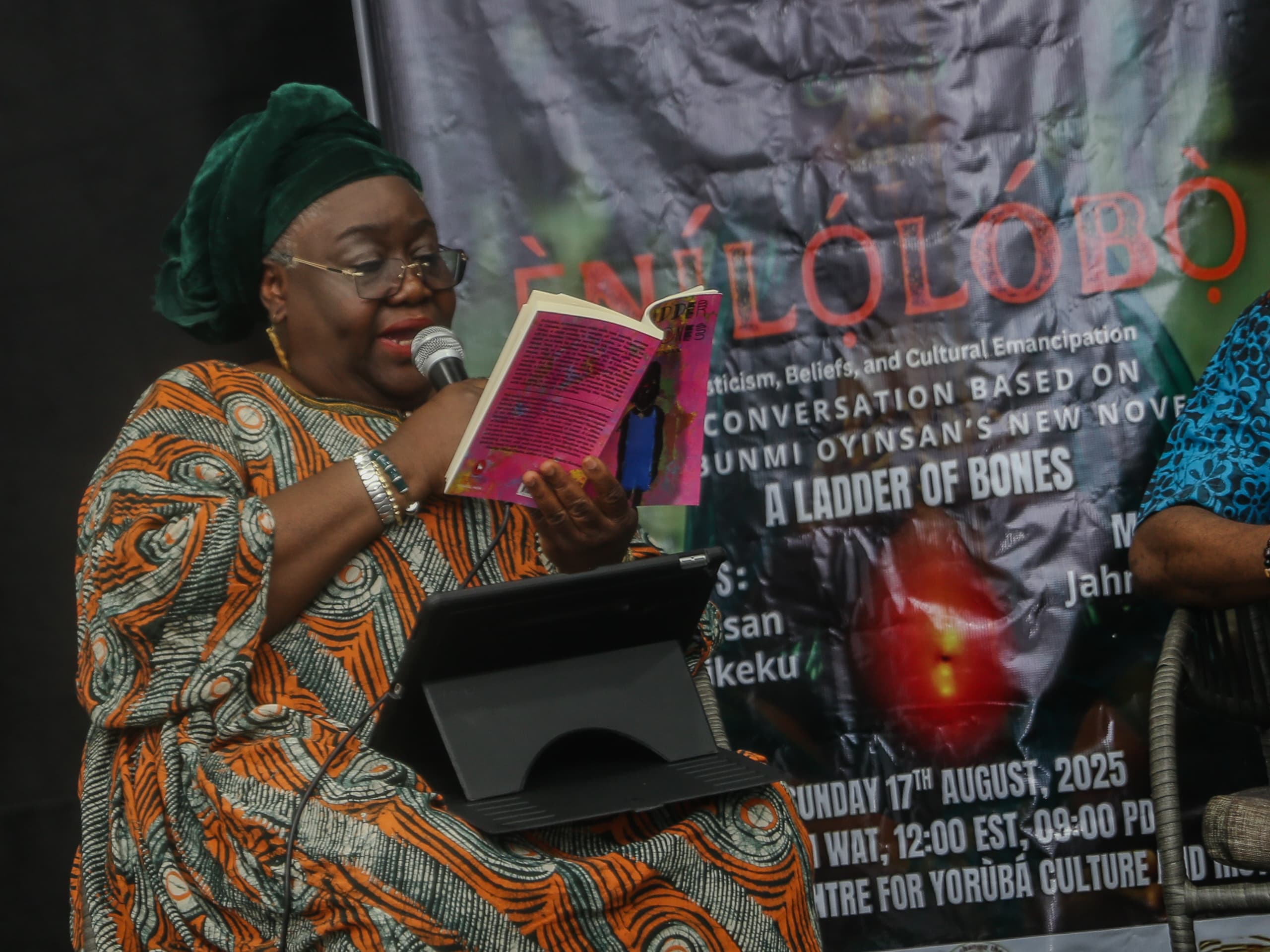
However, the author had the opportunity to present her work to the literary community in Lagos at an event themed ‘Enilolobo: Conversation based on Bunmi Oyinsan’s new novel, Ladder of Bones” which held on Sunday, August 17 at the J.K. Randle Centre For Yoruba Culture and History. And that venue was indeed significant enough.
It was an evening of discourse, of memory and of laughter. Jahman Anikulapo and Qudus Onikeku were in conversation with the author who also read excerpts from her book.
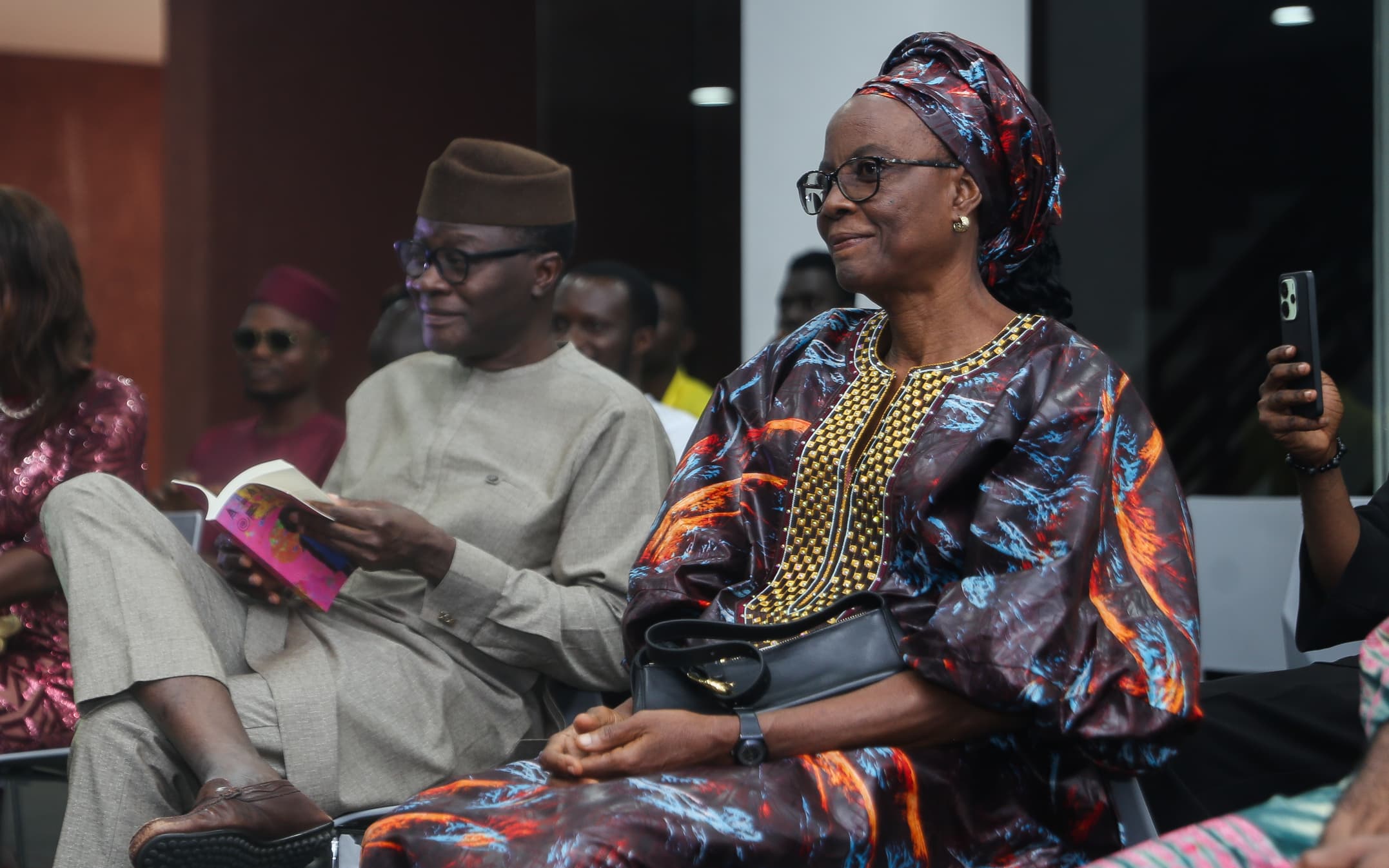
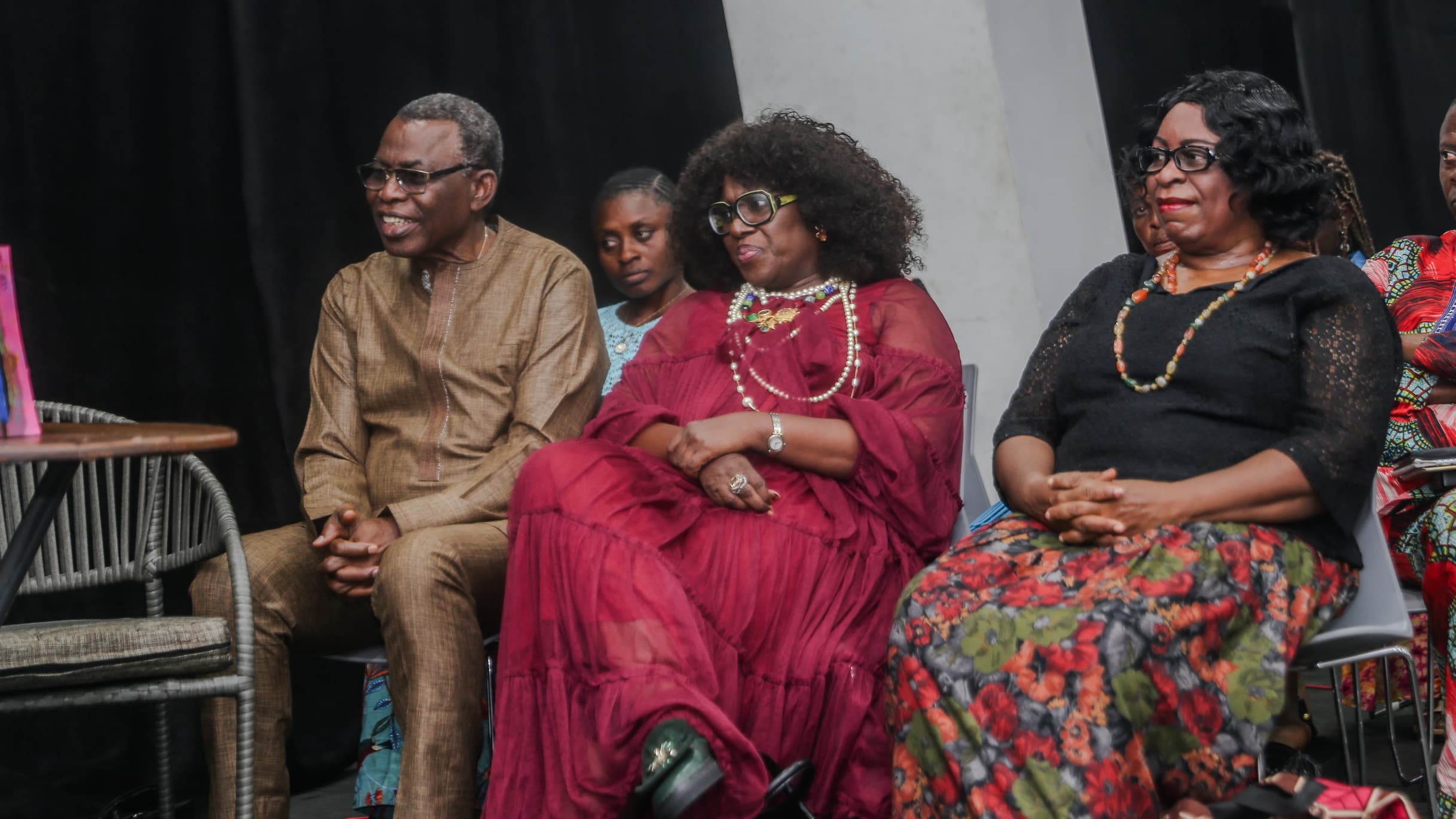
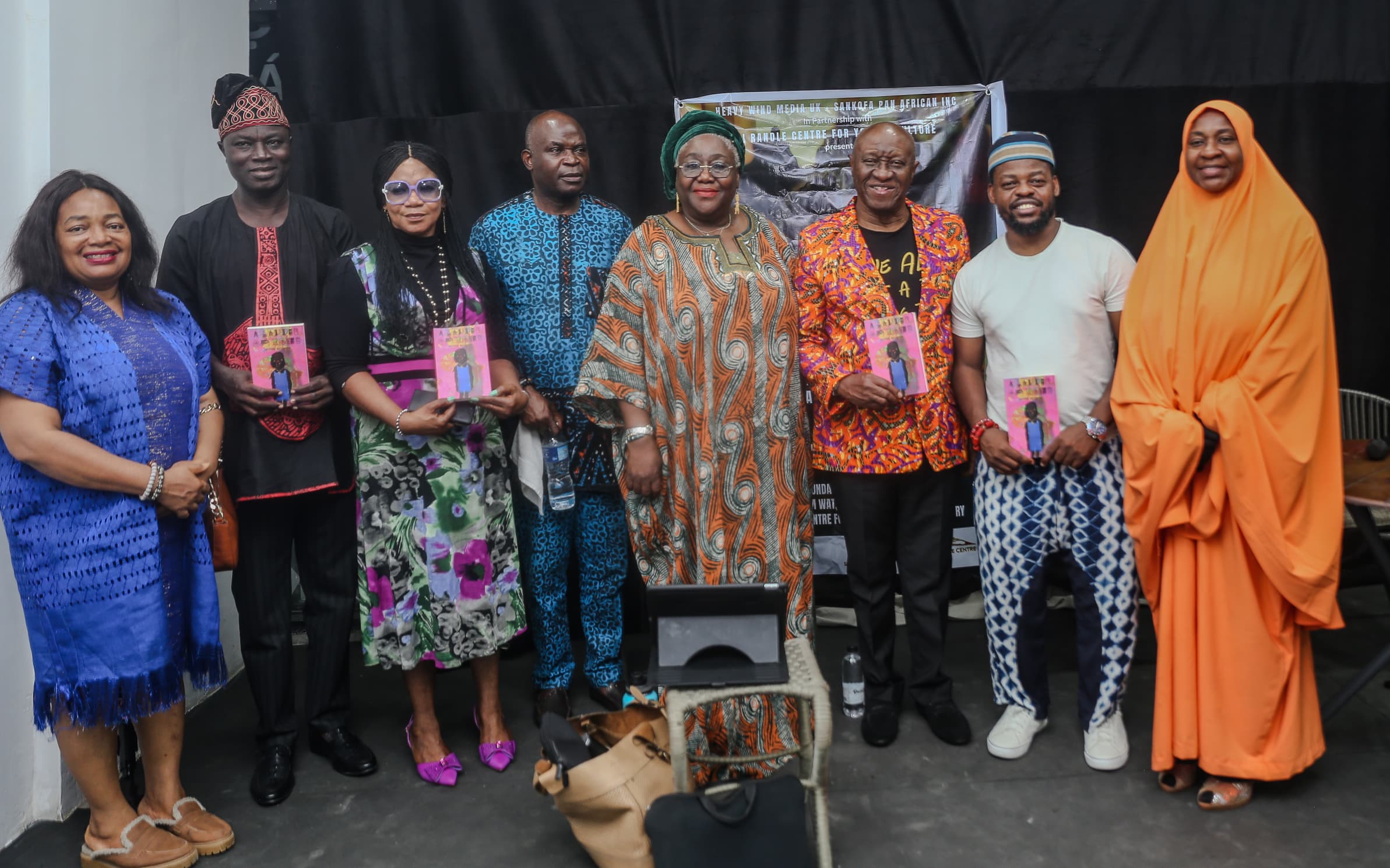
Distinguished guests at the event included the author’s husband Mr Soji Oyinsan, Mr and Mrs Kunle Ajibade, Ms Joke Silva, Mr Kayode Aderinokun, Ms Yetunde Aina and Ms Wunmi Segun. Other guests who joined the conversation via Zoom included Kole Ade-Odutola and Lookman Sanusi.
It was also an Intellectually stimulative evening tinged with sobriety, as the arts and culture community had just lost Ms Evelyn Osagie, performance poet, and journalist who passed away on Sunday, August 17 after a brief illness. A one minute silence was held in the hall in her honour.
However, journalist and poet Akeem Lasisi set the ball rolling with a brief speech and poetic performance.
“When we were growing as performance poets, she (Oyinsan) was the ANA Chairman. And what we were trying to do then, the activities that ANA would always put up, were the things that helped us, whatever generation we represent. We had opportunities to perform, to be critiqued and it helped us a lot, before we now graduated to the CORA Stampede level,” Lasisi enthused.
Asked what inspired her to write the book, Oyinsan explained: “Two things. The first point is the result of my meditation about the powers of memory and also the legacies of slavery, slave trade, empire and the way in which this continue to shape our lives as Africans and Africans in the diaspora.
“I set the story in several African countries as well as the African diaspora around the lives of five young people who suffered all kinds of violence – some economic, some physical, some psychological – that we often do not link to neocolonialism and the current global economic infrastructure that are set up to keep Africans down.
“The second reason is also my resistance to the way in which traditionally history is taught to us. As someone who grew up here and went to school here, I am determined that as many as the generations that come behind me do not go through the same system that I went through, where European history and all their victories were the highlights of the history that we were taught at the expense of our own contributions and our own ancestors’ contributions;
A perfect example of that is the so-called history book about Nigeria written by a British woman, Ellen Thorp, the title of which I deliberately signify on. Her historical account of precolonial Nigeria at the eve of our independence is titled “Ladder of Bones”.
“And in that she paints the works of missionaries and colonizers as saviours who made sacrifices, all their bones and sweat, to help us develop. And I am turning that on its head, that metaphor, and say, look, what are the real prices that we had to pay, that we continue to pay for slavery, for slave trade, for colonization, for Empire and the ongoing effects of neocolonialism?” Oyinsan maintained.
However, talking about takeaways from the book, the Canada-based writer said she would be most satisfied and gratified if readers could leave the book determined to question everything, question every history that has not been written by us, question the way in which Africa is portrayed, and question so-called attempts and helps, by people, do-gooders, who say they are helping us and then take from us with one hand while they are pushing us down with the other.
Asked why she deemed it important the Empire writes back to the Centre in her book, Oyinsan said: “The Centre has not heard us. Yes, we have been talking back to the Centre but the Centre has not heard us. So my belief is our approach probably needs to change. I don’t think we are writing enough stories that talk back to the Centre in a language that the children of the Centre can understand.
“There are a lot of academic works, theories talking back to the Centre. But the nitty-gritty is the way our stories should talk to the young British, the young American, the colonizers, in a way that will make them question the privilege which they enjoy and continue to enjoy as a result of the proceeds of the empire.
“So, by centering the stories around five young people, depicting the horrors that they are going through only because of the accidents of where they have been born and the culture of the enslaved, I am hoping I would awaken something in our children to see that quite frankly why must our lives be the way it is. We have as much rights as any children anywhere else. If this is one world, there must be equity.
“And being citizens of the continent which is richest in resources, our children have no business being poor. Generations after us have no business begging for aid or listening to the likes of Trump to determine the cause of their future …We cannot be talking to academics alone. We must find a way to get these things out. It’s like preaching to the converted, if we stay within the academics,” Oyinsan submitted.
Qudus, for his part, spoke about the marvelous work he has done at the J.K. Randle Centre for Yoruba Culture and History and how he targeted the youths and succeeded in making the centre get their interest and attention. According to him, the Centre received 20, 000 visitors in its first 100 days. He also gave reasons he doesn’t like the centre to be regarded as a museum.
“When we started, our number one target was the Gen Z. So we made sure that the way we were designing our flyers, the way we put Yoruba title on everything we do and its subtitle in English, the way we ran after their social media personnel like Rasere and Masoyibo to make sure that we got them on board first. All of that were very deliberate in trying to anchor this centre for the younger people and also for the future.
“When people describe the centre as Yoruba Museum or J.K. Randle Museum, the first thing I say is that it is not a museum. The word, ‘museum’, has a very clear colonial heritage. Museum is a place where we put artifacts stolen from everywhere in the world. The second reason is that young people will never connect to museum. And in a way, even though we’ve moved away from the word Museum, we have actually ironically created a museum going culture,” Qudus said.
Qudus also spoke about how he sees dance as a way of self-discovery, as a way of reconnecting with memory within the body. According to the accomplished dancer, whenever he dances he goes into a trance, which makes him remember all what he has been disconnected from, to know his purpose on earth. According to him the reason people reincarnate or re-embody is because they couldn’t find their purpose or deliver in their past life.
“There is something, there is information, there is an archive embedded within your body that you need to deliver. And you must find out. Only you can do it. I can lead you, but only you will do the finding yourself. I will never be able to know your own purpose and ypur own reason. I know mine. Because It has stayed with me for so long. But I can’t do that for every other dancer.. So you decide if you want to deliver it or go and then reincarnate again. Because once you reached to the end of that journey you will definitely come back,” Qudus maintained.
This was followed by an equally brilliant Q&A session. Jumoke Verissimo’s review of Oyinsan’s book, entitled “Climbing the Rungs of Memory: Bunmi Oyinsan’s “A Ladder of Bones”, which was read by Ms Perpetual Eziefule-Ohiri, was the icing on the cake.
It signaled the end of an evening rich with history, memory, culture, and emotions. And just as Verissimo puts it in her review, “Award-winning writer Bunmi Oyinsan delivers a masterclass in storytelling with her latest novel, A Ladder of Bones, plunging readers into a weighty emotional landscape.”
Still, if what transpired at the event is anything to go by, the audience was not left out. It too was plunged into an unforgettable emotional landscape that was thought-provoking as well. And they went home with the resolve to tell their own stories in their own way, not according to what the Centre dictates.
Comments