



Belonging is heavy: Lateefat Tobun’s The Weight We Carry and the Sediment of Migration

Okechukwu Uwaezuoke
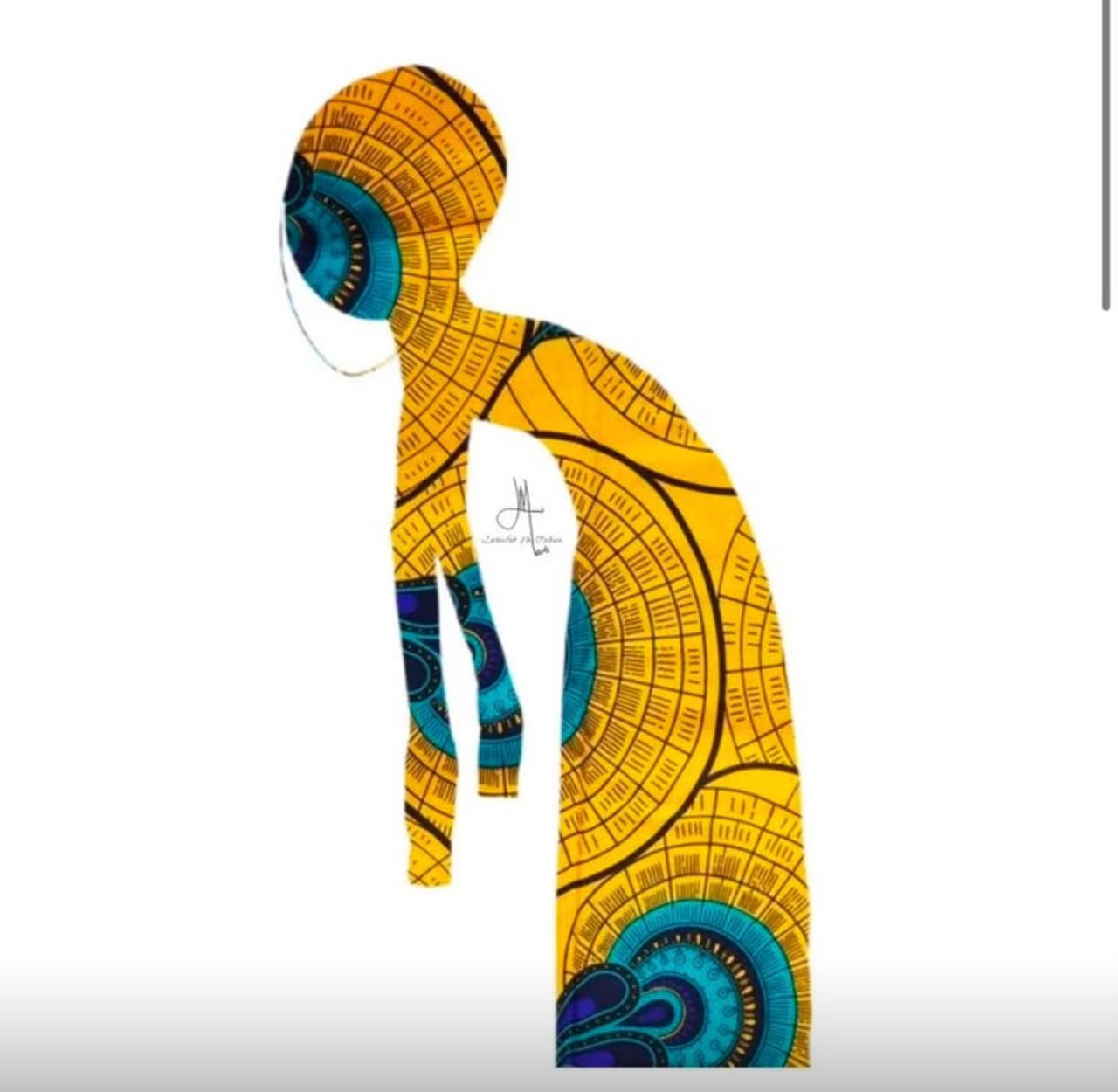
There are paintings that ask to be read, and paintings that ask first to be recognised. Lateefat Tobun’s The Weight We Carry belongs to the second category. Before the viewer begins to interpret the image, the body has already understood it. The bowed back, the dropped shoulders, and the forward lean of the figure—all of it arrives before thought does.
We know this posture. Most of us have inhabited it.
The painting gives us remarkably little else to work with. A single elongated figure bends into an expanse of white space so large it threatens to swallow the body entirely. There is no setting, no horizon line, no object that explains the burden implied by the title. Tobun refuses narrative detail almost completely. Whatever weight exists here remains invisible, and that invisibility is precisely the point.
Contemporary images of migration tend to concern themselves with movement: crossings, borders, departures, and arrivals. Tobun is interested in what comes afterwards. The Weight We Carry is less concerned with migration itself than with its sediment—the obligations, memories, and inheritances that survive the journey and continue to shape those who make it, long after the border has stopped being the relevant boundary.
The figure bends, but not in collapse.
There is strain in the posture, certainly, but also continuity, and Tobun makes that continuity legible in a small formal gesture that is easy to miss on a first look: a fine curved line arcing back from the dropped head toward the shoulder, tracing not the fall but the return from it. It reads less as ornament than as trajectory—the beginning of a body straightening itself again.
Too much visual culture surrounding migration treats hardship as a sequence: the fall, and then, later, separately, the recovery. Tobun compresses the two into a single mark. Weight here is not evidence of failure but of attachment, and resilience isn’t something that arrives after the bending; it is already present within it.
That reading is deepened by the material Tobun chooses to paint with. The figure’s surface is rendered in vivid yellow, interrupted by concentric rings of blue and indigo—a pattern lifted from African wax print, a textile whose own history refuses easy origin stories. Wax print reads as unmistakably African in identity, yet its cloth and manufacture trace back through Dutch and British colonial trade routes and Indonesian batik techniques—a material shaped as much by exchange, appropriation, and adaptation as by heritage.
Tobun seems alert to this complexity rather than smoothing over it. Nothing in the painting is worn: the pattern doesn’t sit on top of the figure as clothing; it constitutes the figure itself, with skin and history rendered as the same surface. Culture, in this reading, is not chosen or performed. It is simply what the body is made of.
There is a quiet irony in that. The very things that burden the figure are also the things that constitute it. Family histories, inherited traditions, obligations to language, and memory—these are weights precisely because they matter. Tobun understands something migration narratives often struggle to articulate: belonging is heavy. It does not become lighter for being loved.
The field of white surrounding the figure intensifies this. In another painting, that much bare canvas might signify possibility, freedom, or a blank page. Here, it feels less generous than indifferent. The emptiness doesn’t threaten the figure exactly, but neither does it support it. The body carries its own context because no other context is on offer.
If the work risks anything, it is the speed of its own legibility. The bowed body is one of the more immediately readable images in contemporary figurative practice, and a painting that lets the viewer arrive at meaning this quickly runs the risk of also letting them stop there.
The arc tracing the fall back into a rise, and the wax print’s layered trade history folded into the pattern—these are the painting’s more considered ideas, and neither announces itself the way the posture does. It is entirely possible that most viewers register the burden and never make it to the recovery; that the work’s quietest, most deliberate gestures end up competing for attention against a silhouette built to be recognised in an instant.
That is not quite a flaw. Tobun clearly wants the immediate impact, but it is a tension the painting does not fully resolve: the tension between asking to be recognised at a glance and rewarding a much slower look.
What saves the work is precision rather than novelty. The curve of the spine, the slightly disproportionate length of the arms, and the visual heaviness built into the downward pull of the entire composition—these are decisions grounded in observation rather than allegory.
The painting does not insist on a single interpretation so much as it invites recognition, and recognition, unlike interpretation, does not require the viewer to be told what to feel.
Perhaps what is most affecting about The Weight We Carry is its refusal to let inheritance resolve into either blessing or burden alone. Memory rarely grants that kind of clarity. What we inherit sustains us, confines us, protects us, and exhausts us—often at the same time, often in the same gesture. The figure bends beneath history, but is also made visible by it; without the weight, there may be no shape left to recognise at all.
Tobun has little interest in spectacle. There are no grand claims here, no visual excess, and no attempt to monumentalise suffering into something legible from a distance. Instead, she offers something quieter and, in the end, more persuasive: the suggestion that identity is not only something we build, but something we carry, often long after we’ve stopped noticing the weight of it.
The painting leaves us with an uncomfortable question and doesn’t pretend to answer it. Perhaps it isn’t whether we carry our histories that matters. Perhaps it is whether we would still recognise ourselves without them.
Comments