


African coalition rises against water privatisation in climate fight

 Quick Read
The coalition argued that these challenges demand urgent public investment in resilient water infrastructure, and not further privatisation.
By Paul Dada
Amid mounting climate disasters and growing water insecurity across Africa, civil society groups have launched a coordinated campaign to resist the privatisation of water resources.
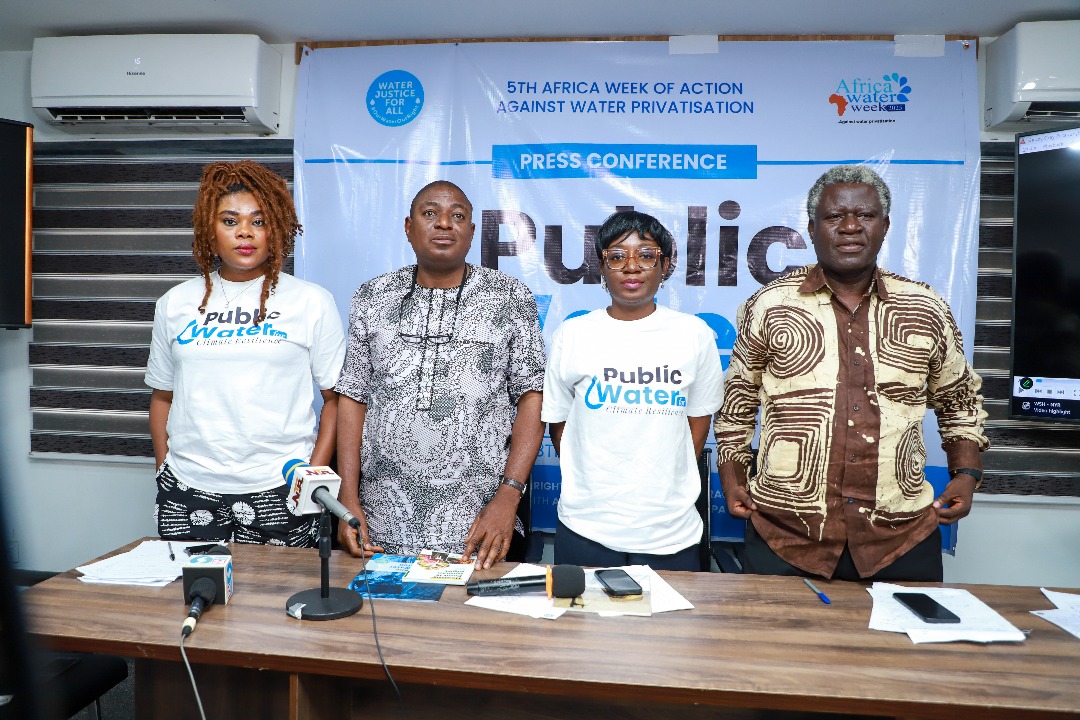
Operating under the umbrella of the Our Water Our Right Africa Coalition (OWORAC), the coalition on Monday began the Africa Week of Action Against Water Privatisation with a press briefing at the Lagos headquarters of Corporate Accountability and Public Participation Africa (CAPPA).
With a campaign themed “Public Water for Climate Resilience,” OWORAC warned that the continent’s worsening water insecurity cannot be solved by handing over water systems to private corporations.
In a statement read on its behalf by CAPPA’s Programme Officer for Water Campaign, Sefa Ikpa, OWORAC painted a stark picture of how climate change is reshaping the African continent, with water — or the lack thereof — emerging as the most immediate and devastating impact.
“Across the continent, intense and prolonged droughts, devastating floods, coastal erosion, and increasing unpredictability in rainfall are disrupting lives and livelihoods,” OWORAC stated.
The coalition argued that these challenges demand urgent public investment in resilient water infrastructure, and not further privatisation.
It said, “Ordinarily, these challenges should serve as a wake-up call for governments to invest in stronger publicly governed water systems capable of protecting life under climate stress. Yet, in many African states, the opposite is taking place.”
OWORAC criticised the growing promotion of desalination plants as a “climate-resilient” solution. While acknowledging the urgency of water scarcity, it warned that desalination, often led by private companies under long-term contracts, is environmentally damaging, expensive, and exclusionary.
“Desalination is no panacea,” OWORAC said. “It is extremely energy-intensive, largely dependent on fossil fuels, and produces a concentrated salty waste called brine that pollutes marine ecosystems, destroys fisheries, and further dispossesses coastal communities,” it said.
Also speaking at the event, Neil Gupta, Water Campaign Director at Corporate Accountability, echoed OWORAC’s warnings and linked the water justice struggle to broader issues of corporate exploitation and neocolonial influence.
Gupta said, “Defending water is defending life itself Unfortunately, there is an entire industry that aims to exploit our need for water to profit.”
He then went on to accuse the governments of advanced countries and their institutions of enabling and even profiting from water privatisation across the Global South.
He said, “From the World Bank to the IMF, international financial institutions foist privatisation and austerity on governments at the expense of the people. We’re also witnessing an alarming rate of direct Global North government interference in water.”
As an example, Gupta pointed to recent developments in Lagos, where the US government is reportedly backing “a multimillion-dollar corporate water scheme that has been shrouded in secrecy.”
“While some might try to convince us that certain schemes like public-private partnerships don’t count as privatisation, we can’t be fooled,” he said.
On his own part, Executive Director of Corporate Accountability and Public Participation Africa (CAPPA), Akinbode Oluwafemi, who delivered the welcome address at the event, lamented that at a time when urgent public investment is needed to shore up equitable and resilient water infrastructure, governments are instead bowing to pressure to privatise.
“While nature cries for justice in the face of the climate emergency, capital smells opportunity.“Multinational corporations now peddle desalination and other privatisation schemes as climate solutions, selling back to us the very water that belongs to the people.”
Adding, he said, “Today we reject these false solutions. We assert that the way we protect and govern water will determine whether our communities can endure the crises ahead.”
Comments