


Umahi speaks on use of wire mesh in Ore-Ondo-Akure road reconstruction

 Quick Read
The Minister also assured that the road being constructed now would last for 50 years, the ministry was monitoring it adequately and was satisfied so far with the level of work done.
By Segun Giwa
The Minister of Works, Sen. Dave Umahi on Thursday reacted to a viral video alleging that the contractor working on the reconstruction of Ore-Ondo-Akure road is shortchanging the country with the use of wire mesh on the outer shoulders instead of the heavy reinforcement used on the main carriageway.
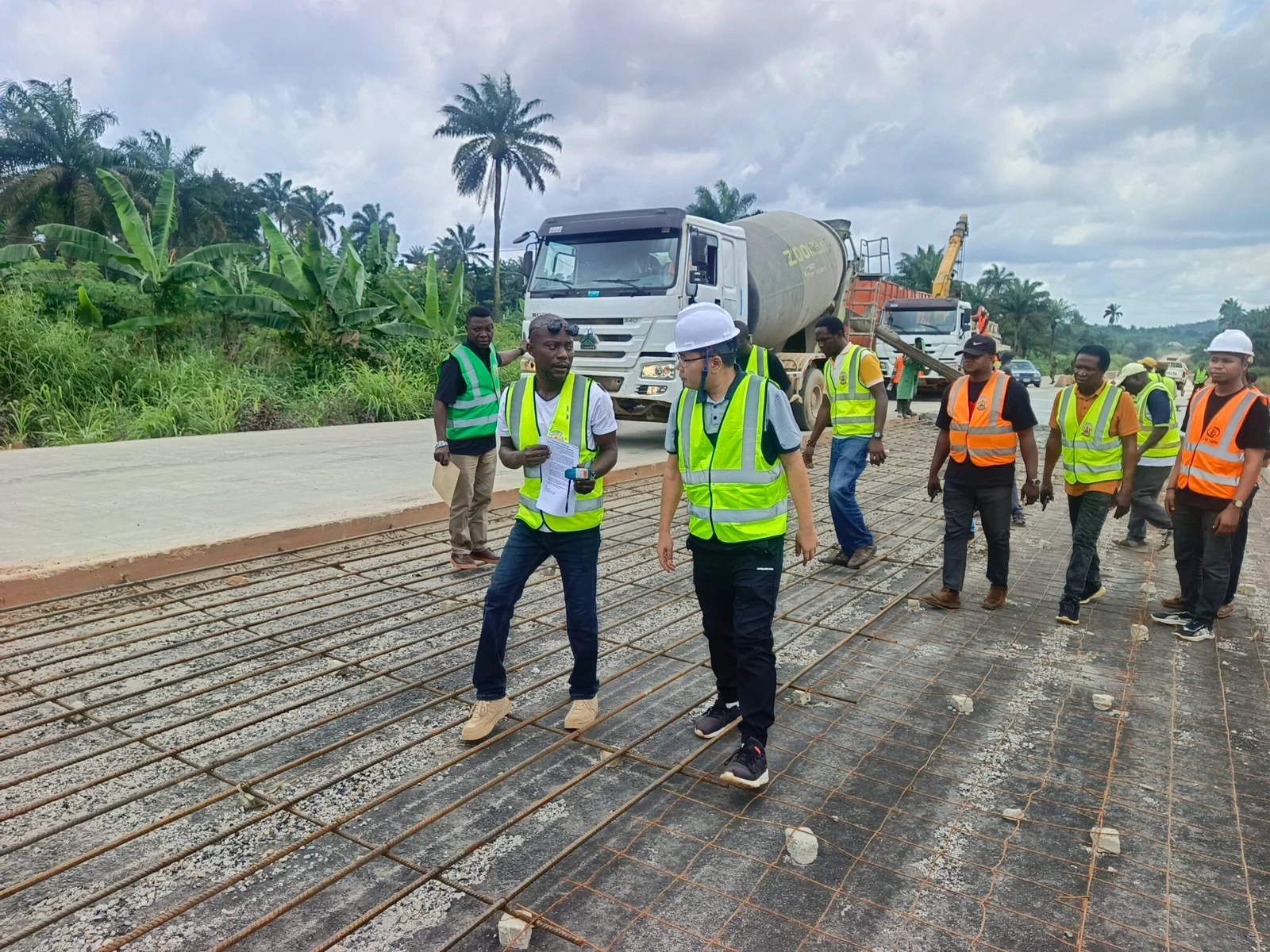
Speaking while in Ore, Odigbo Local Government Area of Ondo State while inspecting the level of work done on the road on Thursday, Umahi said the contractor like the others handling the ministry’s project followed the engineering designs and specifications given to him
“So if you go to all our single carriageway rigid road constructions nationwide, you will find a similar design. It is not peculiar to Ore-Ondo-Akure Road. It is not peculiar to Ondo State. It is a highway standard found in Nigeria and internationally, ” he said.
Umahi, represented by the Federal Controller of Works in Ondo State, Engr. Olajide Hussein further explained that the width of the road is a standard 7.3-meter main carriageway, and 2.75 metres shoulder on each side.
Umahi added that the length of the road was 86.43 kilometres, running from Ore through Ondo to Akure with completion period of four years.
“We also saw the viral video and the complainant specifically mentioned the use of wire mesh on the outer shoulders and suggested that the contractor use the same heavy reinforcement here on the carriage where we are standing with the outer shoulders.
“But we need to make some clarifications, there is a functional difference between the main carriageway and the outer shoulder.
“So, there are also structural differences in their construction. The main carriageway is the central part of the road pavement and it is used for continuous traffic, very heavy traffic loads running constantly.
“We have trailers, trucks, buses, and other kinds of articulated vehicles. So it experiences very high flexural stresses and it has to be designed to counter these forces.
“The outer shoulder on the other hand is expected to carry only occasional loads, maybe for diversions, maybe a vehicle breaks down and needs to be removed from the main carriageway to aid continuation of traffic, or for short stops to pick and drop passengers.
“So, it doesn’t experience this continuous axle load and it is designed with minimal reinforcement.
“Now, the use of A142 wire mesh which you have seen on the outer shoulder is a standard practice all over the world, in Nigeria and internationally, it is a standard practice.
“We use the heavy reinforcement which you can see on the carriageway because of the flexural stresses, and we use light wire meshes on the outer shoulders because it doesn’t carry as much load as I have explained.
The Minister also assured that the road being constructed now would last for 50 years, the ministry was monitoring it adequately and was satisfied so far with the level of work done.
Umahi further reiterated the commitment of the ministry to delivering durable, safe and cost-effective road infrastructure across the country.
(NAN)
Comments