


How a teenager became Nigeria’s Vice President for a day

 Quick Read
The event, organised by PLAN International, gave Joy a platform to speak on behalf of millions of Nigerian girls who continue to face barriers to learning. She noted
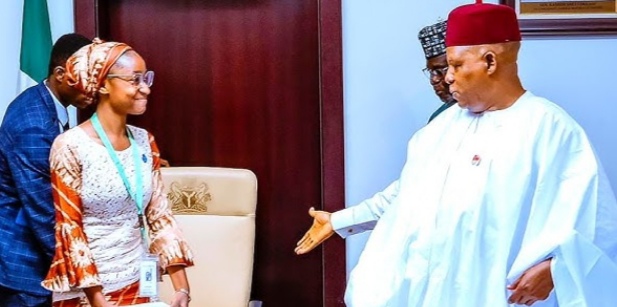
In a remarkable and inspiring moment at the Presidential Villa, a teenage girl, Joy Ogah, took over the symbolic seat of Vice President Kashim Shettima, using her brief time in power to deliver a passionate call for girl-child education and empowerment across Nigeria.
The event, organised by PLAN International, gave Joy a platform to speak on behalf of millions of Nigerian girls who continue to face barriers to learning. She noted that over 10.5 million children remain out of school, with girls making up more than 60 percent of that number.
From the Vice President’s chair, Joy spoke with conviction:
“We must invest in education that is safe and inclusive for every Nigerian child. Every girl deserves a classroom, a choice, and a voice — not silence.”
She also urged the government to provide free sanitary pads, ensure clean water and proper nutrition in schools, and create environments that protect and uplift young girls.
“When girls are protected, peace becomes possible. I may be Vice President for just one day, but the struggle I represent must continue in our classrooms, our policies, and our budgets,” she added to applause.
Vice President Kashim Shettima, impressed by her message, reaffirmed the administration’s commitment to advancing girl-child education, noting that President Bola Tinubu is deeply invested in inclusive learning for all children.
“We will continue to engage with PLAN International and bring the force of government to support your call. In President Tinubu, you have an ally you can trust,” Shettima assured.
Nigeria’s push toward gender equality in education continues to gather momentum. Advocacy groups have recently urged greater investment in mentorship and sensitisation programmes to close the gender gap in schools.
Earlier, the Federal Government launched the Renewed Hope Social Impact Interventions (RH-SII774) programme, targeting 10 million women across all local government areas with digital inclusion, clean energy access, and livelihood support.
With voices like Joy Ogah’s now echoing in the corridors of power, the movement for inclusive and equitable education in
Nigeria appears to be entering a powerful new phase one where every girl’s dream has a chance to shine.
Comments