


Ariyike: Nnochiri Sarah returns with a brand new collection

 Quick Read
Nnochiri Sarah Ibukun, pattern maker and designer, unveiled her latest collection, “Ariyike,” at a Lagos museum on 4 November 2025. Under her label Root & Rhythm, Sarah continues to define a design identity rooted in cultural textile literacy. Still, this latest body of work signals a deeper commitment to structural garment engineering.
By Dimeji Alara
Nnochiri Sarah Ibukun, pattern maker and designer, unveiled her latest collection, “Ariyike,” at a Lagos museum on 4 November 2025. Under her label Root & Rhythm, Sarah continues to define a design identity rooted in cultural textile literacy. Still, this latest body of work signals a deeper commitment to structural garment engineering.
The collection was introduced at a private preview attended by invited stylists, buyers, and members of the Lagos creative community. The controlled setting allowed close examination of the garments’ construction, textile behaviour, and pattern articulation, reinforcing the technical direction of the collection.
With “Ariyike,” Sarah moves beyond surface-driven textile exploration to a more disciplined approach to clothing architecture. In a fashion landscape where embellishment often dominates, her focus on pattern discipline and controlled shaping places her among the few designers prioritising construction-led authorship.
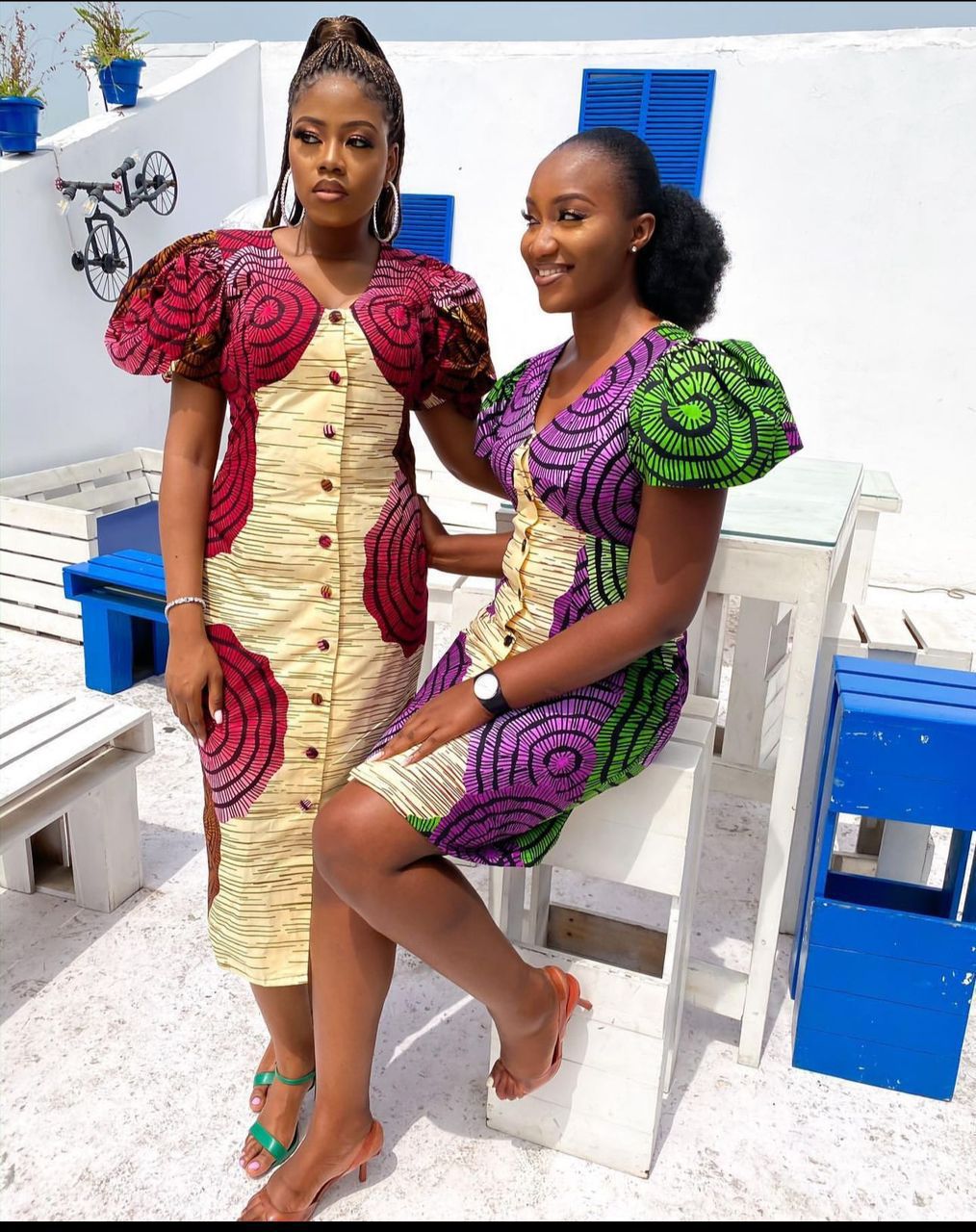
Much of the collection’s visual expression lies in the contrasting side panels, which create vertical movement across the torso and elongate the silhouette. The curved sections along the flanks act as visual contouring, achieved through deliberate textile mapping and thoughtful print placement. While some seam articulations could benefit from refinement, the intent toward structural precision is clear.
The controlled fullness of the puff sleeves, achieved through careful gathering at the sleeve head and calibrated cap easing, reflects growing fluency in volume manipulation. Finishing details, including structured sleeve hems supported by lightweight interfacing, show increasing technical confidence. Curved seam articulation and disciplined panel integration indicate a designer expanding her command of pattern engineering beyond decorative impulse.
Beyond technical considerations, the collection suggests an evolving range. Sarah shows she can move from relaxed textile forms to more structured tailoring, positioning her work for professional women and clients seeking defined elegance informed by cultural reference.
In its restraint, “Ariyike” hints at boldness without excess. It represents a measured step toward technical refinement and conceptual maturity, situating Sarah as a designer gradually consolidating her voice within Nigeria’s contemporary womenswear conversation.
For the designer to balance proportion and form, there is a controlled use of embellishments. Its limitation lies in restraint; it hints at boldness but does not fully surrender to it. Nonetheless, it represents a confident step toward technical refinement and design depth, positioning the designer as one capable of moving fluidly between comfort-led garments and structurally articulate fashion.
Comments