


Oyo set for major leap as Makinde presents ₦892bn Budget for 2026

 Quick Read
Makinde explained that the 2026 budget allocated ₦502.85 billion to capital expenditure and ₦389.14 billion to recurrent expenditure, bringing the state closer to its long-term target of a 60:40 capital-to-recurrent ratio.
By Kazeem Ugbodaga
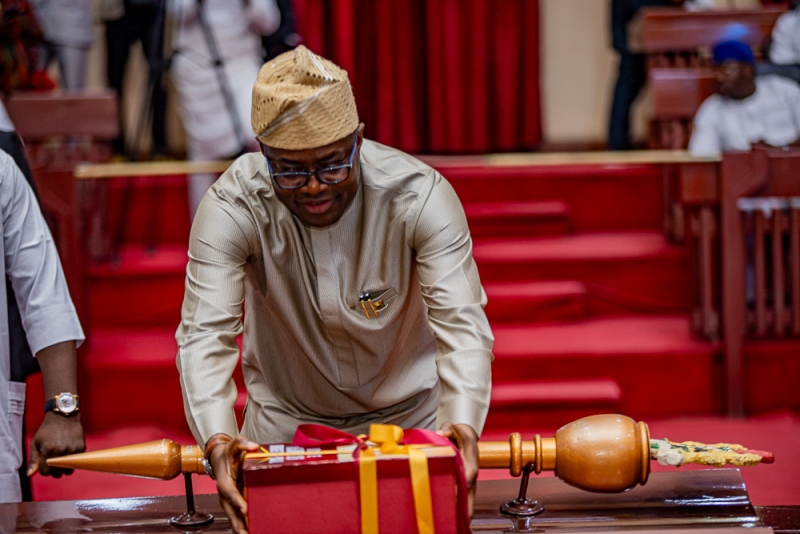
Oyo State Governor Seyi Makinde on Monday presented a landmark ₦891.98 billion Appropriation Bill for 2026 to the State House of Assembly, describing it as a “Budget of Economic Expansion” designed to accelerate the state’s transition into a production-driven and investment-ready economy.
Addressing lawmakers in Ibadan, Makinde said the proposal built directly on the success of the 2025 Budget of Economic Stabilisation, which helped restore fiscal balance, improve internally generated revenue through automation and efficiency, and maintain regular payment of salaries and social services without introducing new taxes.
According to him, stabilisation has now created room for Oyo State to scale into a new phase of growth.
He explained that the 2026 budget allocated ₦502.85 billion to capital expenditure and ₦389.14 billion to recurrent expenditure, bringing the state closer to its long-term target of a 60:40 capital-to-recurrent ratio.
He said infrastructure took the largest share with ₦210.02 billion, reflecting the administration’s commitment to completing all ongoing projects before the end of its tenure.
Makinde noted that rehabilitation of feeder roads across the state has commenced, with the Ogbomoso zone already at the due process stage and awaiting Executive Council approval within the next two weeks.
Education receives ₦155.21 billion, representing 17.40 per cent of the total budget and aligning with UNESCO’s benchmark.
The governor pointed out that the recent recruitment of 12,000 teachers had addressed longstanding manpower deficits, while the new budget will sustain recurrent needs and fund further upgrades of public schools.
The health sector is allocated ₦70.85 billion, which represents 7.94 per cent of the budget.
Makinde said 100 of the 106 primary healthcare centres being upgraded have now been completed, and attention will shift to secondary healthcare facilities, with at least one in each zone to be upgraded before the end of his administration.
Makinde emphasised that major investments across aviation, road networks, agro-industrial development, trade facilitation and logistics had already positioned Oyo State for a production-led economy.
He highlighted the upgrade of the Samuel Ladoke Akintola Airport, now capable of receiving wide-bodied aircraft, the Rashidi Ladoja Circular Road and its development corridor, the Special Agro-Industrial Processing Zones, AfCFTA-driven market integration, the Oluyole Free Trade Zone, and the dry port and logistics hubs that expand the state’s access to regional and continental trade.
He also referenced the commissioning of the Ibadan Central Bus Terminals at Iwo Road and New Ife Road, which now complement two earlier terminals to form an integrated state-backed mass transit system.
The governor described these achievements as part of a broader vision of an interconnected, investment-ready economy that links infrastructure, human capital, and innovation.
He said the 2026 fiscal plan is intended to deepen the transformation already underway and prepare Oyo State for its 50th anniversary in 2026, which will be celebrated under the theme “Renewal,” a recognition of the state’s past and a recommitment to its future.
Makinde reassured residents affected by the Rashidi Ladoja Circular Road development that progress would remain people-centred.
He pledged continued engagement, fairness and inclusiveness through compensation, consultation, and consideration of resettlement options where necessary.
According to him, the Circular Road is not only about connectivity but also about equity, growth and shared prosperity.
Looking ahead to the transition in 2027, Makinde said his administration is focused on strengthening institutions, digitising government processes and entrenching transparency, noting that true legacy is measured not just by physical projects but by sustainable systems that endure beyond any administration.
Comments