


End of an Era? Inside Salah’s Turbulent Liverpool Downturn

 Quick Read
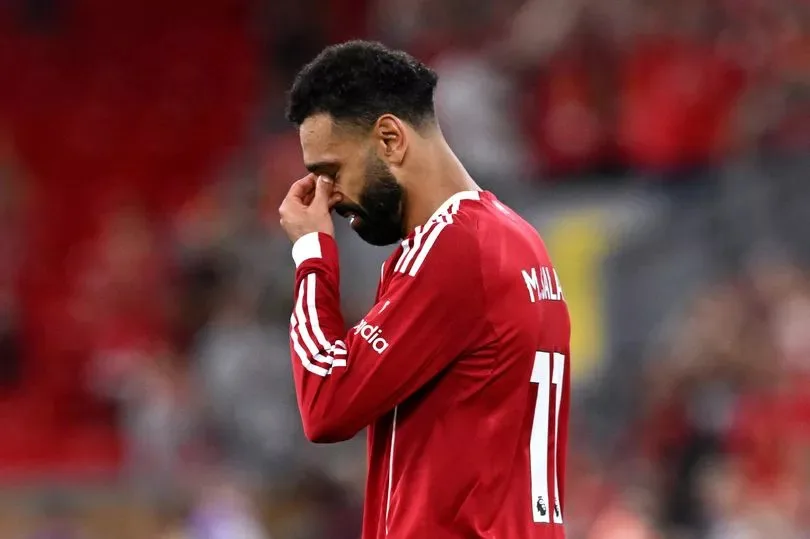
The situation escalated after Salah publicly expressed frustration at being benched and suggested breakdowns in communication with manager Arne Slot, saying he felt “thrown under the bus.”
By Kazeem Ugbodaga
Mohamed Salah’s Anfield story has been one of the Premier League era’s great success narratives: a lightning-fast winger who transformed Liverpool’s attack, delivered trophies and became a global icon.
But by late 2025 the relationship between player and club had entered a fraught new chapter, one that goes beyond simple dips in form and probes at issues of management, ego, squad design and the realities of a modern superstar’s twilight years.
Below I unpack the arc of Salah’s recent struggles: what changed on the pitch, how off-field dynamics amplified problems, and what plausible paths lie ahead for player and club.
From talisman to trouble-the facts on the pitch
Until recently Salah remained a remarkably consistent contributor: goals, assists and the capacity to win matches almost single-handedly. In April 2025 he signed a two-year extension keeping him at Liverpool, a clear signal the club valued him and wanted continuity.
Yet the 2025–26 season saw warning signs. Coverage and data-driven commentary point to a tangible decline in his output and influence: fewer goals, less threat in positional metrics and an overall drop that has coincided with Liverpool’s inconsistent run. Critics and analysts have cited both Salah’s reduced output and tactical rigidity as contributing factors.
The public break: interview fallout and exclusion
The situation escalated after Salah publicly expressed frustration at being benched and suggested breakdowns in communication with manager Arne Slot, saying he felt “thrown under the bus.” That rare, candid outburst provoked swift reaction in the press, with some former players and pundits warning that such public criticism damages dressing-room harmony and player legacy. In the immediate aftermath, Liverpool opted to leave him out of their Champions League trip to Inter, a sign the club chose a short cooling-off period rather than immediate sanctioning.
That sequence-benching, public complaint, then squad exclusion, is the classic pressure cooker moment. For a player of Salah’s stature, the optics matter enormously: fans and pundits weigh past achievements against present conduct, and clubs must balance protecting team unity with respecting star players.
Tactical fit and ageing profile
Part of Salah’s travails are down to footballing evolution. A winger who once prospered on pure speed and timing now finds opposition defences and Liverpool’s own tactical evolution (under new coaching) creating different demands: more positional discipline, interchangeable movement and secondary pressing contributions. Analysts argue that both coach and player share responsibility, the manager for not recalibrating the system to maximise Salah’s strengths, the player for struggling to adapt to a slightly different role.
Age is a factor too. At 32-33, Salah is still elite but not immune to the physical and recovery limitations that creep in. Liverpool’s squad-building choices (who to pair with him, whether there are ready replacements) also shape how much slack he’s afforded when form dips.
Reputation, legacy and the reaction of peers
The public reaction has been mixed. Some former players defended Salah’s right to speak, others warned the comments risked eroding his legacy at Liverpool. Wayne Rooney, among those critical, argued the outburst hurt Salah’s standing. The debate crystallises a difficult truth: elite careers are judged by both trophies and temperament; one untidy episode can recalibrate how a career’s final chapters are read.
The transfer market spectre
When friction of this type surfaces, transfer whispers follow. Reports have linked potential suitors from Saudi Arabia and MLS to Salah, and the market always eyes high-profile players with one foot out the door. Yet the April 2025 contract extension complicates any immediate exit, both in terms of price tag and Salah’s own statements about wanting to remain at Anfield earlier in the year. Clubs, agents and the player must weigh money, sporting ambition and personal legacy.
Two possible trajectories
Reconciliation and recalibration. The cleanest outcome for club and player is a formal reset: private talks, a tactical tweak to get Salah back to producing regularly, and a public olive branch from both sides. This would preserve his Anfield legacy and keep Liverpool competitive while the club plans for the eventual succession.
Parting of ways. If trust breaks down irreparably, a January or summer exit becomes plausible. That would be messy: financial penalties, fan grief, and the complex scramble to replace a player who has been the focal point of Liverpool’s attack for eight seasons.
What this means for Liverpool
Salah’s journey is a stress test of Liverpool’s institutional stability. Clubs with strong identities survive star-player turbulence best when they combine clear succession plans with capable man-management. Liverpool’s recruitment, contract strategy and the manager’s authority will all be judged on how they navigate this episode.
Final take
Salah’s current travails are not reducible to a single bad interview or a short spell of poor form. They reflect the intersection of ageing elite talent, tactical evolution, expectation, and the fragile psychology that binds stars to their clubs. For fans and neutrals, the key will be watching whether Liverpool and Salah can convert this rupture into a reset or whether it becomes the first act in a farewell that will rewrite how his extraordinary Anfield career is remembered.
Comments