


‘Awolowo was convicted too’- Why Nnamdi Kanu’s lawyer says history is repeating itself

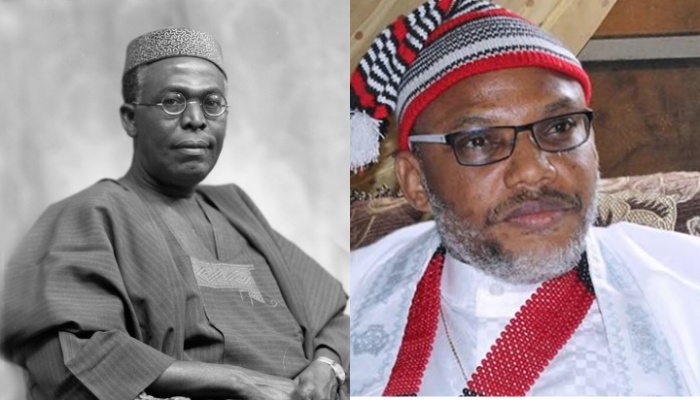
Aloy Ejimakor, the former lead counsel to Mazi Nnamdi Kanu says the IPOB leader’s prosecution mirrors a familiar historical pattern, one in which the courts are asked to carry the burden of political crises far heavier than law alone can bear.
In a video shared on his socials, a clip he termed ‘second part’ of a media spotlight on Kanu’s case, Ejimakor argued that the matter has grown “bigger than the Nigerian judiciary,” pointing to the treason trial of Chief Obafemi Awolowo in 1963 as a cautionary example.
Awolowo, leader of the Action Group, was accused by the federal government under Prime Minister Tafawa Balewa of attempting to overthrow the state. He was tried, convicted and jailed in a case that would later attract intense debate over whether justice or politics prevailed.
What continues to trouble that episode, Ejimakor said, is the later reflection of the trial judge, Justice George Sowemimo, who reportedly acknowledged in his memoir that he felt constrained while delivering the verdict.
“That,” Ejimakor argued, “shows that some cases are bigger than the judiciary itself.”
According to him, trials involving national security and high political stakes place extraordinary pressure on the courts, sometimes tilting outcomes in ways that only become clear years later.
He compared Awolowo’s experience to that of Nelson Mandela, whose imprisonment under apartheid South Africa followed the law of the time but was ultimately resolved through political negotiation rather than legal process.
It is against this backdrop that Ejimakor situates Nnamdi Kanu.
Kanu, leader of the proscribed Indigenous People of Biafra, has been convicted and sentenced to life imprisonment on terrorism-related charges, concluding a prolonged legal battle that has polarised the country.
But Ejimakor believes the sentence may not be the final word.
He warned that when the weight of the state becomes overwhelming, even well-intentioned judges are not immune to pressure. “The judiciary is made up of human beings,” he said. “They are not insulated from fear or politics.”
Comments