


Tinubu presents ₦58tr Budget, vows discipline, growth, shared prosperity

 Quick Read
On sectoral priorities, Tinubu announced major allocations to defence and security (₦5.41 trillion), infrastructure (₦3.56 trillion), education (₦3.52 trillion) and health (₦2.48 trillion), describing them as interlinked pillars for national renewal.
By Kazeem Ugbodaga
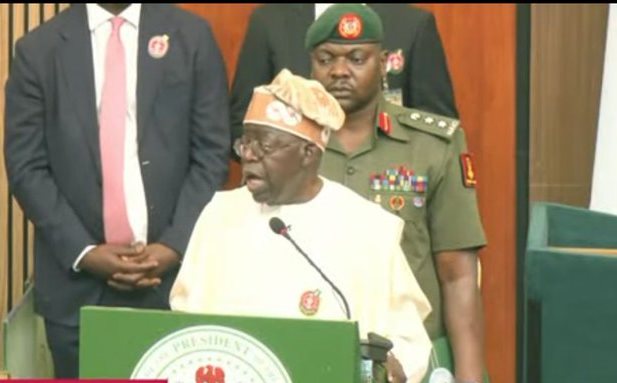
President Bola Tinubu on Friday presented a ₦58.18 trillion 2026 Appropriation Bill to the National Assembly, outlining a consolidation budget aimed at stabilising Nigeria’s economy, restoring investor confidence and translating reforms into jobs, growth and improved living standards.
Addressing a joint session of lawmakers in Abuja on Friday, Tinubu said the 2026 proposal, themed “Budget of Consolidation, Renewed Resilience and Shared Prosperity,” was designed to lock in macroeconomic gains achieved over the past two and a half years while easing the pressures Nigerians endured during the reform period
The President acknowledged that recent economic reforms had been difficult for households and businesses but insisted the sacrifices were beginning to yield results.
He pointed to a 3.98 per cent GDP growth in the third quarter of 2025, a steady moderation in inflation to 14.45 per cent in November 2025, improved oil production and stronger non-oil revenue performance as signs of recovery.
According to him, Nigeria’s external reserves have climbed to a seven-year high of about $47 billion, providing more than 10 months of import cover and strengthening the country’s buffer against external shocks.
Tinubu disclosed that total revenue for 2026 is projected at ₦34.33 trillion, while total expenditure stands at ₦58.18 trillion, including ₦15.52 trillion for debt servicing.
Capital expenditure is estimated at ₦26.08 trillion, with a budget deficit of ₦23.85 trillion, representing 4.28 per cent of GDP.
“These numbers are not mere accounting lines. They are a statement of national priorities,” the President said, stressing the government’s commitment to fiscal sustainability, debt transparency and value-for-money spending.
He said the budget was benchmarked against a conservative crude oil price of $64.85 per barrel, daily oil production of 1.84 million barrels, and an exchange rate assumption of ₦1,400 to the dollar for the 2026 fiscal year.
On sectoral priorities, Tinubu announced major allocations to defence and security (₦5.41 trillion), infrastructure (₦3.56 trillion), education (₦3.52 trillion) and health (₦2.48 trillion), describing them as interlinked pillars for national renewal.
National security, he said, remains the foundation of development, with the government planning to modernise the armed forces, strengthen intelligence-driven policing and introduce a new national counterterrorism doctrine.
Under the revised security architecture, armed groups operating outside state authority will be designated as terrorists, with the government pledging zero tolerance for banditry, kidnapping and violent crimes.
In education, Tinubu revealed that over 788,000 students have already benefited from the Nigerian Education Loan Fund in partnership with 229 tertiary institutions, while healthcare investment now accounts for six per cent of the total budget, excluding liabilities.
He also announced that recent engagements with the United States government could unlock over $500 million in health interventions across Nigeria.
The President further outlined plans to strengthen agricultural productivity through mechanisation, irrigation, storage and agro-value chains, noting that the Bank of Agriculture aims to support the cultivation of one million hectares in 2026, generate hundreds of thousands of jobs and boost export value.
On fiscal discipline, Tinubu pledged stricter budget implementation in 2026, directing key finance and budget officials to adhere strictly to appropriated timelines.
He also ordered government-owned enterprises to meet revenue targets, supported by end-to-end digitisation of revenue collection to block leakages and improve transparency.
He highlighted ongoing procurement reforms and the Nigeria First Policy, which mandates ministries and agencies to prioritise Nigerian-made goods and local companies, as part of efforts to support domestic industries and reduce import dependence.
“The most significant budget is not the one we announce. It is the one we deliver,” Tinubu said, assuring Nigerians that the government would focus on better revenue mobilisation, smarter spending and stronger accountability.
He urged lawmakers to support the passage of the bill, expressing confidence that cooperation between the executive and legislature would help deliver the goals of the Renewed Hope Agenda and set Nigeria on a firmer path to inclusive and sustainable growth.
Comments