


Minister lists strides of Tinubu govt, says pains of reforms evolving to permanent gains

 Quick Read
Idris also noted that the Federal Government initiated the process of building new security architecture in reaction to the security challenges confronting the country. He listed this to include the presidential declaration of a nationwide security emergency, that will in the months ahead translate into massive recruitment into the Armed Forces and Police Force, and the deployment of trained and equipped Forest Guards to secure Nigeria’s forests and other vulnerable locations.
By Ayorinde Oluokun/Abuja
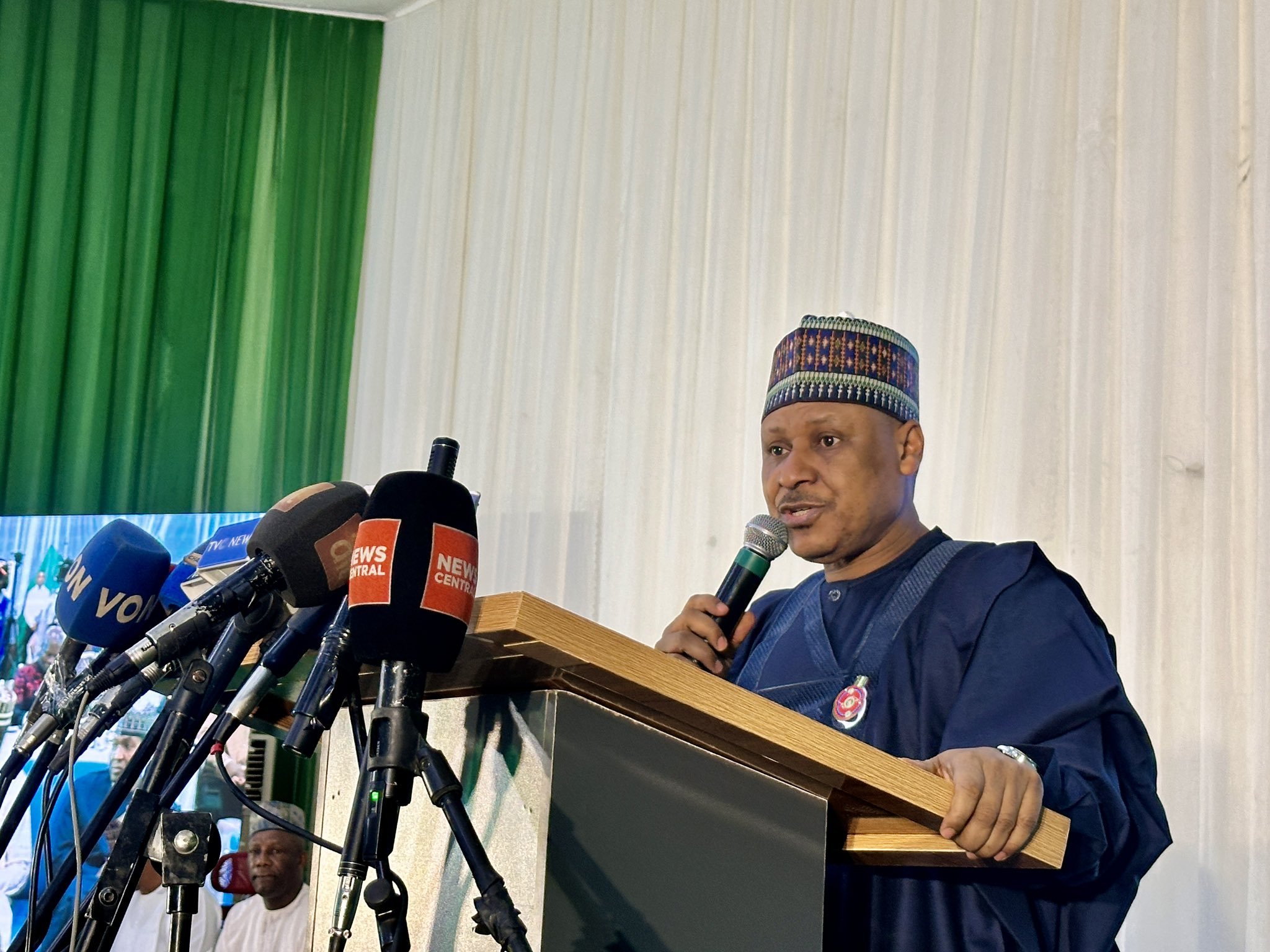
The Federal Government has said the pains of reforms embarked upon by President Bola Ahmed Tinubu when he assumed office on May, 2023 are evolving to permanent gains for Nigeria. Mohammad Idris, the Minister of Information and National Orientation said this on Monday at the end-of –year press conference organized to spotlight some of the key achievements of the Tinubu’s administration in the outgoing year.
“The temporary pains of reform are yielding to permanent gains. President Tinubu’s vision for Nigeria is big, his strategy unambiguous, and his resolve unshakeable. We are consolidating stability, protecting our homeland, empowering our youth, and building a nation where every citizen has the agency to thrive,” the Minister said.
While highlighting some of the achievements, Idris noted that the Nigeria’s Gross Domestic Product (GDP) grew by 3.98% in the third quarter of 2025, demonstrating resilient and sustained expansion in the non-oil sector under the Tinubu’s administration. He also added that that headline inflation has now declined for eight consecutive months, to stand at 14.45% in November 2025 while food inflation is also on a steady downward trend.
Also, the Minister noted that Nigeria’s external reserves have strengthened to approximately $44.56 billion, thus providing a robust buffer that stabilises the naira and assures international investors while the country also recorded a trade surplus of N6.69 trillion in the third quarter of 2025, a 27.29 percent growth year-on-year.
Idris said the most recent Purchasing Managers Index (PMI) data – measure of business sentiment – indicated that Nigeria has now seen 12 consecutive months of expansion in economic activities.
On the energy sector, the Minister noted that on March 4, 2025, Nigeria recorded a maximum daily energy of 128,370.75 megawatt-hours (MWh) nationwide—the highest ever in our history.
He also noted that the Presidential Metering Initiative (PMI), as well as the issuance of the first Bond under the Presidential Power Sector Debt Reduction Programme, the single largest coordinated financial intervention in the history of our power sector kicked off in the year to energise the energy sector.
Furthermore, Idris noted that the massive oversubscription to Eurobond issuance amounting to 400% of the target of $2.3 billion USD demonstrated strong investor confidence in the Tinubu’s administration macroeconomic reforms.
Also, Nigeria in 2025, celebrated exit from the Financial Action Task Force (FATF) Grey List, a development Idris said reflected sustained and coordinated reforms in combating money laundering, terrorist financing and other financial crimes by the Tinubu’s administration.
He noted that the development marked the start of a new reputational and operational chapter for our financial sector.
He also noted that President Tinubu approved the recapitalization of the Bank of Agriculture with N1.5 trillion – the biggest single boost to agriculture financing in Nigeria’s recent history.
On infrastructure, The Minister also noted that Tinubu’s administration committed over 1.5 trillion Naira in investments in road infrastructure in 2025, the largest such commitment in Nigeria’s history.
The huge financial outlay, he said, was based on the firm belief by the administration that an economy cannot grow faster than the infrastructure that supports it.
He added that at the heart of the massive investments in infrastructure projects are four Legacy Highway Projects, engineered to connect every region and unlock new economic corridors in very part of Nigeria.
He listed the legacy highway projects to include the 750-kilometer Lagos-Calabar Coastal Highway, linking our entire southern coastline, the 1,068-kilometer Sokoto-Badagry Superhighway, bridging the North-West to the South-West, the 477-kilometer Trans-Saharan Highway, traversing from Calabar to the FCT and the 422-kilometer Akwanga-Jos-Bauchi-Gombe Expressway, integrating the North-Central and North-East.
“These are not conventional roads. They are being built with reinforced concrete pavement designed to last 50 to 100 years, drastically cutting future maintenance costs and promoting local content,” Idris said.
The Minister also revealed that the Tinubu’s administration implemented projects aimed at youth development in 2025.
Idris listed the programmes to include the Nigeria Education Loan Fund (NELFUND) through which over 788,000 Nigerian students have been offered interest-free loans and stipends amounting to over 150 billion Naira to support their educational advancement.
The Minister also noted that the federal government’s Digital and Creative Enterprises (iDICE) programme officially kicked off during the year, with an anchor investment in a new multi-million-dollar venture fund that will support the creative and digital entrepreneurship aspirations of young Nigerians.
He also recalled that in 2025, the Federal Government launched the Student Venture Capital Grant (S-VCG), offering equity-free financing of up to ₦50 million for undergraduate innovators in Science, Technology, Engineering, Mathematics, and Medicine (STEMM) disciplines, across accredited tertiary institutions.
“With this new intervention, we are nurturing the seeds of entrepreneurship in our campuses and turning our brightest minds into job creators, not just job seekers,” the Minister said.
Also, FG’s three Million Technical Talent (3MTT) programme made significant progress during the year, as it builds Africa’s largest digital army.
Idris also noted that the Federal Government initiated the process of building new security architecture in reaction to the security challenges confronting the country.
He listed this to include the presidential declaration of a nationwide security emergency, that will in the months ahead translate into massive recruitment into the Armed Forces and Police Force, and the deployment of trained and equipped Forest Guards to secure Nigeria’s forests and other vulnerable locations.
He also noted that Nigeria also established a new national counterterrorism doctrine—anchored on four critical pillars: unified command, intelligence, community stability, and counterinsurgency.
“Let me be clear about what this means: That henceforth, any armed group that kidnaps our children, attacks our farmers, or terrorizes our communities is officially classified and will be dealt with as a terrorist organization. The era of ambiguous nomenclature is over!,” Idris warned.
The Minister noted that on the international stage, Nigeria, in 2025, navigated complex international diplomacy with maturity and principle. He particularly noted that Nigeria was able to navigate and resolve the recent diplomatic spat with the United States through firm, respectful engagement, culminating in a strengthened partnership.
Idris cited Nigeria’s five-year, $5.1B bilateral health cooperation Memorandum of Understanding (MoU) with the government of the United States – in which the US will provide $2.1B in grant funding, while Nigeria commits $3 billion as indication of the normalization of relations with the U.S.
“This has been described as the largest co-investment by any country to date under the America First Global Health Strategy. It will strengthen Nigeria’s healthcare system, save lives, and attract investment.
“Indeed, Nigeria is no longer on the sidelines; we are a confident and strategic partner on the global stage, defending our national interests and attracting beneficial partnerships. Just last month we regained our Category C seat on the International Maritime Organisation (IMO) Council for the 2026–2027 biennium; a celebrated comeback following 14 years of absence,” Idris said.
The Minister further cited the significant international positions assumed by Nigeria across various sectors to back his claim of the successful story of Nigeria in the international arena in 2025.
He listed the position to include the Chairperson of the Council of the World Customs Organisation, Executive Director of the World Health Organisation’s Health Emergencies Programme, Vice Chair of the International Telecommunication Union (ITU) Council, and Vice President of the International Association for Ports and Harbours in Tokyo.
He noted that additionally, Nigeria also secured hosting rights for the Creative Africa Nexus (CANEX) 2026, and the Intra-African Trade Fair (IATF) 2027, one of the largest trade gatherings on the African continent.
Idris further revealed that in the media, information and communications space, Nigeria secured the hosting rights for both the 2026 World Public Relations Forum (WPRF) and the 2026 African Public Relations Association (APRA) Conference in 2025.
“We made history by becoming only the second African country ever to host the WPRF, and the first ever to host both the APRA Conference and the WPRF in the same year.
“We also received official affirmation from UNESCO of the hosting right granted to Nigeria for the world’s first Media & Information Literacy (MIL) Institute, and I am delighted to note that the Institute will officially take off in the first quarter of 2026.
Overall, Idris described 2025 as a year of reinforcing and strengthening foundations for the Tinubu’s administration.
“The mission of 2026 is to raise the edifice of a secure, competitive, and prosperous Nigeria upon it. The temporary pains of reform are yielding to permanent gains. President Tinubu’s vision for Nigeria is big, his strategy unambiguous, and his resolve unshakeable. We are consolidating stability, protecting our homeland, empowering our youth, and building a nation where every citizen has the agency to thrive,” Idris said.
Comments