


U.S. tightens grip on Venezuela with massive Oil Seizures

 Quick Read
The United States has outlined a sweeping three-phase strategy aimed at stabilising Venezuela, recovering its economy and steering the country towards political transition, as Washington ramps up pressure through oil seizures and strict enforcement of sanctions.
By Kazeem Ugbodaga
The United States has outlined a sweeping three-phase strategy aimed at stabilising Venezuela, recovering its economy and steering the country towards political transition, as Washington ramps up pressure through oil seizures and strict enforcement of sanctions.
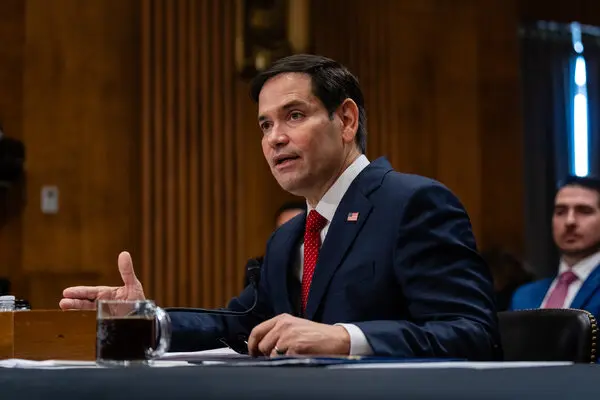
Speaking to reporters in Washington on Wednesday, U.S. Secretary of State Marco Rubio said the plan is already in motion, dismissing claims that the administration lacks a coherent approach to the Venezuelan crisis.
According to Rubio, the first phase centres on stabilisation, with the U.S. seeking to prevent Venezuela from sliding into chaos by leveraging what he described as a powerful oil “quarantine.”
He revealed that two additional vessels carrying Venezuelan oil were seized recently, adding to Washington’s control over the country’s most critical revenue source.
The U.S., he said, is finalising arrangements to take between 30 million and 50 million barrels of Venezuelan oil currently stranded due to sanctions.
He said the crude will be sold at global market prices, with proceeds placed under U.S. oversight to ensure funds are channelled towards the welfare of the Venezuelan people rather than corruption or the existing regime.
“This gives us tremendous leverage,” Rubio said, stressing that Venezuela is currently unable to generate oil revenue without U.S. approval.
The second phase of the plan focuses on economic recovery and national reconciliation.
Rubio said the U.S. intends to open the Venezuelan market to American, Western and allied companies under fair conditions, while facilitating the return of exiled opposition figures, the release of political prisoners and the rebuilding of civil society.
The final phase, he explained, would involve a political transition, although he cautioned that the stages would overlap and no rigid timeline had been set.
Responding to criticism from some lawmakers who accused the administration of “winging it,” Rubio said the strategy was not speculative but already unfolding, citing the oil arrangement with Venezuela’s state oil firm PDVSA as evidence.
He also confirmed that U.S. policy still leaves all options open when national security is at stake, noting that every American president retains the authority to deploy military force if necessary, although diplomacy remains the preferred route.
U.S. Secretary of War Pete Hegseth reinforced the administration’s stance, rejecting questions about the cost of the operation to American taxpayers.
He argued that U.S. forces are routinely deployed across the globe and that operations in the Caribbean are no different from missions in the Mediterranean, Indo-Pacific or Middle East.
Hegseth described the ongoing enforcement actions as part of a highly sophisticated operation that only the United States is capable of executing, adding that the seizure of sanctioned and stateless oil tankers would continue.
Rubio disclosed that Venezuela’s interim authorities are now seeking to have seized oil included in the new arrangement, a move he said reflects their recognition that cooperation with Washington is the only path to economic survival.
Comments