


Rubio says Maduro’s fall ends Venezuela’s gangster paradise era

 Quick Read
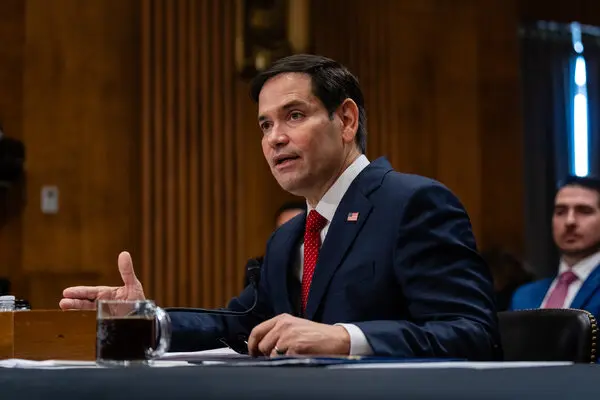
U.S. Secretary of State Marco Rubio on Wednesday told the Senate Committee on Foreign Relations that Washington is pursuing a phased strategy to stabilise Venezuela and guide it towards democratic transition following the removal of Nicolás Maduro, describing recent progress as faster than initially anticipated despite deep-rooted challenges.
By Kazeem Ugbodaga
U.S. Secretary of State Marco Rubio on Wednesday told the Senate Committee on Foreign Relations that Washington is pursuing a phased strategy to stabilise Venezuela and guide it towards democratic transition following the removal of Nicolás Maduro, describing recent progress as faster than initially anticipated despite deep-rooted challenges.
Appearing before the committee in Washington, Rubio said his focus was on “what happens now and moving forward,” rather than events that led to the operation, stressing that the situation Venezuela posed had become “an enormous strategic risk for the United States.”
“What is our goal going in? We had, in our hemisphere, a regime operated by an indicted narcotrafficker that became a base of operation for virtually every competitor, adversary, and enemy in the world,” Rubio said.
He cited Venezuela’s role as a hub for Iran, Russia and China, adding that Chinese firms were receiving Venezuelan oil at steep discounts.
“This is the oil of the people of Venezuela, and it was being given to the Chinese as barter at a 20 percent, at a $20 discount per barrel in some cases.”
Rubio said the former regime also cooperated openly with drug-trafficking groups, including the FARC and ELN, making the situation “untenable” and requiring decisive action.
According to the Secretary of State, U.S. policy now rests on three core objectives, with the end goal being “a friendly, stable, prosperous Venezuela, and democratic, in which all elements of society are represented in free and fair elections.”
He cautioned that elections without media access or genuine opposition participation “aren’t free and fair elections.”
The first immediate priority, Rubio said, was stability after Maduro’s removal.
“The concern was what happens in Venezuela. Is there civil war? Do the different factions start going at each other? Are a million people crossing the border into Colombia?” He asked.
He added that such outcomes had so far been avoided through “direct, honest-respectful but very direct and honest conversations” with those currently controlling state institutions.
He explained that Washington had leveraged oil sanctions as part of a temporary stabilisation mechanism.
“On the oil that is sanctioned and quarantined, we will allow you to move it to market, at market prices, not at the discount China was getting,” Rubio said, adding that proceeds would be deposited into monitored accounts and used strictly for the benefit of Venezuelans.
“Venezuela was running out of storage capacity,” he said, noting the country faced an urgent fiscal crunch to fund basic government functions. Under the arrangement, Venezuelan authorities submit monthly budgets, with restrictions placed on how the funds may be spent. Rubio disclosed that officials had committed to using “a substantial amount of those funds to purchase medicine and equipment directly from the United States,” including diluent needed to process heavy crude.
“They used to get 100 percent of that from Russia. They are now getting 100 percent of that from the United States,” he said.
Beyond short-term stabilisation, Rubio said the second phase focuses on economic recovery, particularly normale through normalising the oil industry.
While acknowledging Venezuela’s vast reserves, he stressed that the goal was not an industry “dominated by cronies” but one free of graft and corruption.
He said authorities in Caracas had passed a new hydrocarbon law dismantling many restrictions from the Chávez era.
“It probably doesn’t go far enough to attract sufficient investment, but it’s a big step from where they were three weeks ago,” Rubio said.
The recovery phase also includes political opening, with the release of political prisoners.
“By some estimates up to 2,000,” Rubio said, adding: “They are releasing them probably slower than I would like them to, but they are releasing them.”
While conceding the challenges ahead, Rubio said progress over the past month had exceeded expectations.
“In three and a half, almost four weeks, we are much further along on this project than we thought we would be,” he said.
“At the end of the day we are dealing with people over there that have spent most of their lives living in a gangster paradise,” Rubio added, warning that change would not be instant.
Nevertheless, he maintained that “we are certainly better off today in Venezuela than we were four week ago,” and expressed confidence that conditions would continue to improve in the months ahead.
Comments